Bitwise’s Q4 Crypto Review: 10 Takeaways Before Year-End

Bitcoin is down 4.55% this year. The Bitwise 10 Large Cap Crypto Index rose 46.39% in the third quarter alone, with all ten assets posting double-digit gains.
Both numbers come from Bitwise’s Crypto Market Review for Q4 2026. Matt Hougan titled his opening note “Crypto Spring Arrives,” yet bitcoin still sits last on the year’s asset class scoreboard.
Think of it like an annual physical:
Most people step on the scale, see a number they don’t love, and never open the bloodwork.
Price is the scale, and the labs are everything underneath it: fund flows, stablecoin volume, onchain revenue, institutional plumbing.
This quarter, the labs improved much faster than the scale.
These are the 10 takeaways I’d focus on heading into year-end.
1. The scale lags the labs
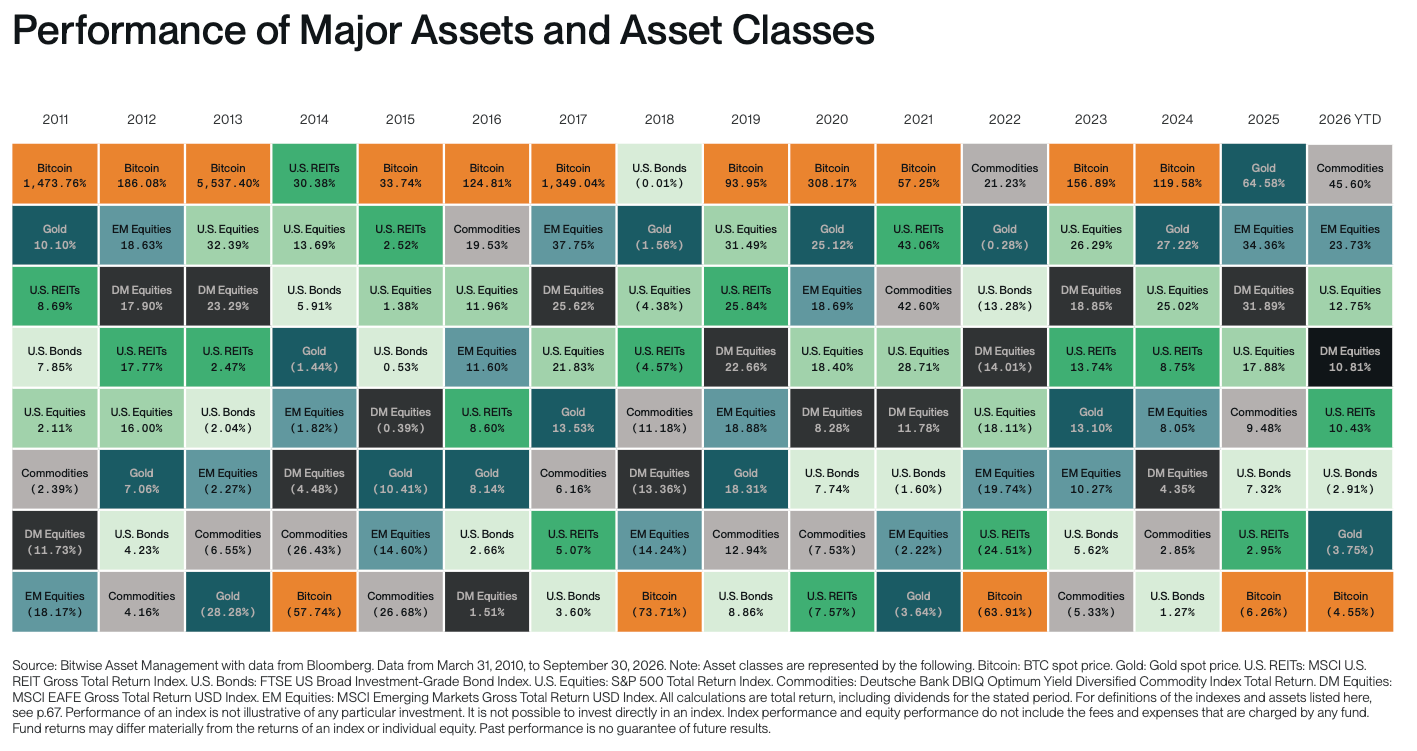
“Performance of Major Assets and Asset Classes”
Bitcoin finished first in 11 of the 15 full years shown and sits last in 2026 YTD. Its last-place finishes in 2014, 2018 and 2022 were each followed by a first-place year.
Crypto equities, measured by the Bitwise Crypto Innovators 30, are up 27.94% YTD while the large-cap token index is down 6.21%. Commodities lead everything at +45.60%. Q3’s rebound started from a June bitcoin low of $59,000, so the year still reads negative.
TAKEAWAY: If you hold positions still underwater for 2026, talk to your tax advisor about harvesting losses before December 31. A rally that hasn’t erased the year’s drawdown is the window to do it.
2. ETF flows came back, and advisors are the buyers
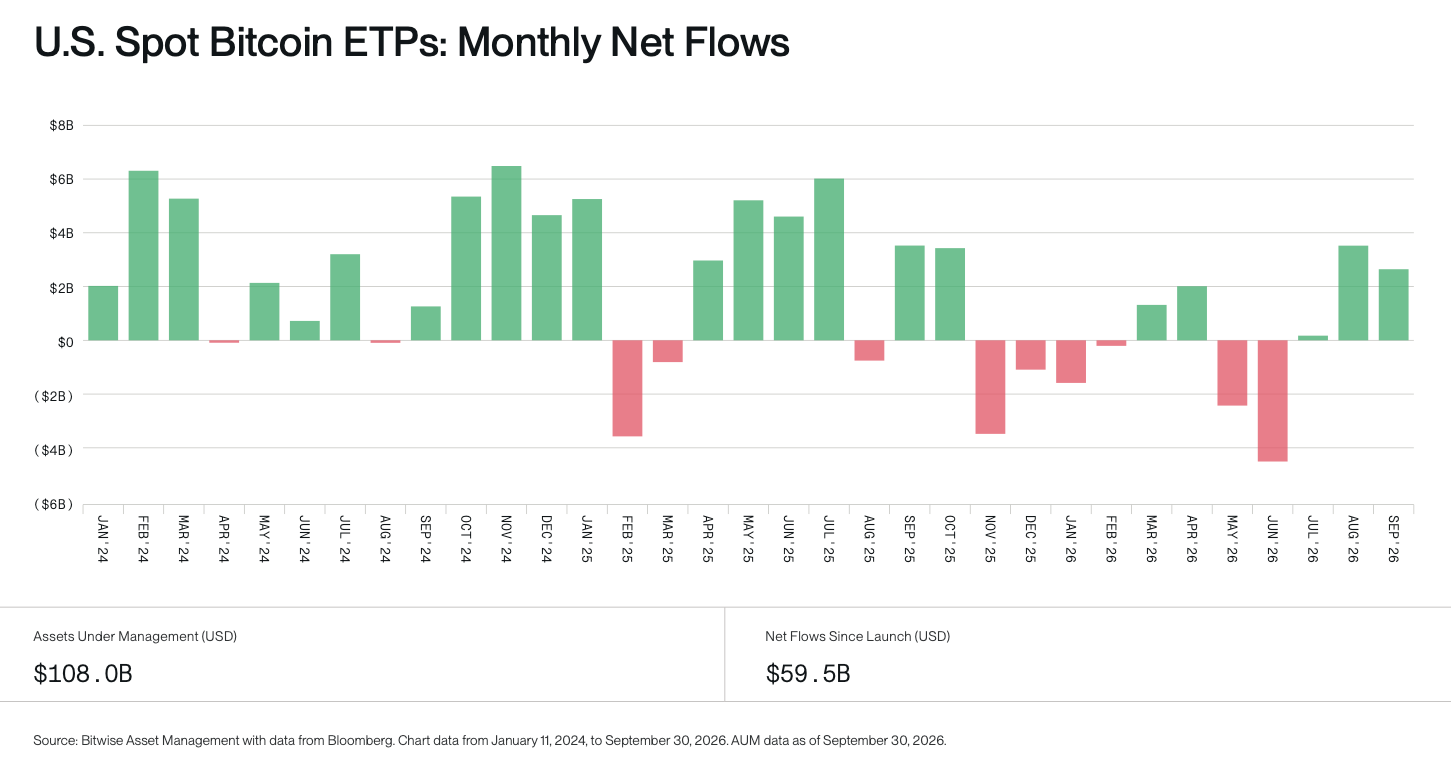
“U.S. Spot Bitcoin ETPs: Monthly Net Flows”
Three green months close the quarter, right after June’s outflow, the largest on the chart.
Spot bitcoin ETFs took in roughly $6 billion in Q3, including $3.5 billion in August, flipping year-to-date flows positive after record Q2 outflows. Investment advisors hold 48.3% of 13F-reported ownership, more than hedge funds, brokerages and banks combined.
Morgan Stanley, Merrill, Schwab, Fidelity, Vanguard and Wells Fargo now let advisors recommend bitcoin ETFs, while Goldman Sachs, Edward Jones and Raymond James only accept unsolicited orders.
TAKEAWAY: Find out which bucket your wealth platform sits in. That one policy decides whether your advisor can raise the topic or only respond when you ask.
3. The corporate treasury bid has stalled
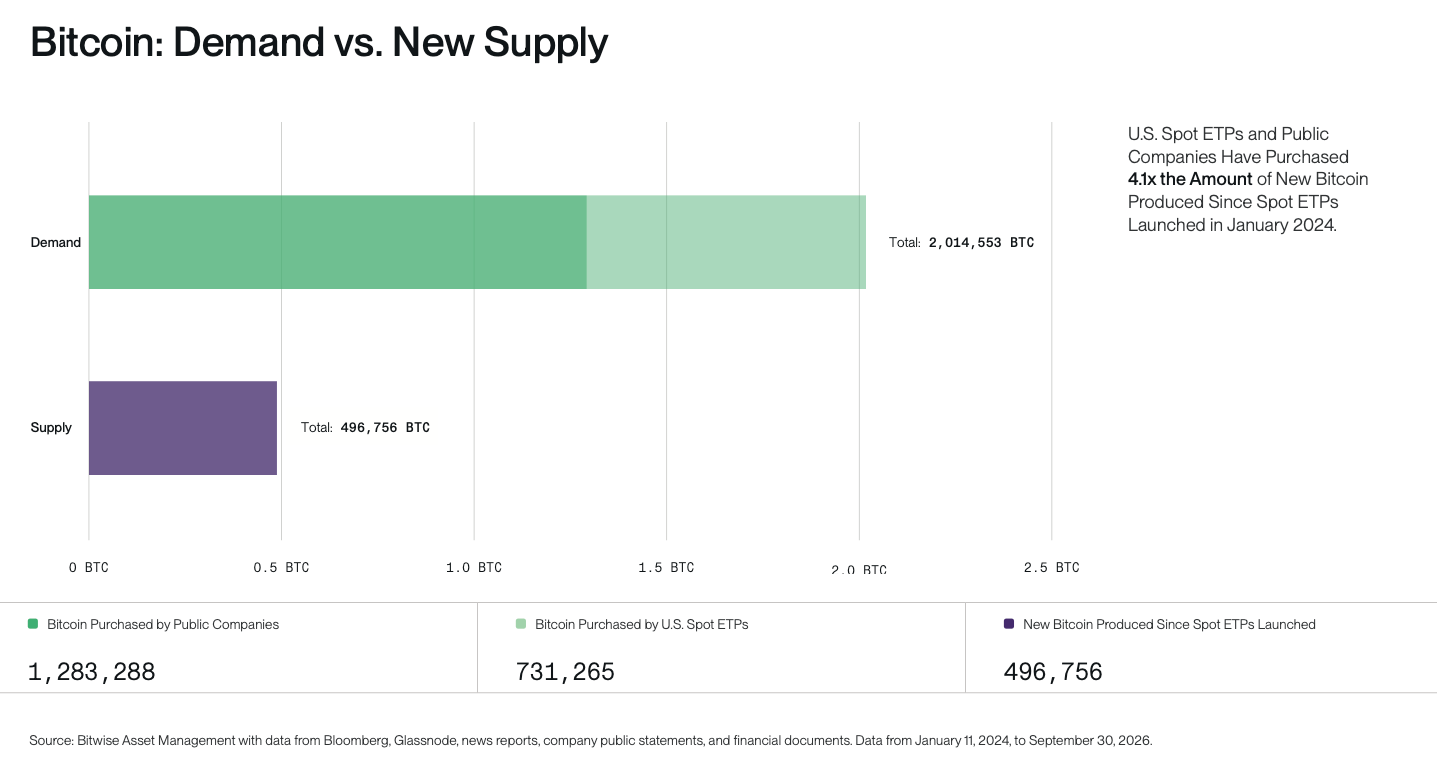
“Bitcoin: Demand vs. New Supply”
ETFs and public companies have bought about 4.1x the bitcoin mined since January 2024.
That makes a strong headline, but Q3 tells a different story. Public companies added a net 6,441 BTC (+0.50%), and the number holding bitcoin fell 5.98% to 173. Strategy alone holds 847,666 BTC, about two-thirds of the corporate total.
TAKEAWAY: My hypothesis is that ETFs are now the marginal buyer and treasury companies have become more holding tank than engine. If you own treasury stocks, underwrite them on balance sheet and financing terms, because the buy-every-quarter flywheel has slowed sharply.
4. The sizing math still favors a small position
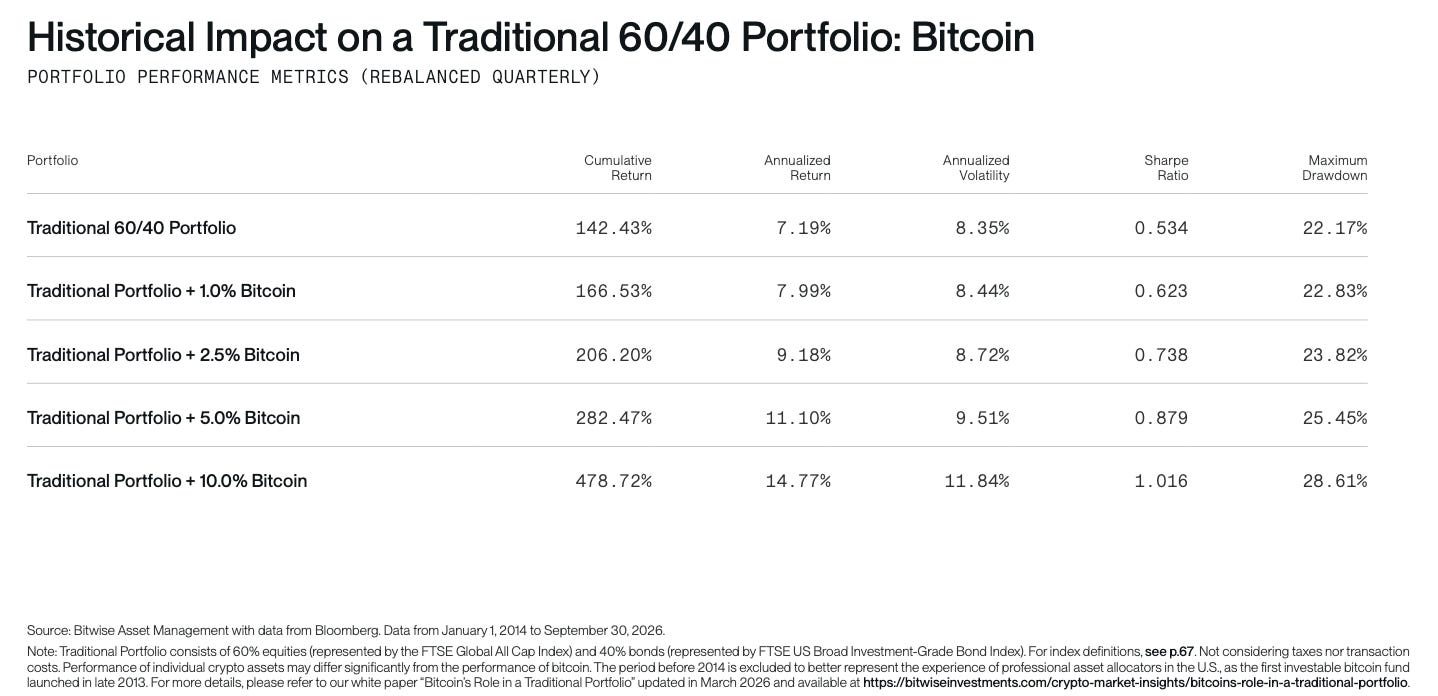
“Historical Impact on a Traditional 60/40 Portfolio: Bitcoin”
Compare the annualized return and maximum drawdown columns side by side.
Since 2014, adding 5% bitcoin to a quarterly-rebalanced 60/40 portfolio lifted annualized return from 7.19% to 11.10%, while max drawdown rose only from 22.17% to 25.45%. Bitwise notes the benefit of hindsight here, and so should you. Bitcoin’s one-year volatility now sits in the mid-40s, the same neighborhood as Tesla and Nvidia.
TAKEAWAY: Set a target weight and a rebalancing rule now, before Q4 volatility tempts you to improvise. Rebalancing trims at highs and adds at lows without asking your opinion.
5. The Q4 calendar is crowded
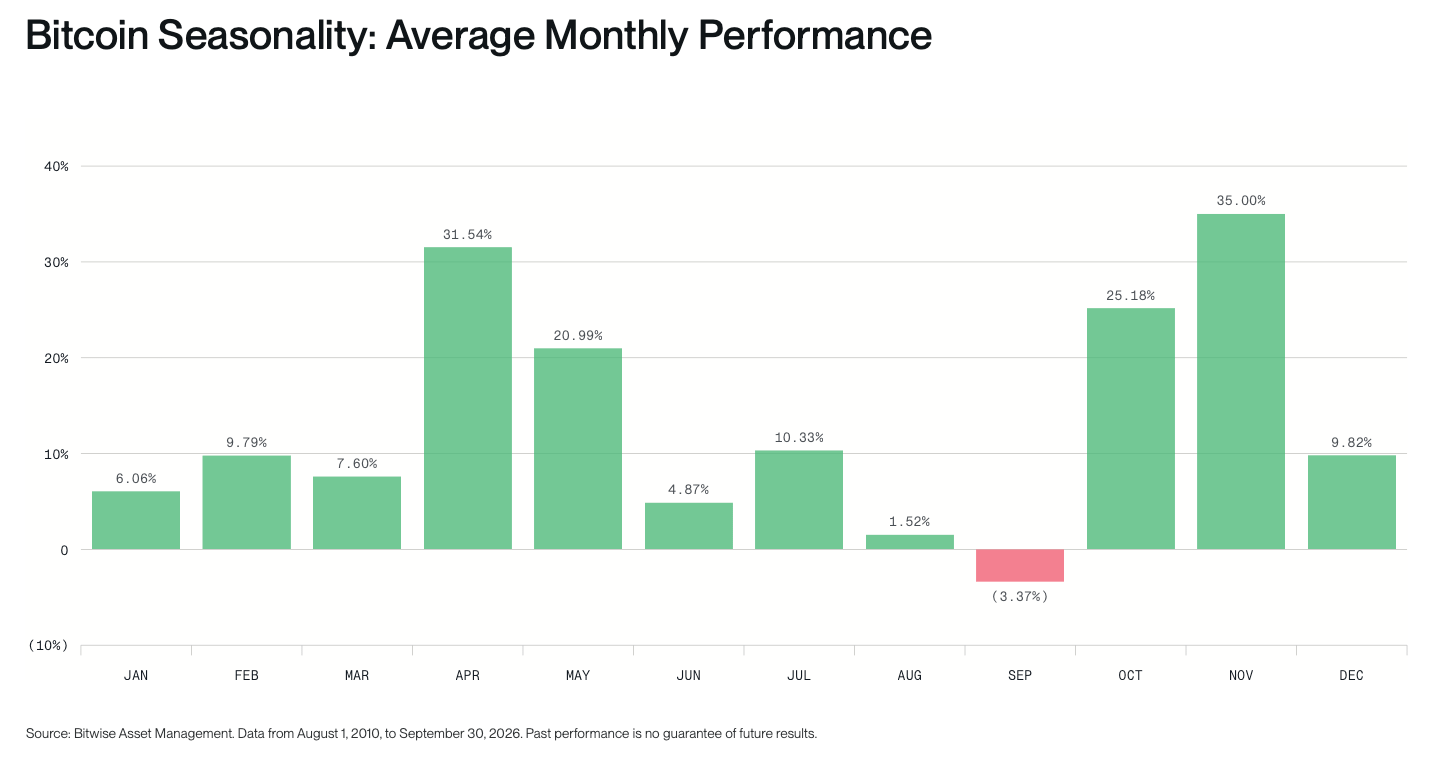
Bitwise p.15, “Bitcoin Seasonality: Average Monthly Performance”
October and November rank among bitcoin’s strongest months historically, though averages going back to 2010 include years when bitcoin was tiny.
The Fed raised rates 25 basis points on September 16, its first hike since 2023, with inflation at 3.4% and the 10-year Treasury above 5.2%. Polymarket puts the odds of a Democratic sweep in November above 60%, and the CLARITY Act already failed in the Senate. Bitwise argues a Democratic Congress could slow legislation but can’t do much to reverse SEC and CFTC rulemaking, which I’d treat as a reasonable hypothesis rather than a given.
TAKEAWAY Expect volatility around the November 3 midterms, and don’t add leverage on the strength of a seasonal average.
6. Tokenization moves into production
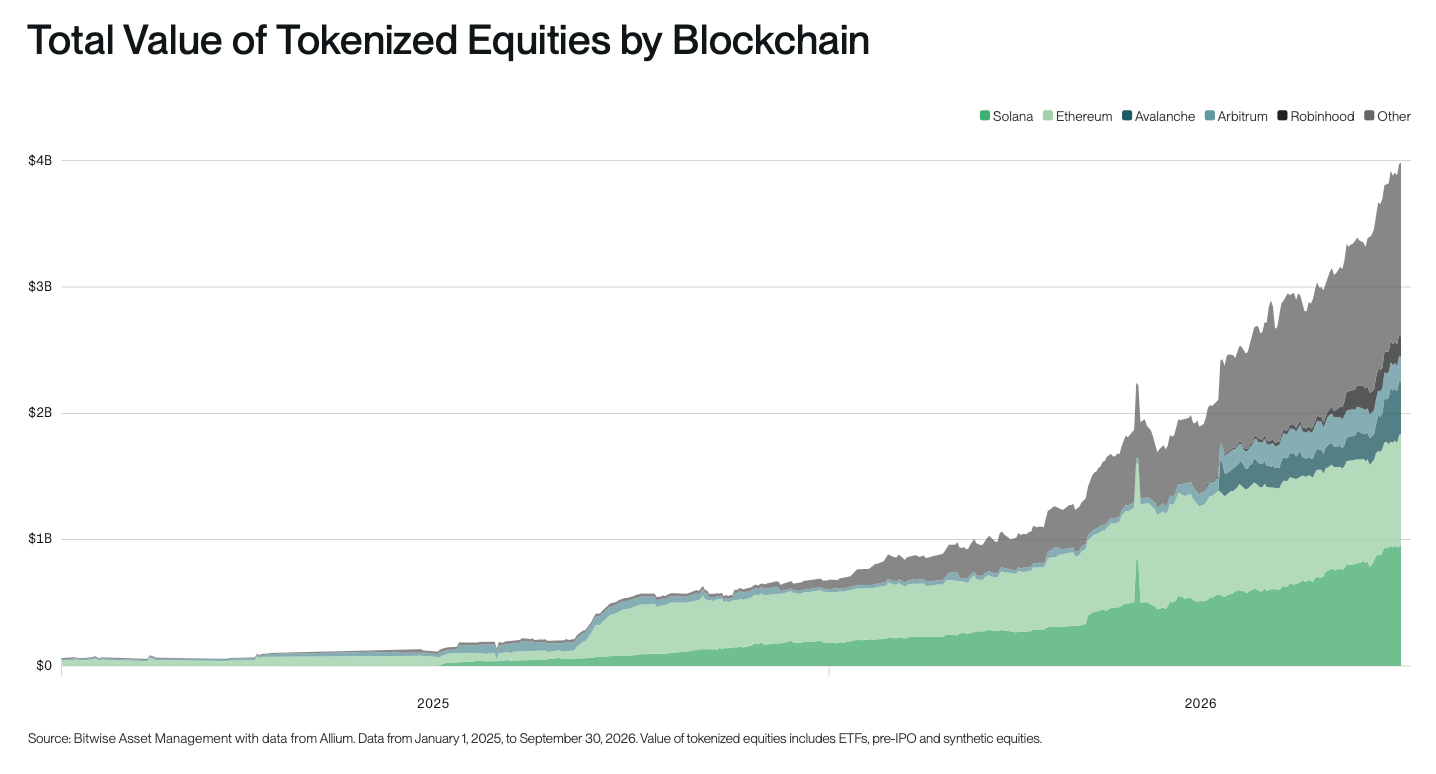
“Total Value of Tokenized Equities by Blockchain”
This chart includes ETFs, pre-IPO and synthetic equities, so it runs higher than the $3.2 billion stock figure. Solana and Ethereum carry the largest named shares.
Quick vocabulary stop: a tokenized stock is a digital token representing a share that trades around the clock on a blockchain. Tokenized stocks rose 65.5% in Q3 to a record near $3.2 billion. Robinhood’s own Ethereum network launched July 1 and drew about $94 billion in onchain volume. The SEC’s September 17 exemption lets tokenized U.S.-listed stocks trade onchain, and the DTCC plans to launch its tokenization service this month.
TAKEAWAY: $3.2 billion is tiny next to the U.S. stock market, which is why the DTCC launch matters: the plumbing is arriving ahead of the volume. Track which brokers and chains capture the flow.
7. Stablecoins are settling more than Visa
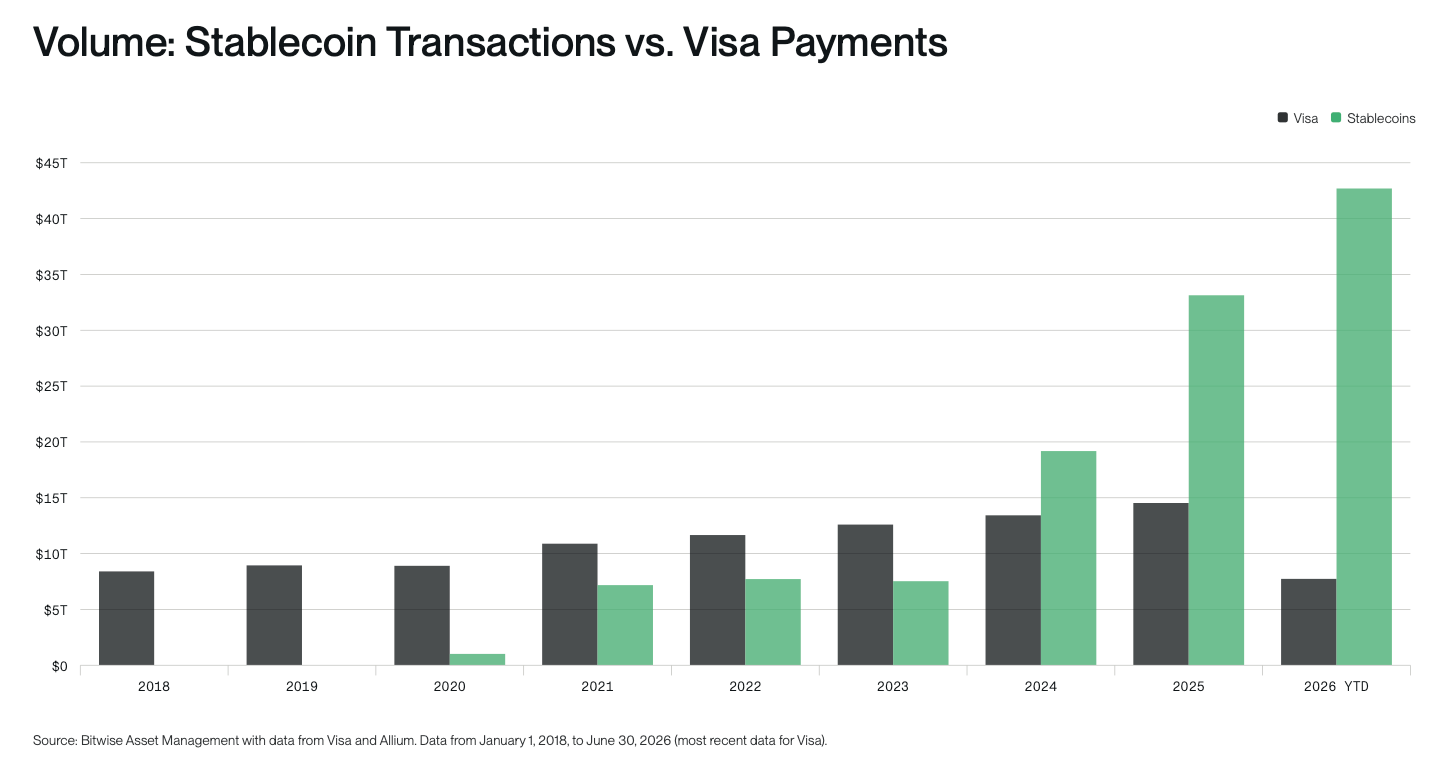
“Volume: Stablecoin Transactions vs. Visa Payments”
Through June 30, stablecoins cleared roughly 5x Visa’s 2026 volume. Much of that is trading and automated flow, so treat it as a rough comparison to card spending.
The four largest stablecoins also hold roughly $270 billion in U.S. Treasuries, more than Norway, India or Brazil.
TAKEAWAY: Stablecoins are now a steady buyer of short-term government debt, and that interest is how issuers like Circle earn money. If you own Circle, know that rate cuts would squeeze revenue even as adoption grows.
8. Follow the revenue
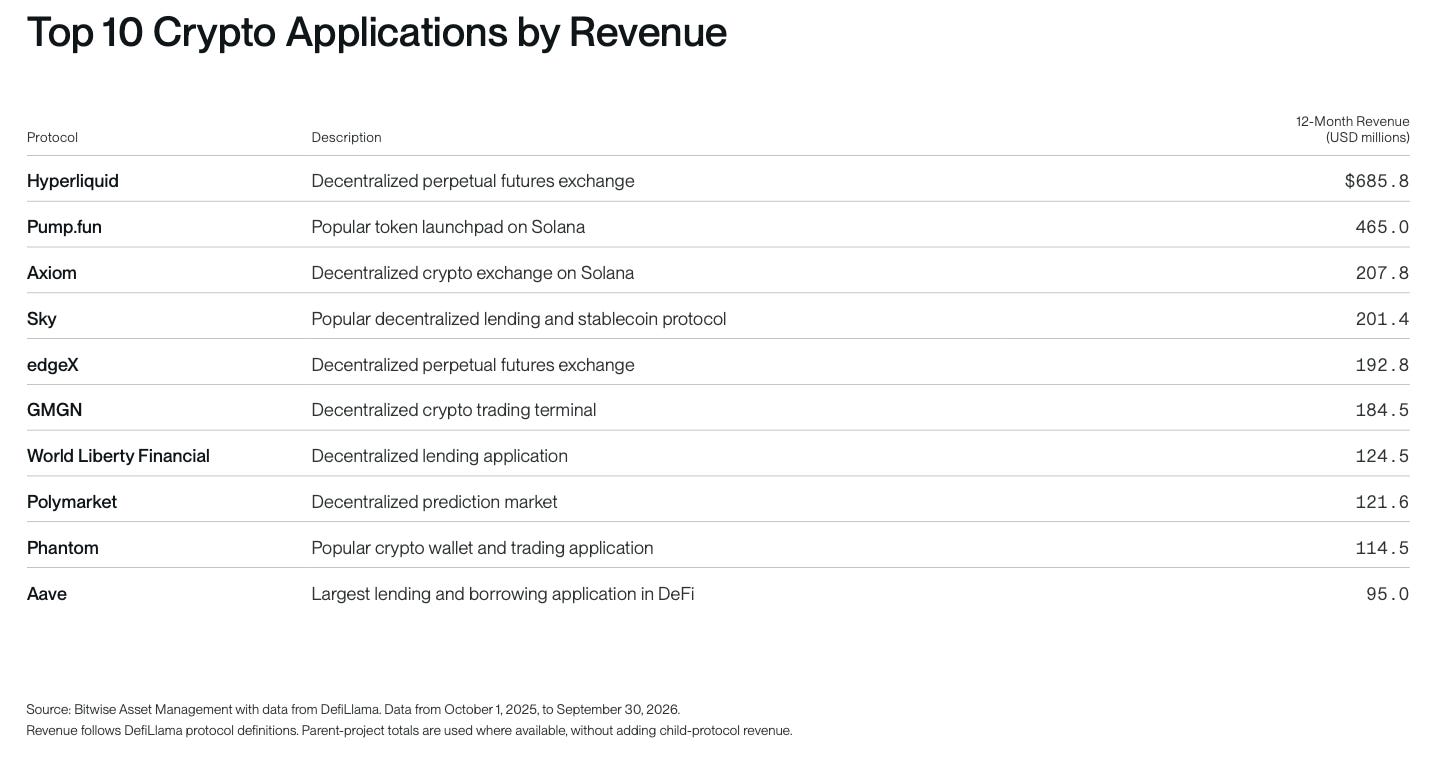
“Top 10 Crypto Applications by Revenue”
Hyperliquid earned about 7x Aave’s revenue over the past year.
Hyperliquid generated $685.8 million in twelve-month revenue, and its token is up 249.57% YTD. Decentralized perpetual futures (leveraged contracts with no expiration date) hit a record of roughly $26 billion in open interest, increasingly tied to stocks, commodities and currencies. Revenue-generating tokens led Q3: Pump.fun +289%, Ethena +233%, Uniswap +207%.
TAKEAWAY: Ask what you’d ask of any business: who earns the fees, and does any of it reach token holders through buybacks or distributions? A protocol can thrive while its token captures very little.
9. Prediction markets grew up…fast
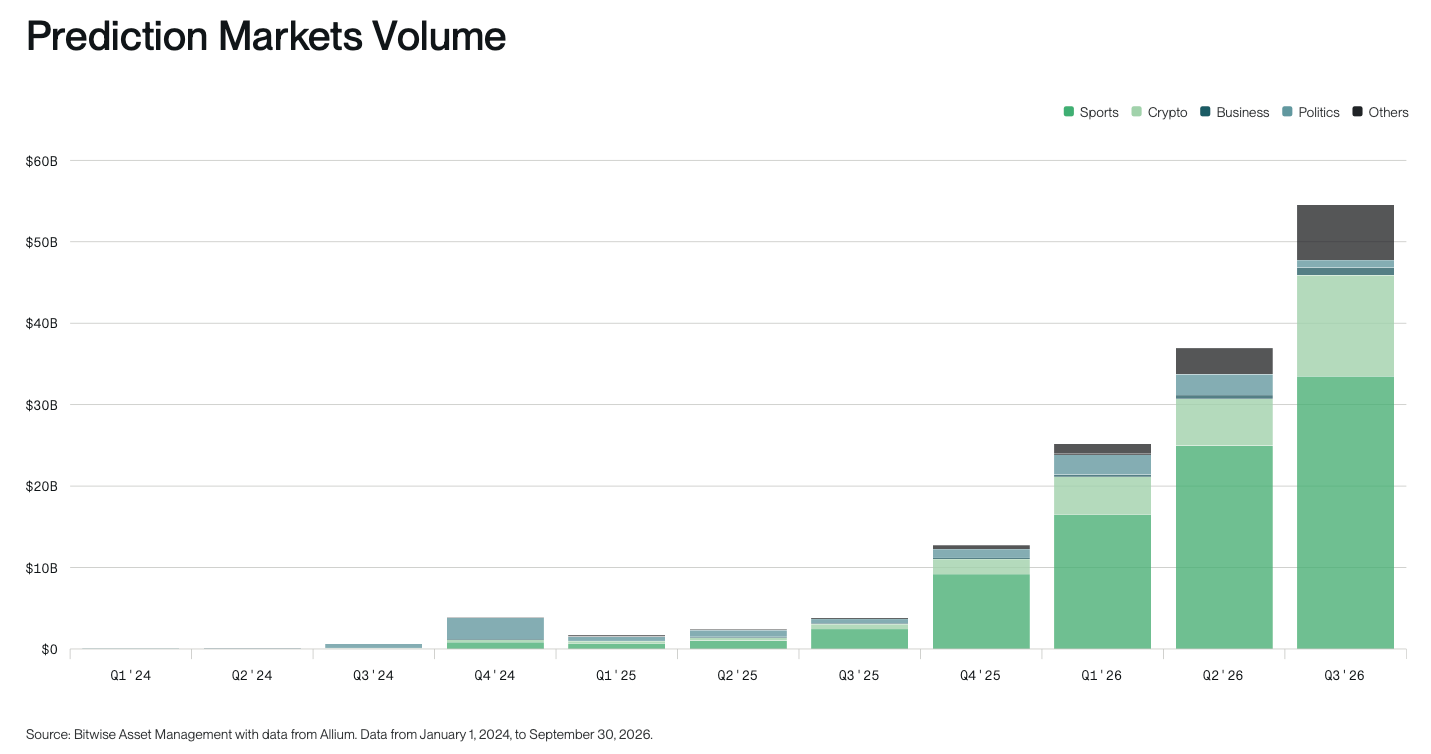
“Prediction Markets Volume”
Q3 volume of roughly $55 billion is more than double Q1, and sports drive most of it.
Kalshi led sports with 65.4% of $33.5 billion in Q3 volume and crypto with 87.6% of $12.4 billion. Polymarket led politics at 70.4%, though that category was only $902 million, even in a midterm year.
TAKEAWAY: Use these markets as a live sentiment gauge for policy timing, the way Bitwise uses Polymarket odds for its midterm outlook. Thin markets can move on small money, so weigh volume alongside the odds.
10. Q3 was 2026’s worst quarter for hacks
Crypto lost more than $1.25 billion across 116 incidents last quarter, with Bitget ($387 million) and Coldcard ($116 million) among the victims.
With a Ledger breach this week using third-party sellers, it’s so imperative that investors work to keep their assets secure. This is something I work directly with wealth managers on as it’s becoming a much larger topic of conversation when clients are looking to place assets into secured custody.
TAKEAWAY: Run a custody check before year-end: where your assets sit, who controls the keys, and whether any single platform holds more than you could stand to lose. A great quarter does nothing for a position that walks out the door.
Reading the Labs 👀
One good set of labs doesn’t make anyone healthy, and skeptics have fair points: the rebound started from a deep June low, corporate buying has stalled, rates are rising, and much stablecoin and perps activity is trader flow.
Still, Hougan’s advice to flip through the report and look at the shape of the charts holds up, because nearly every fundamental line bends upward at the right edge. My working hypothesis is that the scale eventually catches up to the labs, though nobody can give you the date.
Which of these ten are you acting on before December 31? Hit reply and tell me.
In Case You Missed It

Congress Stalled on CLARITY. The SEC Just Handed RIAs a Crypto Playbook Anyway. (Oct. 8)
Clients keep ordering crypto: 94% of advisors were asked about it in 2025, but only 32% allocated, so the money ended up in apps no advisor manages.
On October 1, the SEC proposed custody rules that would let RIAs hold client crypto through state trust companies, or on their own if they clear a high bar. With the CLARITY Act stalled, the SEC and CFTC are building the framework Congress hasn’t, and the advisors who learn the recipe first will keep a lot of tables.
Matthew Snider is the founder of BitFinance and principal at Block3 Strategy Group, where he advises emerging digital asset fund managers and RIAs on fund operations and compliance frameworks. He holds both Series 65 and Series 7 licenses, and is the author of Warren Buffett in a Web3 World.
BitFinance is for informational and educational purposes only and does not constitute investment, tax, or legal advice, or a recommendation to buy or sell any security or digital asset. Digital assets are highly volatile, and you can lose all of your principal. Consult your own financial, tax, and legal advisors before making any investment decision. The author may hold positions in assets discussed.
Sources