20 Traders, $20 Million, 30 Days: The Combine Trading Never Had
Every February, a few hundred college football players run the same drills in the same stadium wearing the same numbers on their chests. A receiver from a school nobody watches runs a 4.38 and a five-star recruit runs a 4.51, and every scout in the league sees both. The combine doesn’t decide careers, though it does something narrower and useful. It makes talent legible under identical conditions.

Investing has nothing like it.
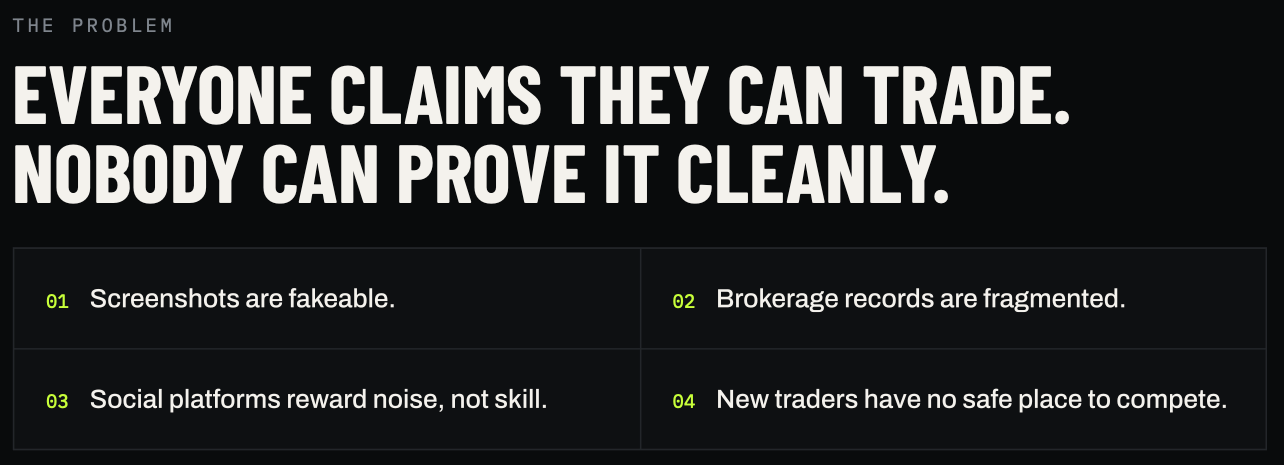
I get emails from people who want to manage money. Some of them are quite good, and their evidence is a screenshot. There’s no drill, no stopwatch, no standardized environment, and no third party willing to say the numbers are what the numbers claim to be.
The Wall
Here’s what I tell people when they ask how to turn trading skill into a business.
Launching a fund runs somewhere around $150,000 for the first year once you add legal formation, an administrator, an audit, a custodian, compliance, and the operational work of keeping it alive.
That figure moves depending on structure and jurisdiction, though it doesn’t move to a number a talented individual can absorb. To justify the expense you need meaningful assets, and in my experience of pricing these out, you’re looking at something in the neighborhood of $10 million before the math stops embarrassing you.
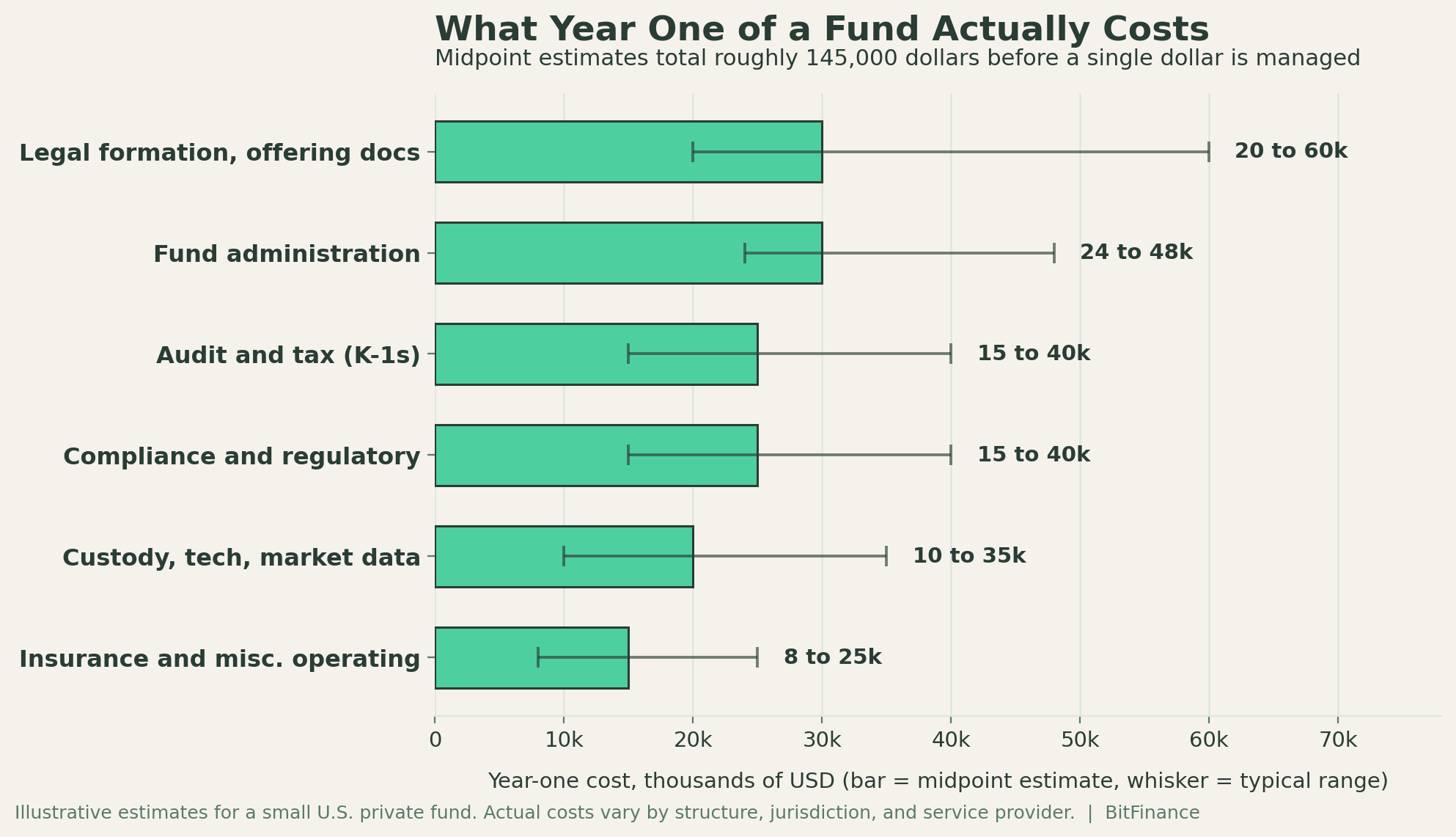
For the majority of traders looking to manage money legally the gate is capital, not skill.
A person who manages risk beautifully with $80,000 has no path to demonstrating that to anyone who allocates, which means the industry keeps sourcing managers through pedigree and personal networks the same way it did forty years ago.
What Exists Now, and What it’s Missing
I want to be fair about the landscape, because a few people are working on adjacent problems and one of them is doing well.
Fomo, the social crypto trading app, raised $75 million in June in a Series B led by Index Ventures at a $550 million valuation, with Union Square Ventures and Benchmark participating. The company reported more than 625,000 traders and $4 billion in trading volume roughly a year after launch. The product puts other traders’ buys and sells on your chart and ranks the most profitable traders across 24-hour, 7-day, and 30-day windows.

That round tells you the appetite is real.
People want to watch other people trade, and they want a scoreboard.
What a scoreboard like that can’t tell you is whether the person on top has skill.
Everyone is running a different account, in a different size, over a different window, at a different risk level, with the disclosure they choose. First place might be a disciplined operator or someone who went all-in on one token during a good week. From outside, those look identical.
Trading competitions have the same defect in a smaller package. They end, the results scatter, and nothing portable comes out the other side.
What I’m Sketching
Alpha League is my attempt at the standardized version, and Season Zero is deliberately small because a proof of concept should be.

The details are fairly straightforward:
20 invited traders, each get $1 million simulated portfolio ($20m total)
U.S. stocks and ETFs, long only, no leverage, regular market hours
30 days
Trades become visible ~1 hour after placed by competitors
Target opening bell is October 1
Prize pool: $10,000 guaranteed with $20,000 as the goal
Everyone plays the same game on the same clock. That single constraint is what turns a leaderboard into a comparison somebody can reason about.
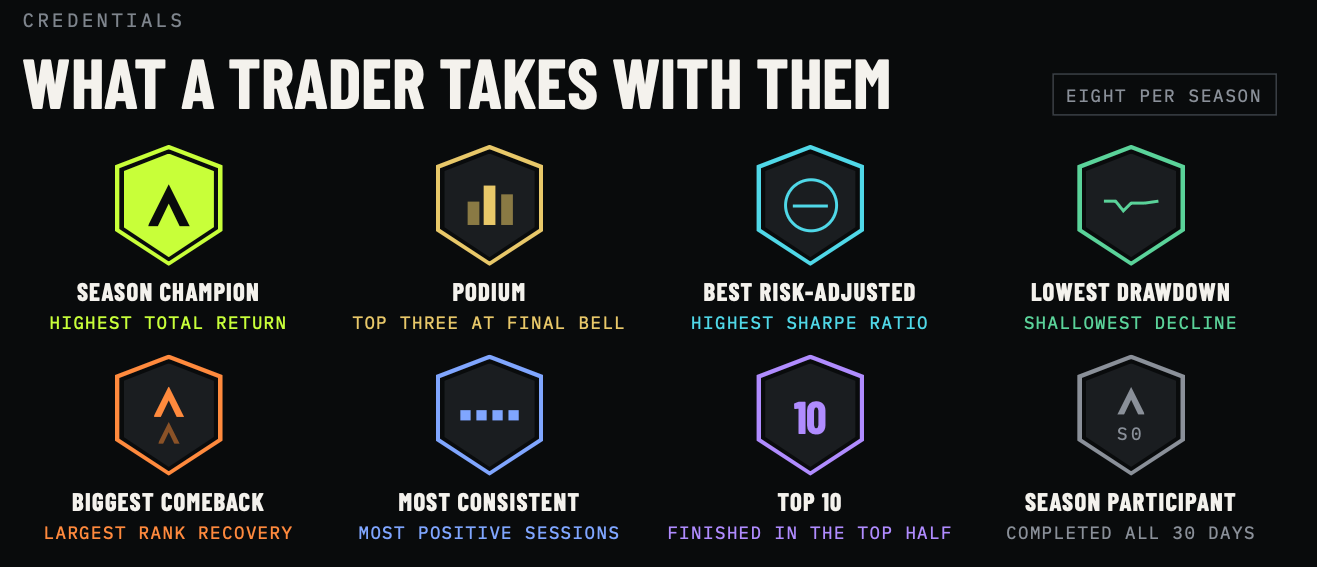
The champion is whoever posts the highest total return, because a competition needs a clean winner. The record is where the interesting part lives, since we capture drawdown, volatility, Sharpe, turnover, concentration, consistency, and full position history alongside the return. A seventh-place finisher with a shallow drawdown and steady weekly results may be the person an allocator wants to meet, and the data should make that visible even when the trophy goes elsewhere.
Where it Gets Interesting
Each participant ends the season with a Trader Passport, a persistent record that carries forward across seasons.
On top of that sits verification.
We take standardized snapshots of competition results and commit them cryptographically, so a published record can be checked later against a tamper-evident history. To be precise about what that does and doesn’t buy you: a snapshot proves the record matches what was committed at the time, and it does not prove that simulated performance could have been achieved with real capital.
The reason this matters to me sits downstream.
If a trader builds several seasons of verified, risk-aware results, that record becomes something a registered investment adviser can evaluate. Separately managed accounts and model portfolios already exist as compliant structures where a client holds assets in their own custodial account. The missing input has always been credible evidence about the person running the strategy.
From where I sit as someone building on the RIA side, that’s a recruiting tool. Rather than asking who has the right résumé, you could ask who has 200 verified trading days with a drawdown profile you can live with.
The Buffett Framework Question
Buffett judged managers by how they behaved in the bad years, which is why he’d read a drawdown before a return. If your last three years of trading were scored on drawdown, consistency, and position sizing rather than your best trade, what would the record say about you?
Where I’m Still Undecided
3 open questions, and I’d take input on all of them.
Equities or perpetual futures. Running paper accounts on Alpaca gives me real brokerage infrastructure, standardized fills, and a clean separation between execution and scoring. Building a perpetual futures paper environment would attract a different and more aggressive field, though it means I’m calculating the fills myself, which weakens the credibility the whole thing depends on.
Ranking by total return versus risk-adjusted return. Return makes a better broadcast, and risk-adjusted metrics make a better filter. Season Zero currently uses return for the title with everything else recorded, though I could see arguments for a dual crown.
How many seasons before a record means anything. 30 days is mostly noise, and I’d rather say that plainly than pretend one month proves skill. My guess is three seasons before the data starts separating operators from lucky ones.
What I’m Asking
This is a proposal rather than a launch announcement, and I’m publishing it partly to find out whether it resonates with anyone besides me.
2 questions for you:
Does this address a real gap, or am I solving a problem that only looks like one from inside my own head?
And would you want one of the twenty seats? (no entry fee!)
If the second answer is: “HELL YES”, send me a message below and we’ll send over some more information.
A combine doesn’t guarantee anyone a career. It gives the fast kid from the small school a stopwatch and an audience, and the rest is up to him.
Moving right along!…
In Case You Missed It

Pokemon Cards Cracked Tokenization’s Problem (August 12)
Five years of real-world asset tokenization went looking for buyers, and the buyers turned out to be sitting in a trading card livestream all along. Whatnot’s valuation hit $20 billion in August, nearly double the $11.5 billion it carried nine months earlier, while onchain gacha spending ran $324 million in June against roughly $50 million a month a year earlier.
The specific thing to track is fractionalization: once a platform sells partial ownership of a high-value card and markets it on appreciation, securities law almost certainly applies, and the compliance bill arrives with it.
Market Winners 🏆
Berkshire Starts Buying Again. Berkshire spent a net $19.8 billion on stocks in the second quarter, its first quarter as a net buyer in fourteen, ending a selling streak that ran from late 2022 through Greg Abel’s first months in the CEO seat. The 10-Q shows $23.47 billion of equity purchases against $3.69 billion of sales. Most of it went to one name: roughly $17 billion into Alphabet, with about $10 billion through a private placement tied to Alphabet’s June capital raise and the rest bought on the open market. The cash pile still sits at $365.5 billion, so this is basically a drop in the Berkshire bucket.
Super Micro Computer (SMCI). Supermicro’s fiscal fourth quarter delivered non-GAAP EPS of $1.70 against consensus near $0.88, and non-GAAP gross margin came in at 17.6% versus company guidance of 8.2% to 8.4%. Fiscal 2027 revenue guidance of $65 billion to $72 billion landed against a $54.4 billion consensus, and first-quarter guidance of $14.5 billion to $15.5 billion cleared a $11.68 billion estimate. Shares rose about 9% on the print, a single-day move. Read the margin line skeptically before celebrating it: Goldman lifted its price target while keeping a Sell rating, calling the quarter’s margin unusually strong on product mix and expecting it to normalize as the AI server mix shifts.
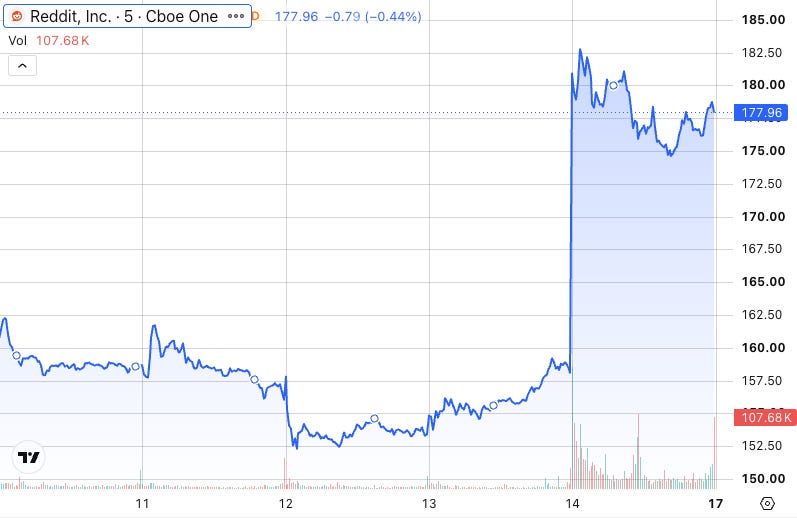
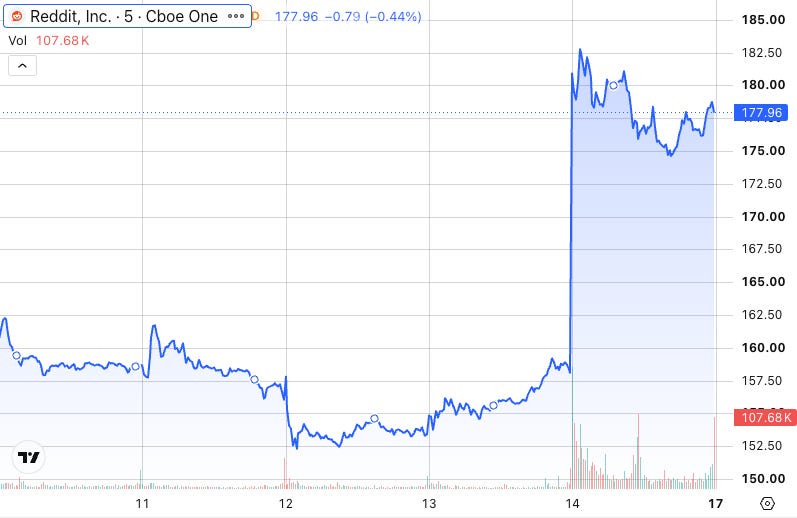
Reddit (RDDT). Reddit jumped more than 11% in a single session after S&P Dow Jones Indices confirmed it will replace AvalonBay Communities in the S&P 500 before Tuesday’s open, making it only the second pure-play social media company in the index alongside Meta. Index inclusion forces every S&P 500 tracker to buy, which is a mechanical bid rather than a change in the business. The useful question for anyone holding it is what the stock does once that forced buying clears, because inclusion pops have a long history of fading when the passive demand is satisfied.
Market Losers 📉
Cisco (CSCO). Cisco fell about 8% for the week, most of it in one session after fiscal fourth-quarter results that beat on both lines. Revenue hit a record $17.3 billion, up 18% year over year, non-GAAP EPS came in at $1.22, and management guided fiscal 2027 revenue to $72.2 billion to $73.4 billion, about 15% growth at the midpoint. The market sold it anyway because adjusted gross margin slipped to 66.3% as hardware-heavy AI products scaled. Cisco is buying its AI growth with margin, and at a premium investors decided that trade wasn’t priced in.
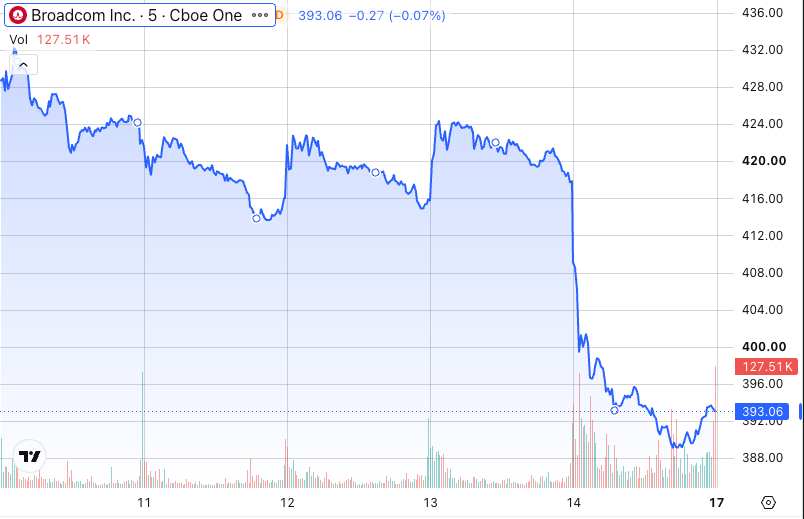
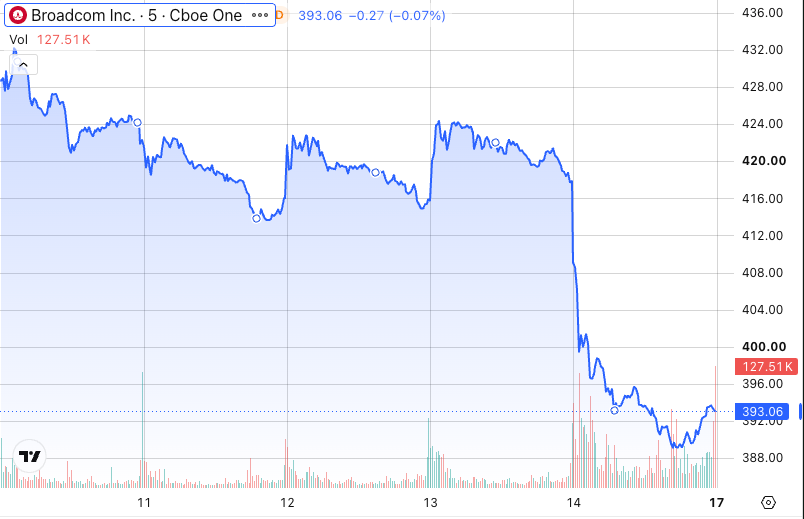
Broadcom (AVGO). Broadcom dropped roughly 5% on Friday and slipped below $400 after Bank of America cut its issuer and bond ratings over the XPV financing vehicle Broadcom built with Apollo and Blackstone. BofA’s Tom Curcuruto estimates the platform could carry up to $370 billion of senior debt by mid-2029 at 20 gigawatts of scale, including about $150 billion of new issuance in 2027 alone. None of that is Broadcom’s own debt, since the vehicle raises capital and leases custom AI accelerators to customers, with a first transaction near $35 billion to build over a gigawatt of compute for Anthropic. That distinction is exactly the point: AI capital spending is migrating into leasing structures that sit outside the income statements investors are actually reading.
Bitcoin (BTC). Bitcoin fell more than 2% on the week to close near $62,976, its weakest level since August 3, with ether at roughly $1,881. Two crypto-specific events did the damage. The Senate mustered around 51 of the 60 votes needed to advance the Digital Asset Market Clarity Act and left for August recess without another vote, and a scheduled SEC meeting on regulator-led tokenization rules was cancelled. Spot bitcoin ETFs saw about $131 million of outflows and their first back-to-back outflow days since late July. Macro gave crypto a friendly week and it fell anyway, which says the legislative calendar is now the swing factor.
What to Watch This Week 👀
July FOMC Minutes (Wednesday, August 19). The minutes cover the contentious July 28 and 29 meeting where three officials dissented in favor of a rate hike and Chair Warsh described the discussion as a good family fight. Markets now price roughly 62% odds of a September hold, up from about 52%, with meaningful hike odds still on the board and essentially none on a cut. Count how many members were near a hike rather than at one, because that number sets the bar for what the next inflation print has to clear.
The Retail Earnings Wave (Tuesday through Thursday). Home Depot reports Tuesday, with Target, Lowe’s, TJX, and Walmart following across the week, arriving directly on top of a 0.6% retail sales decline and sentiment at 51.0. Listen for the split between traffic and ticket. If revenue is holding up on higher prices while units fall, the consumer is weaker than the headline sales figures suggest, and that changes the second-half earnings math across consumer discretionary.
Housing Data Against a 25-Year High in Long Rates. The NAHB housing market index lands Monday and housing starts follow Tuesday, days after the 30-year Treasury was issued at 5.216%, the highest yield in a quarter century. Short-end yields eased on the cool inflation data while the long end went the other way, and long rates are what set mortgages. Housing is where a standing-still Fed and a rising term premium collide, so these two prints will show whether builders are already feeling it.
Matthew Snider is the founder of Block3 Strategy Group, author of “Warren Buffett in a Web3 World,” and publisher of the BitFinance newsletter. He holds a Series 65 and MBA, and has been an active participant in digital asset markets since 2015. This article is for educational purposes only and should not be considered financial advice. Always consult with a qualified professional before making investment decisions.
Sources
Cointelegraph, “Social trading platform Fomo raises $75M, reaches $550M valuation,” June 22, 2026
QuickNode Builder’s Guide, fomo by FOMO Labs product profile
CNBC: CPI inflation report July 2026: Prices rose 0.1%, annual rate 3.4%
Kiplinger: S&P 500, Nasdaq Extend Weekly Win Streaks: Stock Market Today
MarketScreener: Russell 2000 reaches record high
Yahoo Finance: Supermicro Stock Rises 9% on a Margin Recovery
Quartz: Reddit stock jumps after S&P 500 inclusion announcement
24/7 Wall St.: Broadcom Sinks 6% as BofA Flags $370B in AI Debt,
Yahoo Finance: Bitcoin and ethereum prices today, Friday, August 14, 2026
Charles Schwab: Retail Sales Take a Dip, Stocks Eye Weekly Gain