I’m Going Back to College, This Time to Teach Students About Crypto, Investing and AI
75% of people who use AI for money questions say it lets them ask things they’d be too embarrassed to ask another person.
More than 50% say it’s also led them into a poor financial decision or mistake.
Both numbers come from a 2025 Intuit Credit Karma survey, and together they describe the student I’m most excited to meet this fall.
If you went to college, there’s a good chance the most useful hour you spent there happened in office hours rather than a lecture hall. You’d knock on a half-open door, someone would push a stack of papers aside, and you’d finally ask the question you were too nervous to raise in front of two hundred classmates. No slides, no syllabus, just a person who’d already walked the road pointing out the potholes before you hit them.
A lot of students now take those questions to a chatbot instead. It’s always available and it never makes anyone feel dumb, but it also never says “let me double-check that.”
So this fall, I’m going back to college to hold office hours of my own.
I’ve always loved teaching. I did plays in middle and high school, served as Toastmasters club president during my MBA program, and helped organize a TEDx event at Loyola Marymount.
For a long time, though, I didn’t have enough road behind me for my pothole warnings to help anyone.
Over the last 10+ years though, my experience in finance and crypto has grown into a tangible subject matter expertise that can be shared with students/teachers excited about the intersection of these fields.
In 2015 I was writing business school papers on Bitcoin.
In 2017 I was breeding cryptokitties and buying digital real estate in metaverses.
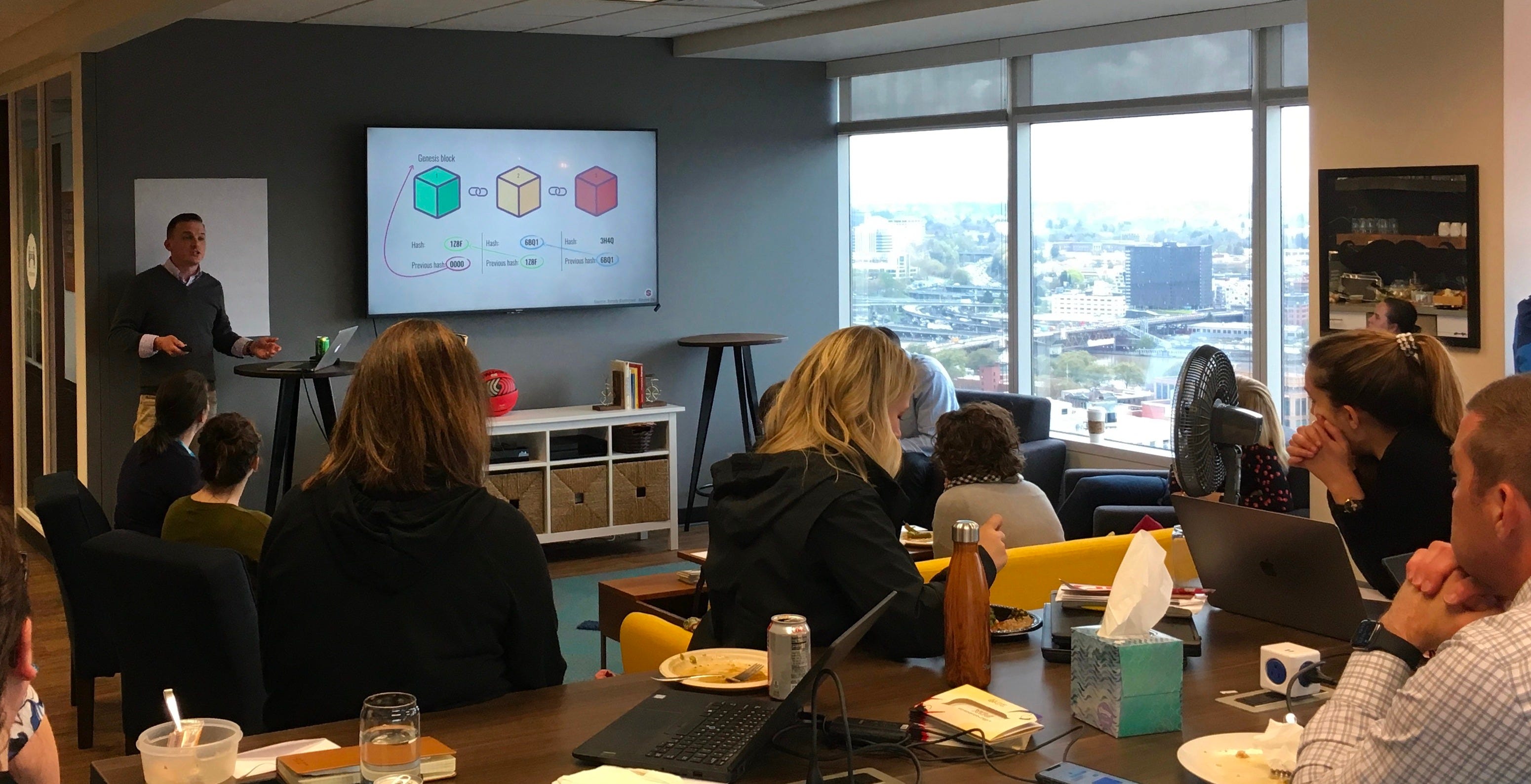
I led lunch and learns for executive teams about blockchain (see pic above).
In 2023, I passed my Series 65 which allowed me to provide investment advice.
I Wrote a book on digital asset investing using Warren Buffett’s lessons.
In 2024, I become CIO at an SEC-registered investment advisor.
In 2025, I structured more than $250 million in digital asset private offerings.
And this year I pushed forward with this newsletter and taught myself to build agentic trading systems to share with my community.
I’ve spoken on campus before, too:
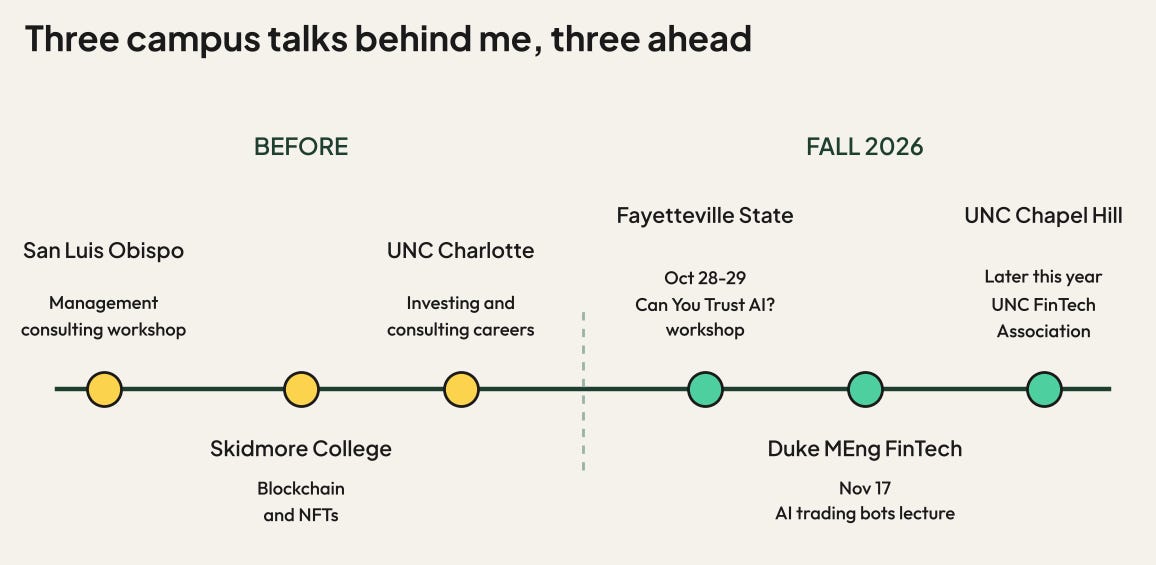
a management consulting workshop in San Luis Obispo,
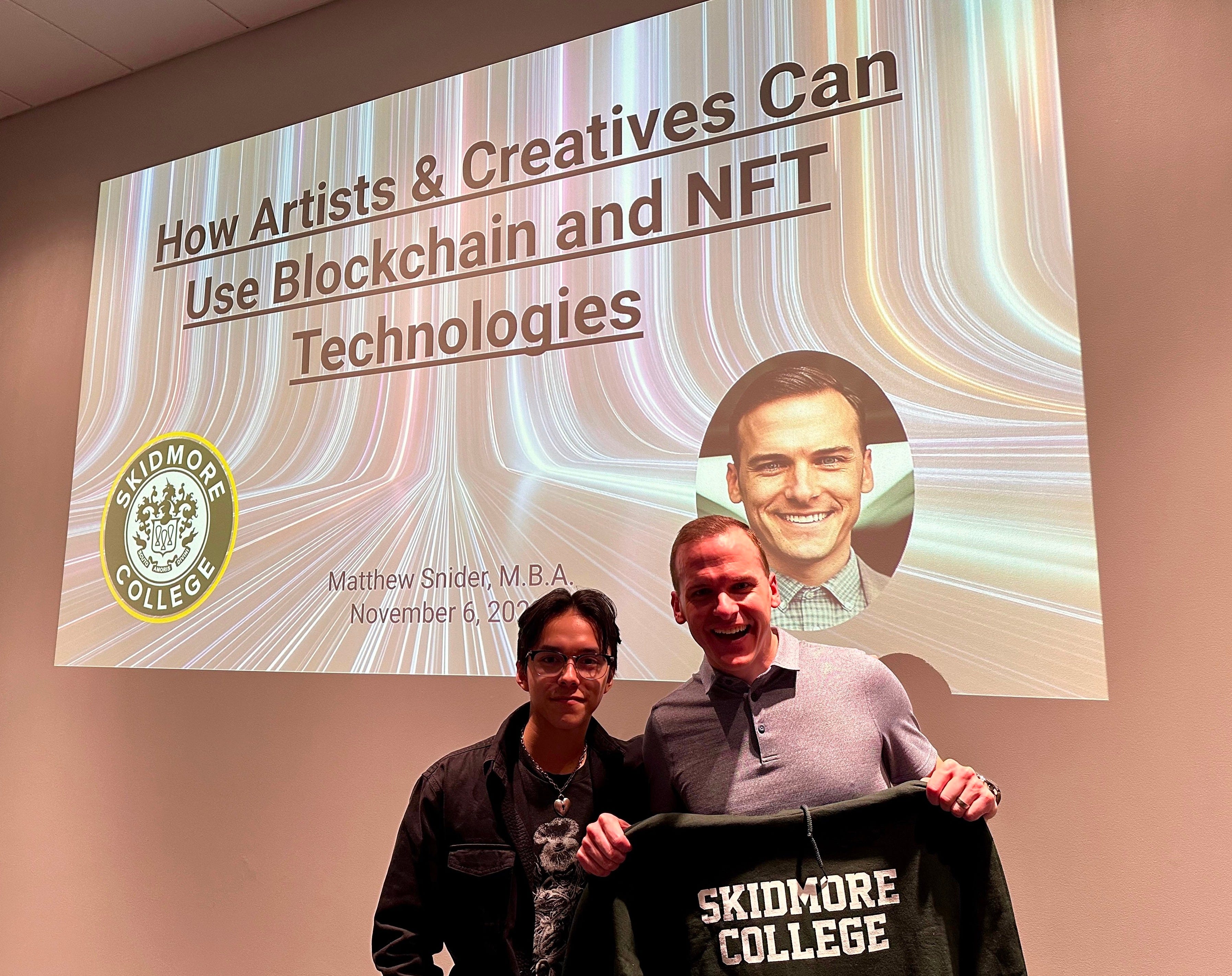
a talk on blockchain and NFTs at Skidmore College, and
a session on investing and consulting careers at UNC Charlotte.
Yes, I’m a finance and crypto nerd, but I also love sharing these experiences, trials, tribulations and successes with students. Eager to find more opportunities to share my experience, I looked to the universities close by to see if there was interest among professors….and there was!
To my surprise, almost all of the universities I reached out to either had a specific class or club related to crypto, blockchain, investing or AI.
3 Upcoming Stages on My Calendar
Fayetteville State University, October 28-29. Next week at FSU’s Fintech & Insurtech 2026 Conference, I’m leading a student workshop called Your Money, Your Future, Your AI: Can You Trust It?
Duke University, November 17. A guest lecture for Duke’s Master of Engineering in FinTech program on machine learning, AI, and what we’ve learned building automated trading bots.
UNC Chapel Hill, later this year. A session with the UNC FinTech Association.
My Method for Reaching Out
A while back I wrote about building a speaking pipeline for 2027 conferences.
Conferences are a long game, though, and I live in the Research Triangle, a short drive from a few of the best-known universities in the country. So I turned the same approach toward campuses.
Draw the circle. I set a 100-mile radius around Durham, close enough to drive there and back in a day.
Build the list. Every college and university inside that circle, then a level deeper to the student organizations where these conversations already happen: investment clubs, blockchain clubs, and machine learning and AI groups, along with the graduate programs that teach this material.
Find a person, not an inbox. Club officers and faculty advisors decide who gets the room, so they’re the ones who heard from me.
Make the pitch about them. An investment club and an AI club want different talks, so each note offered something shaped to that group.
That turned up roughly 30 opportunities. I reached out to every one, and so far three said “YES!”.
One in ten from a cold start is a hit rate I’ll take any day, and the rest of the list isn’t going anywhere.
What I’m Bringing to Each Opportunity
Fayetteville: a room full of AI auditors.
The plan is to let students catch AI’s mistakes with their own eyes. We’ll open with a game called Two Answers, One Liar: two AI responses to the same money question, both delivered with total confidence, and the room votes on which one to trust before I reveal the answer.
Then come three rounds of Spot the Error, built on questions college students ask: whether a little side hustle income is tax-free, whether paying the minimum on a first credit card is enough, and whether to skip a 401(k) match to pay down student loans faster. Every answer sounds polished, and each hides a planted mistake.
After that, I’ll fix a bad prompt live so students can watch the answer improve in real time, then close with a traffic-light lightning round: green when AI is fine, yellow when you should verify, red when you need a human.
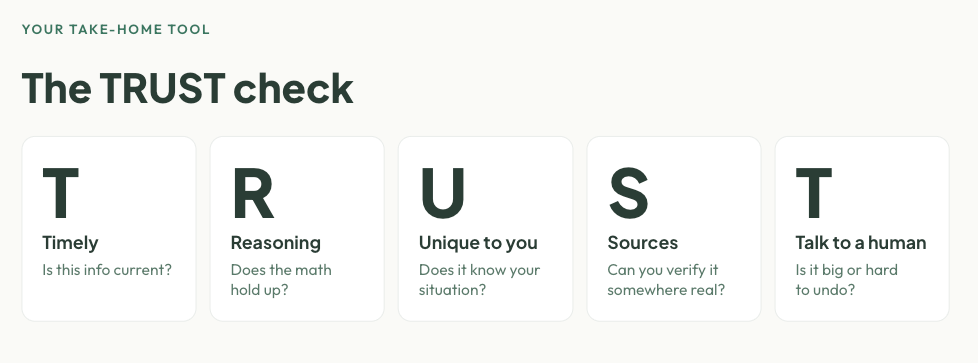
Everyone leaves with a five-question TRUST check.
Is it Timely?
Does the Reasoning hold up?
Is it Unique to my situation?
Are there real Sources?
Should I Talk to a human?
The line I most want them to remember comes from my day job. As an investment adviser, I have a legal duty to act in my clients’ best interest, and the chatbot on their phone carries no such duty.
Duke: the strategies we killed.
Students in the FinTech program are the people who’ll build the next generation of financial tools, so I’m bringing them the unglamorous side of the Buffett Bot, the trading system I started building with an AI coding partner and no programming experience.
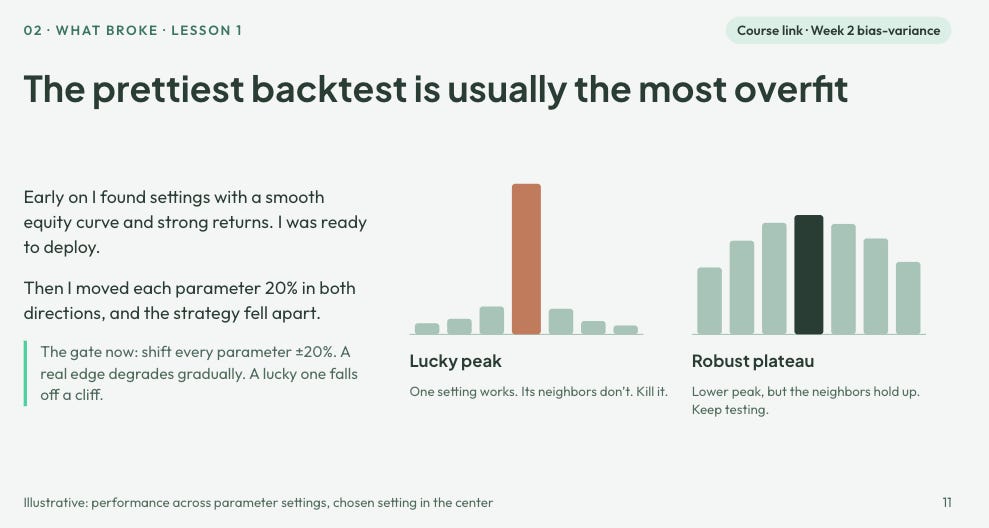
I’ll show them parameter settings that produced gorgeous backtests and fell apart when I nudged a single setting by 20%. I’ll walk through how a viral trading bot advertising a 79% win rate failed the very first gate of our eight-gate validation framework, because on data it had never seen, it predicted about as well as a coin flip.
I’ll explain why I bought institutional-grade data before trusting a single result, and why the gate that kills the most ideas asks a plain-English question: what market behavior does this exploit, and why should it last?
I’ll also tell them about the week my AI coding partner told me to stop building and go read a book, because it was right. A backtest exists to kill bad ideas, and the builders who last are the ones willing to throw out their favorite results.
UNC: a map of where fintech is heading.
With the UNC FinTech Association, I’m planning something closer to a working session than a lecture. I want to give them the view from my seat: tokenized funds still searching for buyers, stablecoins moving into everyday payments, AI showing up inside fund operations and compliance, and the careers forming around all of it.
My own route ran from management consulting to a CIO seat to starting my own firm, and I’d love to save a few students some of my detours.
Why I’m Doing This
Students are going to ask AI about money whether anyone teaches them how or not, and the Credit Karma numbers say the habit is already here. I’d rather they learn to question it in a workshop than learn the hard way with their first paycheck.
The learning runs both directions. Preparing for a room of twenty-year-olds is the fastest way I know to find out whether I understand my own work, and the student I meet this year could be running a fund, a startup, or a compliance team in ten years. Relationships built early compound the same way a good portfolio does.
This fall is the pilot. In 2027 I want more schools, more clubs, and more classrooms where someone finally asks the question they were too nervous to ask.
My Door is Open🚪
If you know a professor, a class, a student club, or a program that could use a speaker on investing, digital assets, AI, or building a career in finance, I’d love an introduction. Reply to this email or find me on LinkedIn.
If it’s outside my 100-mile circle, send it anyway.
The best office hours never needed a sign-up sheet, because the door was already open. Mine is open too, and I can’t wait to see who walks through it.
What school or club should be next on my list? Hit reply and tell me. 🎓
In Case You Missed It

Microsoft, Goldman and 14 Others Said No to Stock Tokens (Oct. 21)
Sixteen companies, including Microsoft, Alphabet, Goldman Sachs and McDonald’s, used the SEC’s new 30-day veto to keep their shares off OKXICE’s around-the-clock stock token venue.
My read is that it’s a fight over control more than code, and I walked through why with a condo board and a rental app.
Matthew Snider is the founder of BitFinance and principal at Block3 Strategy Group, where he advises emerging digital asset fund managers and RIAs on fund operations and compliance frameworks. He holds both Series 65 and Series 7 licenses, and is the author of Warren Buffett in a Web3 World.
This newsletter is for informational and educational purposes only and does not constitute investment, legal, or tax advice, or an offer or solicitation to buy or sell any security or digital asset. Digital assets are highly volatile and speculative, and investors can lose their entire principal. Past performance is not indicative of future results. Consult your own financial, legal, and tax advisors before making any investment decision.
Sources
1. Fortune, “80% of millennials and Gen Z who used AI for financial advice say it helped, but over half made a bad decision”, September 24, 2025, citing an Intuit Credit Karma survey.
2. Fayetteville State University, Broadwell College of Business and Economics, “Fintech & Insurtech 2026 Conference”, accessed October 24, 2026.
3. Duke University Pratt School of Engineering, “Duke Engineering Announces a 12-Month Master of Engineering in Financial Technology”, accessed October 24, 2026.