How to Own the Future Without Picking the Winner

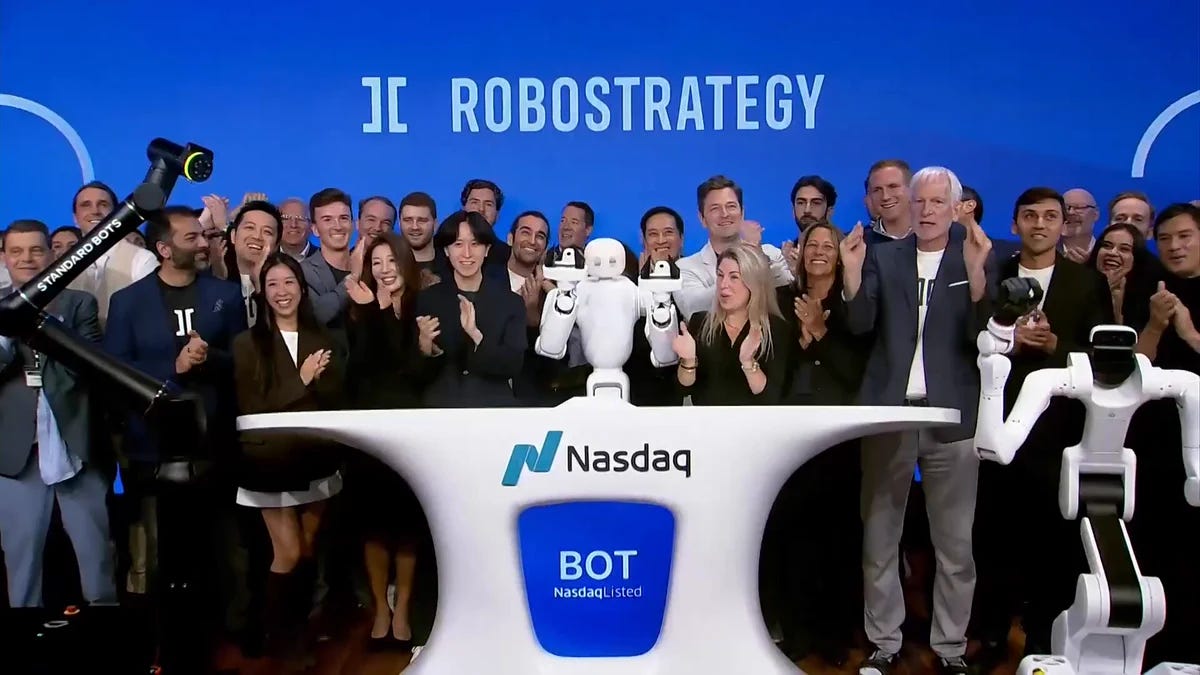
This week, a wheeled robot named Taku helped ring the Nasdaq closing bell.
Taku belongs to Dyna Robotics, one of 17 private companies inside a fund called RoboStrategy (BOT). We wrote about them back in June and their progress has been really cool to see.
For most of the last decade, the best part of the innovation curve sat behind a velvet rope. SpaceX, OpenAI, Anthropic, Figure. Unless you were accredited and well connected, you stood on the sidewalk until the IPO, and by then the people inside had already captured most of the move.
The rope is fraying.
SpaceX priced at $135 in June and opened at $150 in a $75 billion raise, the biggest IPO on record. Fund issuers had spent months building ways for regular investors to get in early, and that playbook is now running for AI labs and robotics startups.
Three funds have my attention, and each answers the same question differently.
How do you own a theme without having to pick the one company that wins it?
1. $BOT: A Venture Fund With a Ticker
When I first wrote about BOT this summer, it had been trading for three weeks. Since then the portfolio has grown up and the stock has cooled off, though it still trades far above what the fund owns.
Quick vocabulary stop. A closed-end fund has a fixed pool of shares that trades like a stock, so its price can drift far from the value of what’s inside. That inside value is net asset value, or NAV.
BOT buys stakes in private robotics and physical AI companies. It’s run out of San Juan by Andrew Kang, a founding partner of Mechanism Capital.
What changed in the portfolio
BOT listed in May with at least 13 investments and held 17 at the end of September. Since listing it has put about $124 million into six companies.
Standard Bots. BOT helped lead a $200 million Series C at a $1 billion valuation in June. It’s now the largest position at about $87 million, or 31% of net assets.
Figure AI. Built more than 1,000 Figure 03 humanoids in July after a May deal with Catalyst Brands, the operator behind JCPenney.
Apptronik. Opened a 90,000 square foot robot training facility in Austin with Google DeepMind, with Apollo 3 aimed at 2027.
Path Robotics. Signed a production deal with shipbuilder HII of up to $600 million.
Newer names. Nox Metals, Eccentric Machines, Prometheus and one company still in stealth.
What you pay vs. what you own
BOT’s NAV climbed from $7.24 at the end of May to $11.35 at the end of August, then sat flat through September. The stock closed at $26.74 on October 13, about 136% above NAV, so a buyer pays roughly $2.36 for every $1 of robotics stakes inside.
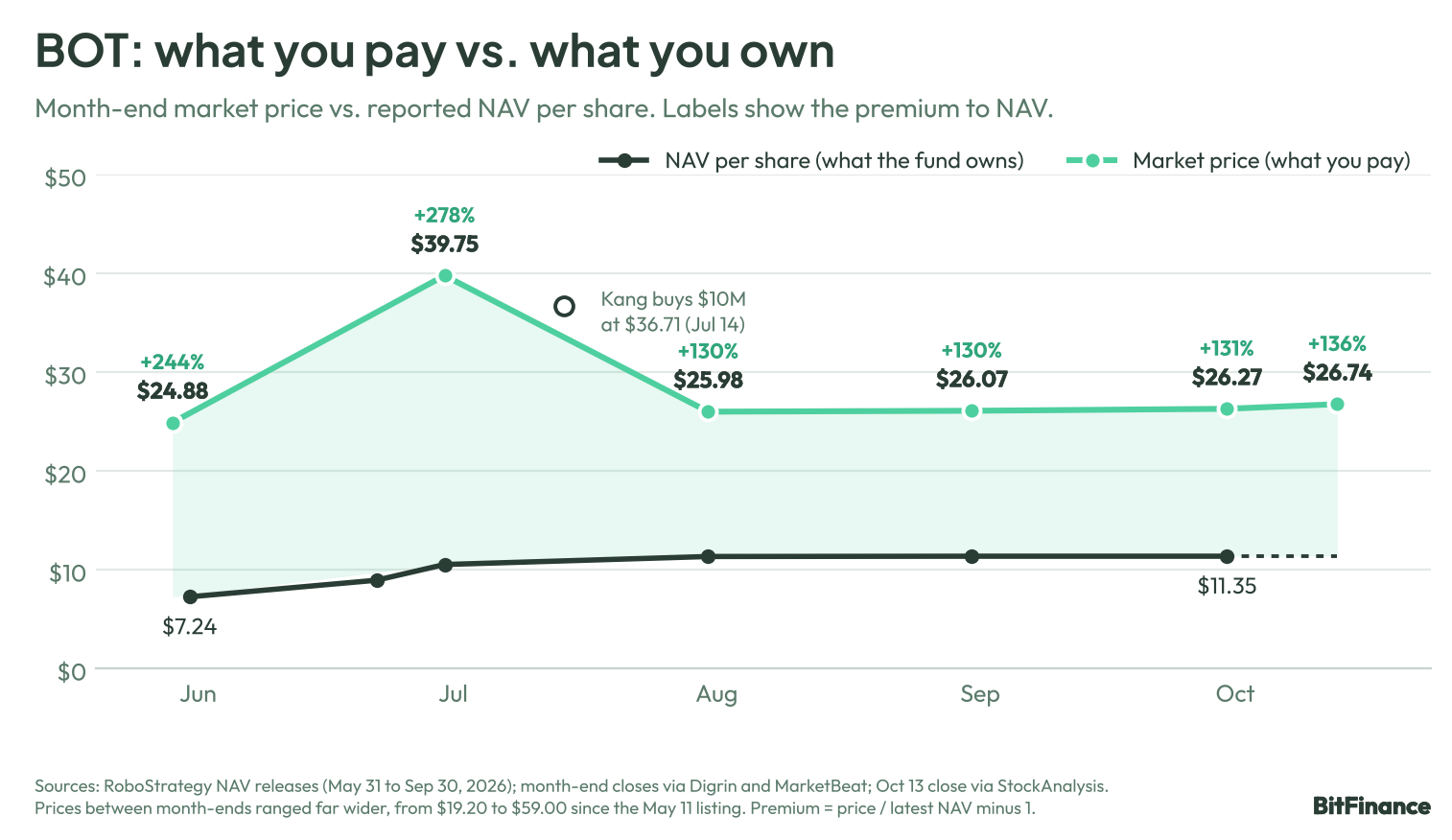
The mint line is what you pay and the dark line is what the fund owns. The premium has narrowed from about 278% at the end of June to roughly 130% since, but the stock still trades at more than twice the portfolio’s value.
Kang’s August shareholder letter credits most of the NAV growth to selling new shares above NAV and investing the cash at NAV. A Roth equity line of up to $2 billion lets the fund keep doing that, generally at 2% below market and never below NAV. Kang bought $10 million himself on July 14 at $36.71. Anyone who followed the MSTR debates will recognize this flywheel, pointed at robots.
NAV per share grows two ways here: private marks go up, or new shares sell above NAV. Watch the October NAV release after a flat September, because a stalled flywheel leaves the premium with less to stand on.
Kang’s case for the premium is that private valuations lag reality. He points to Unitree, which opened its August Shanghai debut at roughly $66 billion, about 39x its last private round.
The other side deserves equal airtime. The fund charges a 2.5% management fee on gross assets, total estimated expenses run near 4%, and it was taxed as a regular corporation in its first year.
But keep in mind that one company is nearly a third of the portfolio.
BOT is 2 bets in one ticker: robotics, and Kang’s ability to keep the premium alive.
2. $MN: OpenAI and Anthropic, by Swap
Corgi Invest launched the MANGOS ETF (MN) on October 2.
The name is a clever acronym that stands for: Meta, Anthropic, Nvidia, Google, OpenAI and SpaceX. It’s actively managed, costs 0.20% a year, and needs no accreditation or lockup.
OpenAI and Anthropic are private, so MN reaches them through total return swaps. A swap is a contract where a bank pays the fund whatever the reference asset returns, in cash, one for one with no leverage. Combined exposure to the two labs is capped at 15% of the fund.
The crypto plumbing underneath
The prospectus says those swaps are priced off perpetual futures, crypto-style contracts with no expiration that let traders bet on a company’s value before it lists. The fund doesn’t hold the perps, and Corgi says MN isn’t a cryptocurrency fund.
Even so, crypto market structure is now setting a reference price inside a regulated ETF. After eleven years in this market, I count that as a milestone. It’s also a new kind of risk, since a perp can drift a long way from what a company’s shares would fetch in a real deal.
Two weeks in, the private sleeve is nearly full. As of October 13, with about $75 million in assets, MN held 6.4% in OpenAI and 6.3% in Anthropic through swaps. The other 86% sits in Meta, Alphabet, SpaceX and Nvidia.
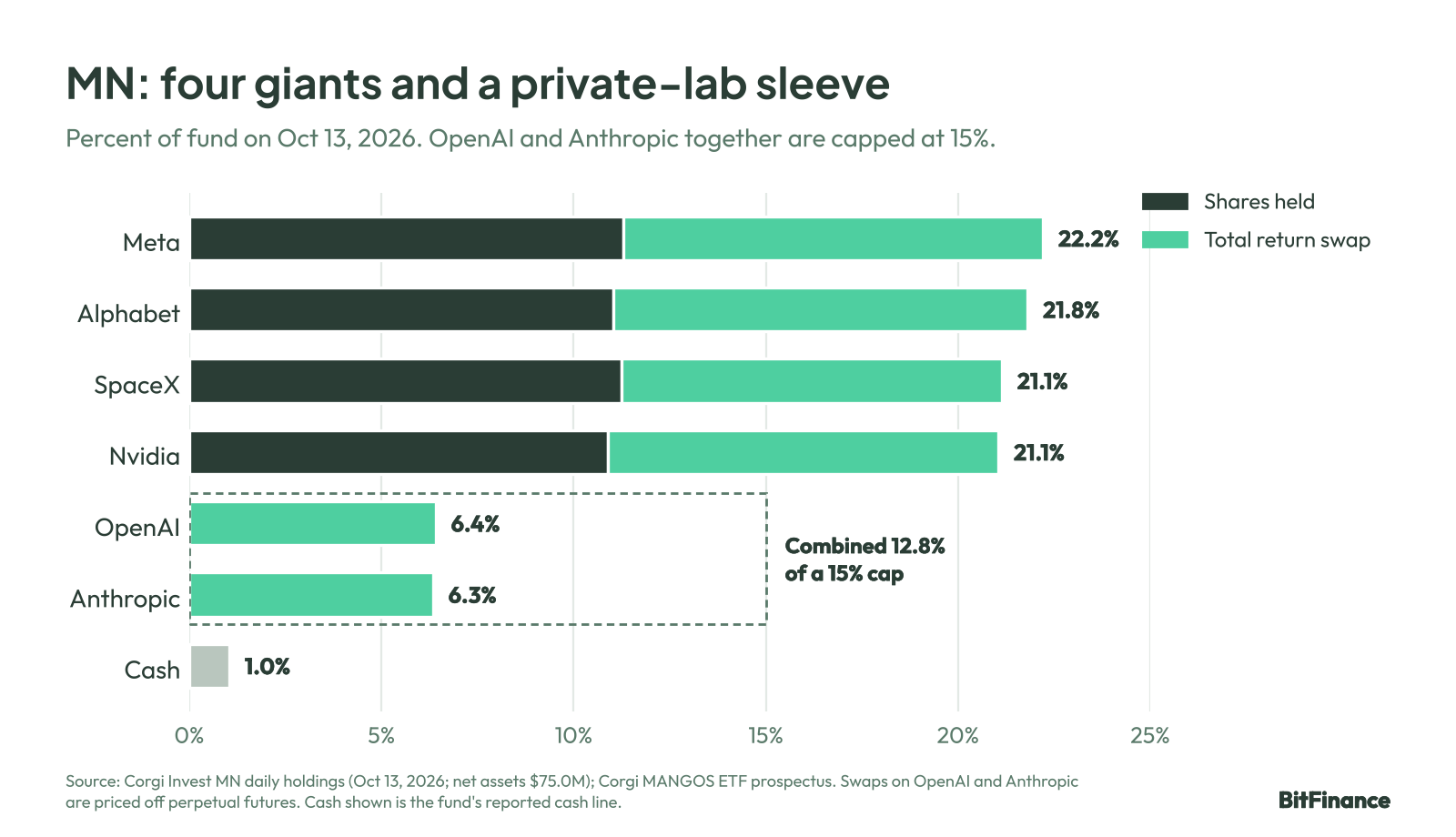
Four public giants make up about 86% of the fund, split roughly evenly between shares and swaps. The dashed box marks the 15% cap on the two private labs.
Timing drives this one. Anthropic filed confidentially on June 1, and Bloomberg reports it could trade before Thanksgiving. When a private name lists, MN’s swap re-references the public shares, so the Anthropic sleeve may have a short shelf life.
MN is mostly a concentrated big-tech fund with a private-market garnish.
Before buying, I’d want to know what price the swaps entered at, who the counterparty is, and how far the perp reference can wander.
3. AIPO: Own the Plug
The Defiance AI & Power Infrastructure ETF (AIPO) skips private companies and swaps and owns the toll road instead.
AIPO tracks an index of US-listed companies that earn at least half their revenue from AI and power infrastructure. Half the target weight goes to power generation and grid equipment, 20% to AI hardware and data centers, and 15% each to construction and utilities.
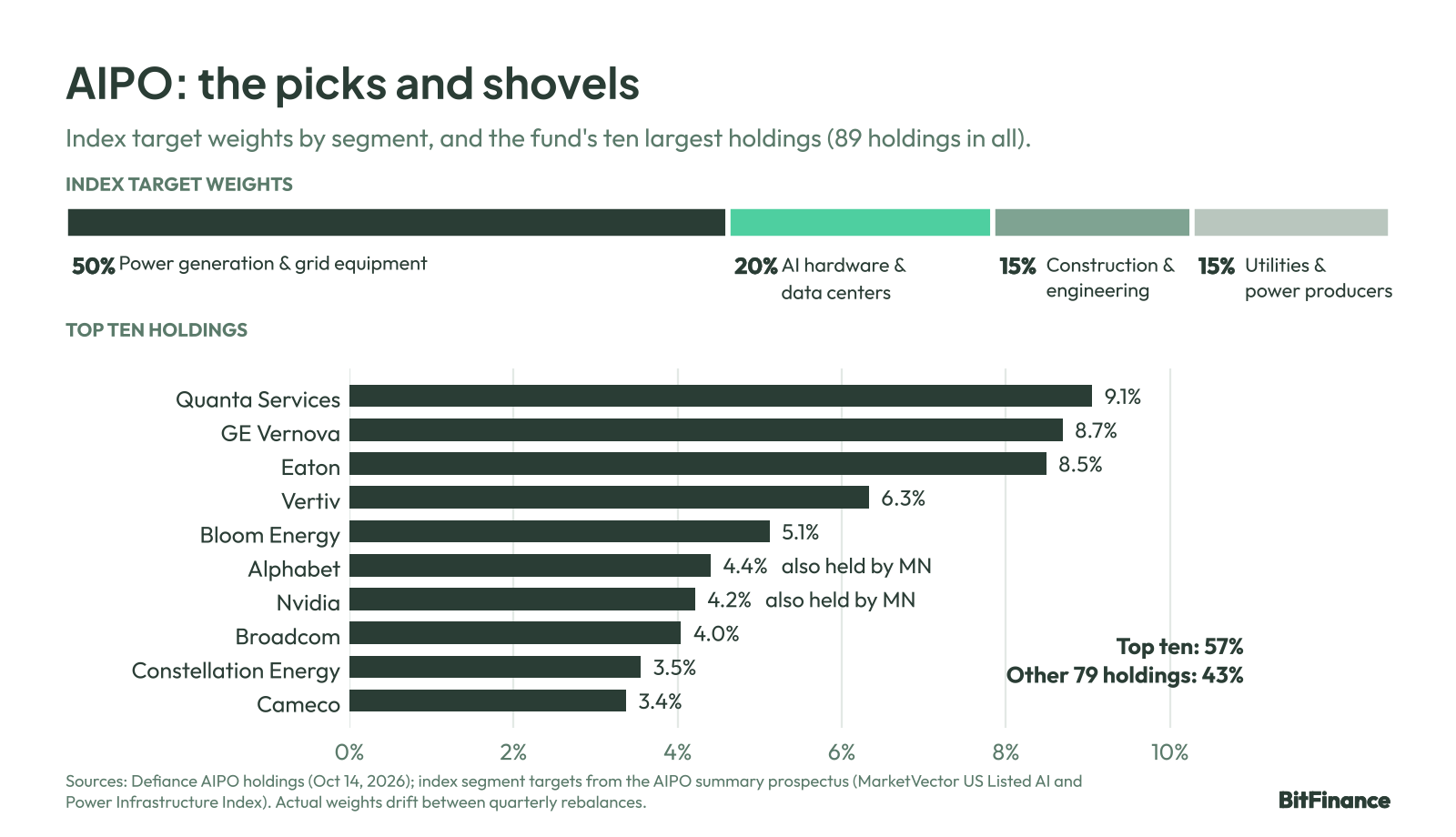
Grid builders and equipment makers dominate the top of the fund. Alphabet and Nvidia also sit inside MN, so holding both funds doubles up on those two names.
AIPO launched in July 2025, won Best New Thematic ETF at the 2026 ETF.com Awards, and holds about $912 million with a 0.69% expense ratio. It returned about 27.5% this year through September 30, but gave back about 16% in the third quarter alone.
You didn’t need to know which railroad would win to make money selling the steel. Whether OpenAI, Anthropic or Google wins the model race, each needs electricity, transformers and cooling.
The risk is the spending cycle. If the big cloud providers slow their data center budgets, these names reprice fast, as the third quarter showed.
What Ties Them Together
BOT gives you real private stakes and charges for access through fees and a premium. MN offers cheap, capped, synthetic exposure to the AI labs with crypto pricing underneath. AIPO skips the race and owns what every runner needs.
Through a fund formation lens, a useful first check on any structure is what an investor’s dollar buys on day one. Today that ranges from about 42 cents of NAV in BOT to roughly a full dollar in MN, which traded within 0.3% of NAV on October 12.
Crypto has run this experiment before. GBTC traded at a fat premium when it was the only easy door into bitcoin, then flipped to a deep discount once other doors opened. My hypothesis is that premiums like BOT’s mostly measure how scarce access is, and that scarcity shrinks every time a SpaceX or an Anthropic lists.
To be fair to BOT, its premium buys direct stakes you can’t get anywhere else. If a Figure or Apptronik lists at a big step-up, today’s price could look reasonable in hindsight.
The velvet rope is coming down, and that’s good for individual investors, but it puts more weight on the price of admission. Before you walk in, check what each fund owns, what you’re paying above NAV, what happens on IPO day, and what the all-in fee is.
Which of the three would you hold for five years without checking the price?
Hit reply and let me know!
Matthew Snider is the founder of BitFinance and principal at Block3 Strategy Group, where he advises emerging digital asset fund managers and RIAs on fund operations and compliance frameworks. He holds both Series 65 and Series 7 licenses, and is the author of Warren Buffett in a Web3 World.
This article is for informational and educational purposes only and is not investment advice or a recommendation to buy or sell any security. Investing in closed-end funds, ETFs, derivatives and private-company exposure involves substantial risk, including the total loss of principal. Funds can trade at large premiums or discounts to NAV. Read each fund’s prospectus and consult your own financial, tax and legal advisors before making any investment decision.
[POSITION DISCLOSURE: I hold $BOT]
Sources
RoboStrategy Form N-2, Oct 7 price and Sept 30 holdings (Oct 9, 2026)
RoboStrategy prospectus supplement, Standard Bots position (424B3)
RoboStrategy founders forum and Nasdaq (GlobeNewswire, Oct 8, 2026)
RoboStrategy NAV as of June 30 and private placements (Finviz, July 8, 2026)
RoboStrategy $16M private placement incl. Kang purchase at July 14 close (StockTitan, July 15, 2026)
Figure signs agreement with Catalyst Brands (Figure, May 2026)
Unitree surges 629% to $66B valuation in Shanghai debut (SCMP, Aug 2026)
Corgi MANGOS ETF (MN) fund and daily holdings, Oct 13, 2026 (Corgi Invest)
Anthropic investor day and IPO timeline (FinanceFeeds, Oct 12, 2026)
SpaceX raises $75 billion in biggest IPO in history (IPOScoop)
Defiance AIPO fund page: holdings, assets, performance (Oct 14, 2026)