Hyperliquid: The Everything Store for Markets

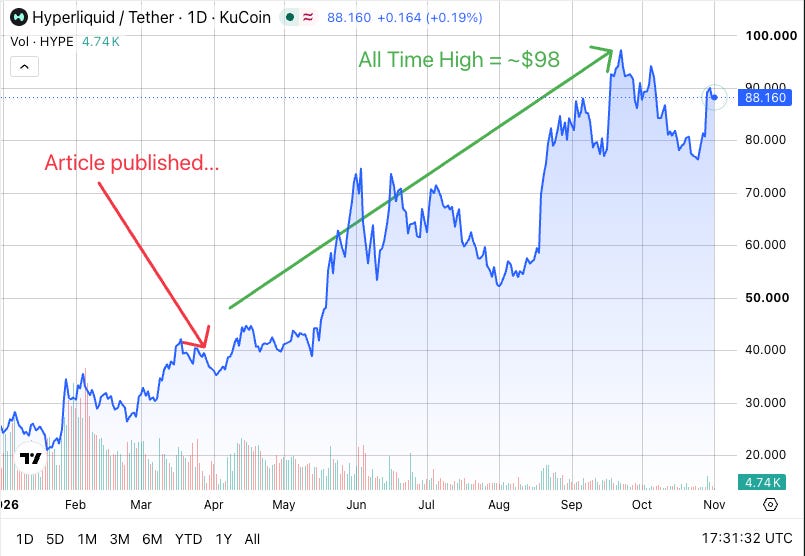
On March 28, fresh off the Digital Asset Summit in New York, I wrote about two tokens I’d been adding in a bear market: Hyperliquid and Morpho.
The thesis was simple: identify crypto-native ocmpanies that actually produced revenue AND accrued that value back to its native token. (Tougher to find than you might think…)
HYPE traded around $38 that week. This morning it’s around $88.
Remember when Amazon just sold books?
It became the “everything store” by opening its shelves to outside sellers, taking a cut of every sale, and letting the catalog grow faster than any one company could stock it.
Hyperliquid is running the same play for markets. It built the engine and the checkout, and outside builders list whatever they want to trade: Bitcoin, crude oil, Nvidia, the Nasdaq-100. Every sale pays Hyperliquid a fee, and most of that fee buys back HYPE.
Since March, stocks and commodities have caught up with crypto on the shelves, a billionaire macro investor has started shopping, and the NYSE’s parent signed a deal to bring the biggest seller’s products to US customers.
Disclaimer: I currently do not have a position in HYPE. This piece is not intended as a recommendation but only serves as an educational review of their ecosystem. This is not investment advice. Do your own research. 👊🏼
What Changed Since March
The price more than doubled, from about $38 to about $88, a gain of roughly 130%. Market cap went from about $9.8 billion to about $21 billion.
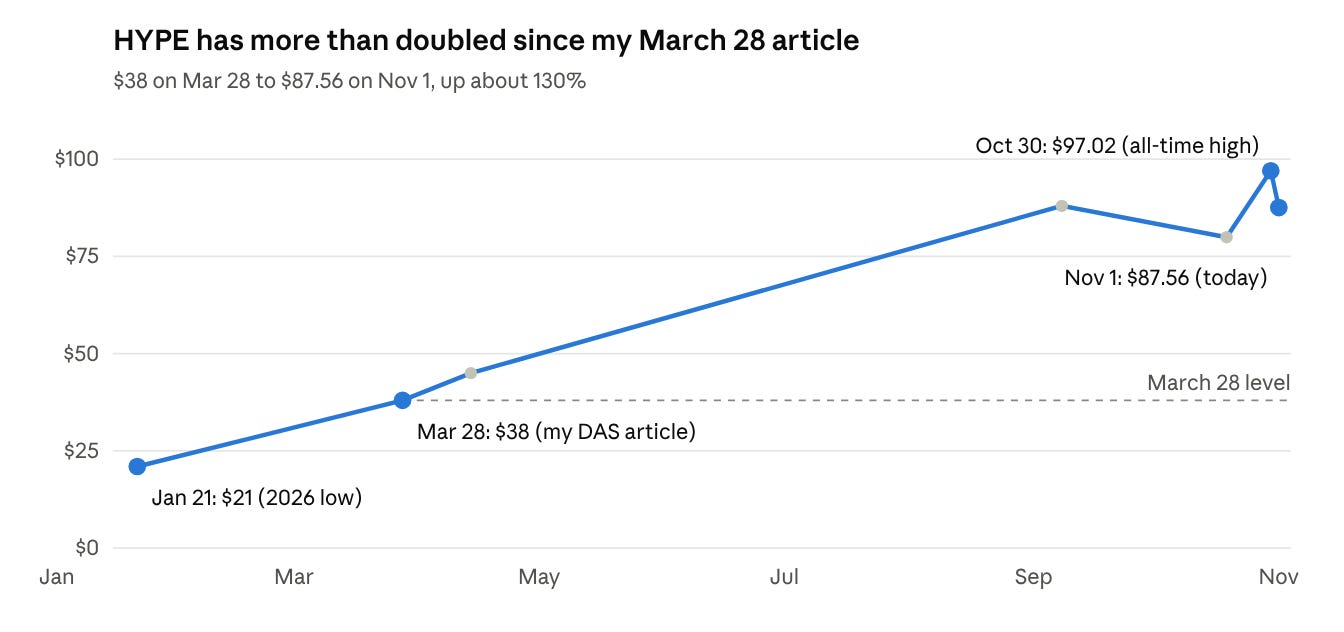
Reported price levels: CoinGecko (Nov 1), Cointelegraph (Jan 21 low, Apr 14), The Block (Sep 8), CoinGabbar via CoinMarketCap (Oct 19, Oct 30).
Unfortunately, revenue went the other way but this is largely attributable to lower trading volumes in Q3 across the board in crypto.
Hyperliquid’s annualized revenue ran at $843 million in March, per Cointelegraph, and DefiLlama puts it near $671 million today.
My hypothesis is that the market stopped valuing Hyperliquid on what the store sells today and started valuing how big the catalog could get once stocks, commodities, and Wall Street distribution move in. That’s the bet you’re making at $88 that you weren’t making at $38.
Still the Most Profitable Team on Earth?
Back in April, one of my best-performing LinkedIn posts was a single chart:
Hyperliquid, 11 people, about $78 million in revenue per employee.
The team is now 14 (Fortune), and revenue runs about $671 million a year, or roughly $48 million per employee.
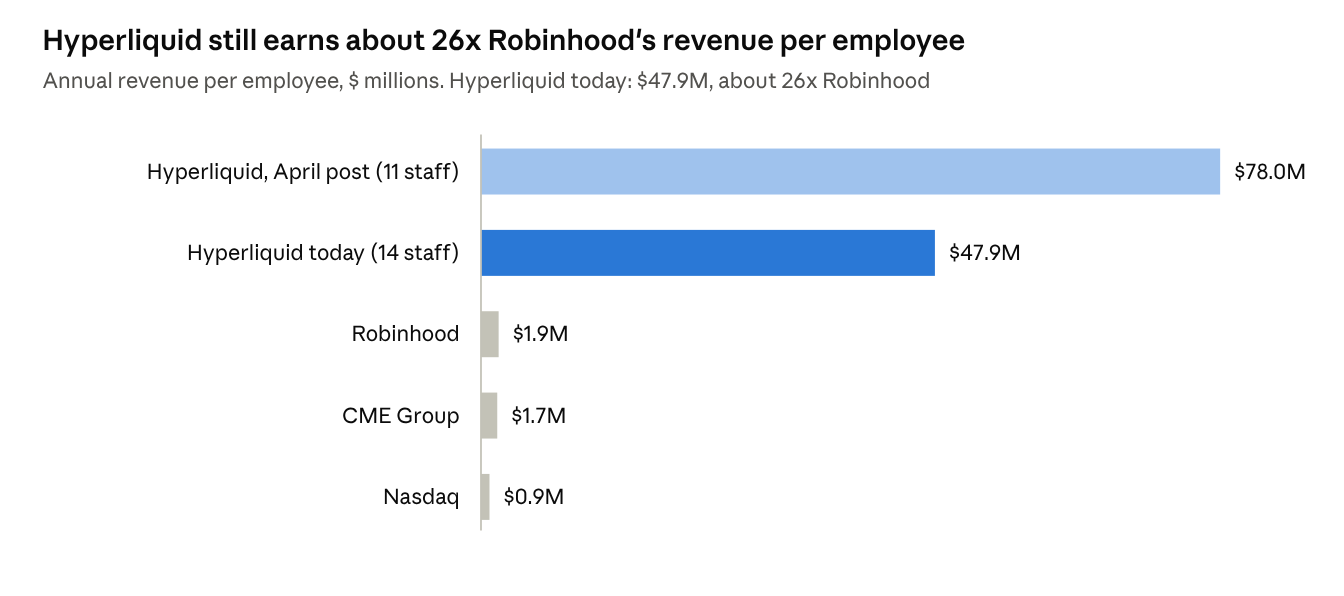
Hyperliquid today: DefiLlama annualized revenue ($670.6M) over 14 staff (Fortune, Jan 2026). April figure: Artemis chart from my April post. Peers: analyst figures compiled June 2026 via KuCoin/AiCoin, revenue divided by headcount.
The number came down, but Hyperliquid is still in its own league.
Robinhood generates about $1.9 million per employee,
CME Group about $1.7 million, and
Nasdaq about $0.9 million, per figures compiled in June (KuCoin/AiCoin).
In short, Hyperliquid runs about 26x Robinhood at a reported margin near 100%.
One caveat: 14 is Hyperliquid Labs alone. Builders like Trade[XYZ] and the validators carry plenty of the work, which flatters the math, but the gap still runs 20x or more.
3 New Signals: ICE, Druckenmiller, & Vaults
ICE wants to carry the catalog
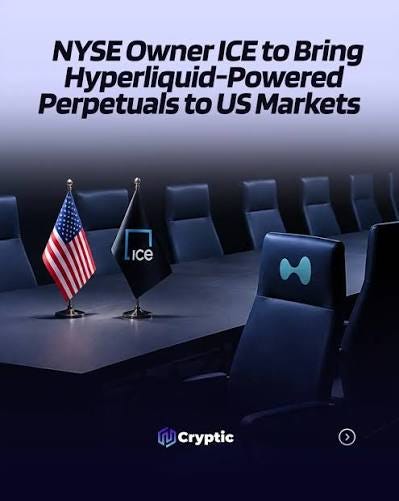
On October 29, ICE, the parent of the NYSE, signed a definitive agreement with Trade[XYZ], Hyperliquid’s biggest outside seller and the builder behind most of its stock and commodity markets.
Quick Note: Trade[XYZ] is a separate company that uses HIP-3, Hyperliquid’s upgrade for permissionless market listings, to launch 24/7 perpetual contracts on stocks, indexes, commodities, and currencies for eligible users outside the US. Those markets run on Hyperliquid’s order book, and Trade[XYZ] splits the trading fees with the protocol, so Hyperliquid earns on every trade it brings in. As of June, it ran 92 markets and handled about 98% of that segment’s volume (KuCoin).
ICE takes a minority stake and becomes the exclusive operator of a regulated US version, with a separate retail market and clearing structure reached through futures brokers and partners like the ICE-OKX joint venture. Approvals are still ahead, with no timeline. CEO Jeffrey Sprecher called the perp markets “additive to our futures markets, not a replacement for them.” HYPE jumped about 17% on the news (FinanceFeeds).
When the incumbent signs up to distribute a seller’s products instead of building its own, that tells you whose design won. The open question is how much US flow would touch Hyperliquid’s own order book versus ICE’s regulated rails.
Druckenmiller walks in twice
In August, Druckenmiller’s family office disclosed a $23.2 million stake in Hyperliquid Strategies (PURR), a public company that holds HYPE.
On October 29, in his first post on X, he disclosed an investment in Trade[XYZ] and said he’ll use its products himself.
Elon Musk replied: “Interesting” garnering 6.3 million views in the process.
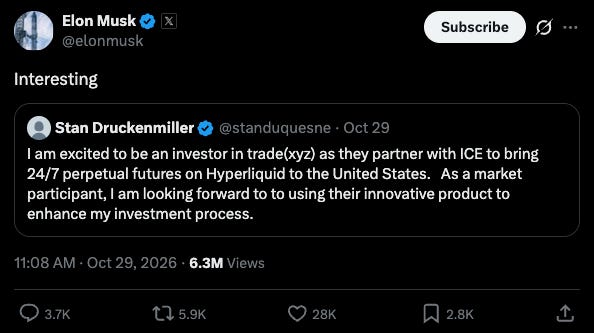
The dollars are small, about 0.4% of his reported holdings. The signal is a career futures trader saying he’ll trade 24/7 perps.
Vaults open a fund aisle
Vaults let a manager trade pooled money onchain without being able to withdraw it. Buoy Finance’s Vaults 2.0, live since August, puts each vault in its own contract and lets managers trade crypto, stock, and commodity markets. In October, INFINIT opened fixed-term managed vaults, starting with a dollar-neutral momentum strategy across stocks, commodities, and crypto.
I help emerging managers launch funds, and the two hardest problems are trust and cost. A vault where the manager can trade but can’t take the money, and that anyone can launch for a dollar, addresses both in code, though strategies still lose money and INFINIT hasn’t published an audit.
The Thesis: One Order Book for Everything
My hypothesis is that Hyperliquid becomes the everything store for markets, the default place to trade anything around the clock. Crypto came first. Stocks and commodities are arriving now as perps. Stock tokens could end up settling right alongside them.
The data supports the first two steps. Builder-deployed markets, mostly stocks and commodities, went from about 2% of Hyperliquid’s perp volume at the start of 2026 to nearly 50% by July (The Block). Their open interest hit a record $4.44 billion in August. The most active contracts track the Nasdaq-100, Nvidia, and Tesla.
The third step ties back to my September piece on the SEC’s Innovation Exemption for tokenized stock. A stock token is the share wrapped onchain, while a stock perp tracks its price and settles in stablecoins. Wall Street keeps those in separate buildings. Onchain, nothing forces that split, and liquidity collects wherever hedging and borrowing are easiest.
That’s where vaults fit. If a manager can run one strategy across stocks, commodities, and crypto from a single account, with the rules enforced in code, the everything store starts stocking the funds alongside the contracts they trade.
ICE’s deal fits from the other direction, with Wall Street building a regulated door into the 24/7 perp rather than a rival to it.
Extrapolating, With the Brakes On
If this plays out, two hypotheses follow. Weekend price discovery for US stocks drifts onchain, and HYPE trades more like a royalty on global trading than a crypto token.
The counterpoints deserve equal airtime. Builders keep up to half the fees on markets they deploy, while crypto perps send about 97% to HYPE buybacks (The Block), so stock volume earns holders less per dollar. Revenue is below its March pace while the price is more than double. Market cap is about $21 billion against a fully diluted value near $83 billion. One builder handles nearly all stock and commodity volume, and the ICE deal still needs approvals.
In March, I bought into a store that mostly sold one thing. Seven months later, stocks and commodities fill half the shelves, a famous investor is shopping there, and the NYSE’s parent wants to carry its biggest seller’s products in the US. Revenue hasn’t caught up to the catalog yet, and that gap is what I’ll be tracking from here.
Where do you think stocks move onchain first: through perps like these, or through tokenized shares?
Hit reply. I read every one.
In Case You Missed It
Last week I wrote about going back to college to teach, and the first stop is done. I led two workshops on AI and personal finance at Fayetteville State University’s annual Fintech conference, with about 60 students and adults in the room.
We hunted for planted mistakes in AI answers about side hustle taxes, credit card minimums, and 401(k) matches, and everyone left with the TRUST check: Timely, Reasoning, Unique to you, Sources, Talk to a human.

Next up is Duke’s Master of Engineering in FinTech on November 17, and I’ve just booked a session in Campbell Law School’s course on the legal side of wealth management.
If your class or team could use a speaker, my door is open.🚪
Matthew Snider is the founder of BitFinance and principal at Block3 Strategy Group, where he advises emerging digital asset fund managers and RIAs on fund operations and compliance frameworks. He holds both Series 65 and Series 7 licenses, and is the author of Warren Buffett in a Web3 World.
This article is for informational and educational purposes only and is not investment, legal, or tax advice. Digital assets are highly volatile, and you could lose your entire principal. Consult your own financial, legal, and tax advisors before making any investment decision.
Sources
Intercontinental Exchange, Intercontinental Exchange and Trade[XYZ] to Bring Hyperliquid-Based Perpetual Markets Onshore, October 29, 2026
FinanceFeeds, Stanley Druckenmiller Invests in Trade[XYZ] as Musk Amplifies Announcement and HYPE Surges 17.64%, October 30, 2026
Stock Market Today, Oct. 29: Hyperliquid Strategies Stock Surges 23%,
Stanley Druckenmiller Just Bought a Company That Holds Hyperliquid,
CoinGecko, Hyperliquid price, market cap and supply,
CoinMarketCap, Latest Hyperliquid updates, accessed November 1, 2026
DefiLlama, Hyperliquid fees, revenue and volume, accessed November 1, 2026
Cointelegraph, HYPE hits 2026 high as Hyperliquid volumes soar, April 14, 2026
Hyperliquid open interest climbs to $14.3 billion as HYPE hits all-time high,
The Block, Hyperliquid’s HIP-3 markets surge to nearly 50% of perp volume,
Trade[XYZ] has established 92 markets and captured 98% of HIP-3 volume,
KuCoin News, Hyperliquid’s revenue per employee reaches $56.42M,
Fortune, Hyperliquid’s Jeff Yan and the perps exchange, January 12, 2026
CoinGabbar, HIP-3 Sets $4.3B Record as Vaults 2.0 Go Live, August 17, 2026
DeFi Prime, INFINIT opens managed trading vaults on Hyperliquid, October 2026