Microsoft, Goldman and 14 Others Said No to Stock Tokens
A month ago I wrote that stock tokens had been handed a five-year hall pass. One line on that pass read: the company gets a veto. I treated it as fine print.
Sixteen companies have now used it, including Microsoft, Alphabet, Goldman Sachs and McDonald’s.
The venue they turned down is OKXICE, a joint venture between the second largest crypto exchange OKX and Intercontinental Exchange, the company that owns the New York Stock Exchange. In early October it told the SEC it planned to trade tokenized versions of 63 U.S. stocks around the clock, settled in stablecoins.
By Monday, 15 of the 62 companies on that list had objected. Cerebras, which wasn’t on the list, objected anyway. Nasdaq separately said it would keep its own shares off the venue.
That’s a lot of pushback against something most of these companies never asked for. To see why, think about a condo board.
The Condo Board and the Rental App
Pretend for a moment that you own a unit in a building.
A new app wants to list it as a rental, open 24 hours a day to anyone who passes a background check. You still own the unit, and the app isn’t buying the building. Under the building’s rules, though, the board gets 30 days to object, and if it does, that app can’t list a single unit.
That’s close to how the SEC’s Innovation Exemption works.
A quick reminder that a “tokenized stock” is a digital version of a share that lives on a blockchain, backed one-for-one by a real share held at a registered broker-dealer.
The holder gets the same dividends and the same vote.
A venue like OKXICE can match buyers and sellers of those tokens without registering as a stock exchange, which is the relief the SEC handed out on September 17.
When a third party does the tokenizing, the venue has to notify the company first. The company gets 30 calendar days to object, and a timely objection bars that venue from trading its token.
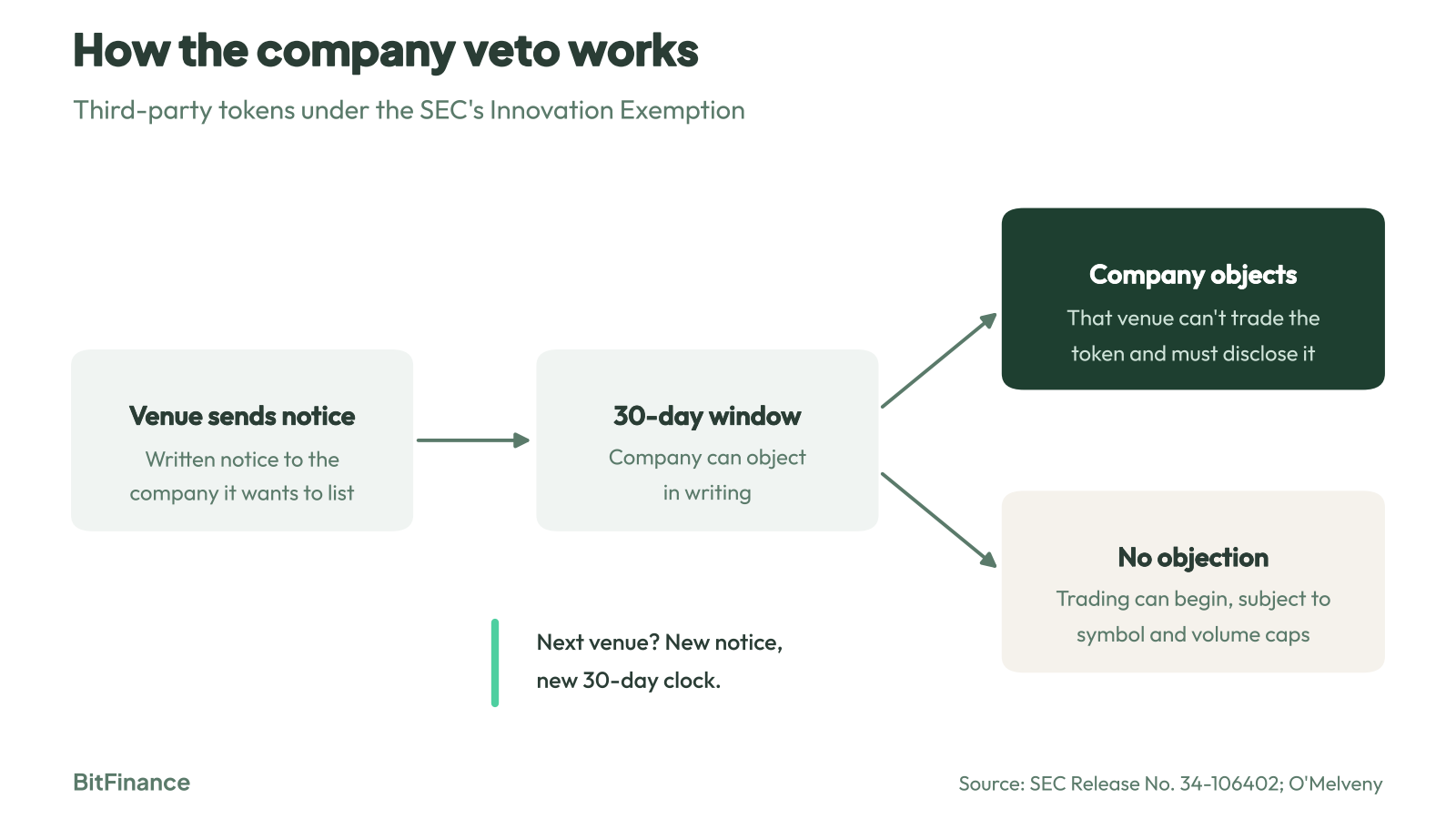
An objection only blocks the venue that sent the notice. The next venue has to start over with its own notice and its own 30 days.
In this picture, shareholders are the unit owners, and they keep their shares no matter what happens. The board is the company, and it just found out it has a say over a market it never built.
Who Said, “No”
The first wave, disclosed October 15, leaned toward AI and data infrastructure: Broadcom, CoreWeave, Applied Digital, Applied Optoelectronics and Cerebras, alongside Verizon, UnitedHealth, AppLovin and Rocket Lab.
The second wave, in an updated notice dated October 19, brought the household names: Microsoft, Alphabet, Goldman Sachs, Qualcomm, Caterpillar, McDonald’s and Western Digital.
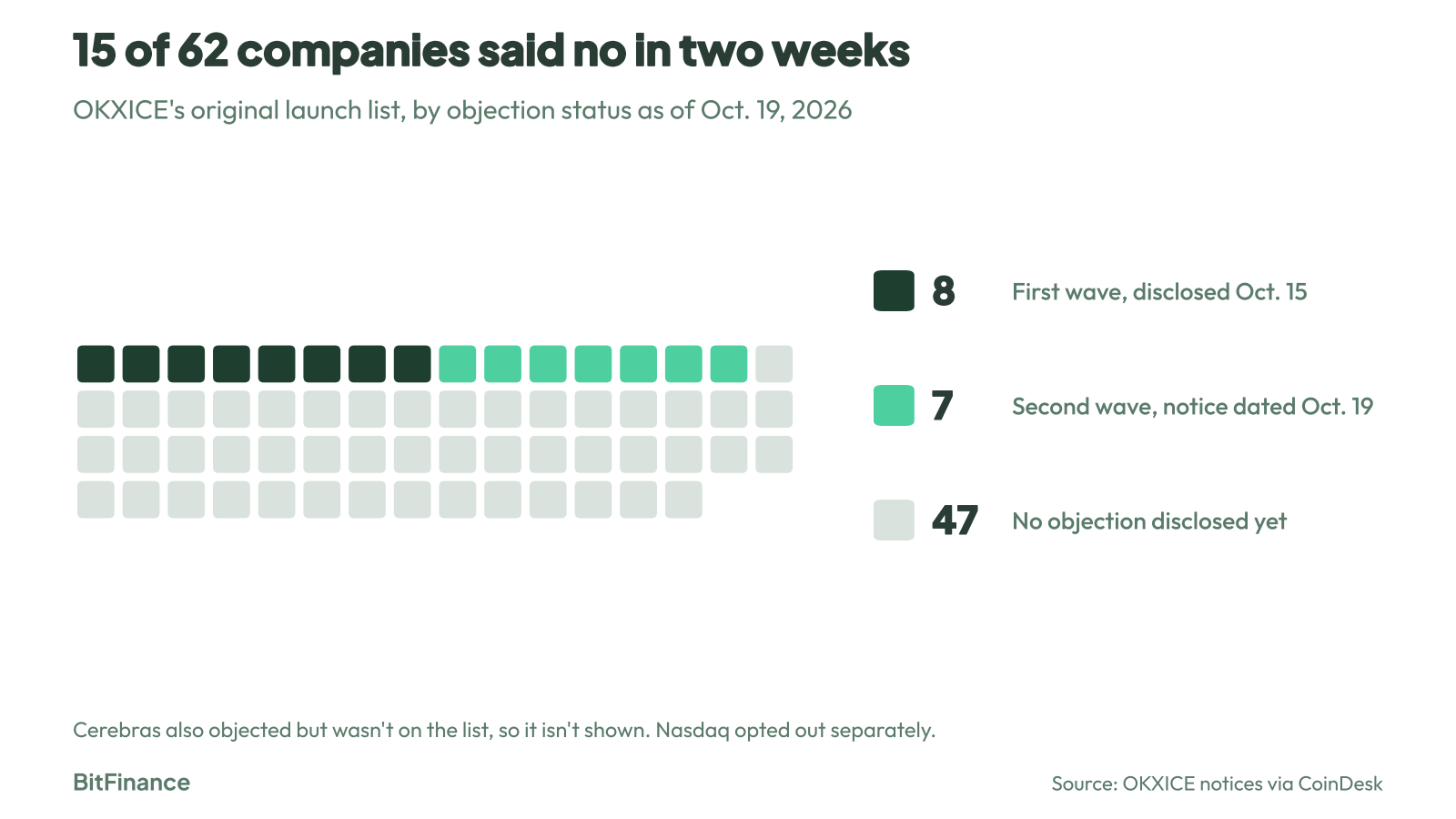
Each square is one company on OKXICE’s original list. Gray means no objection has been disclosed yet, which isn’t the same as agreeing to be listed.
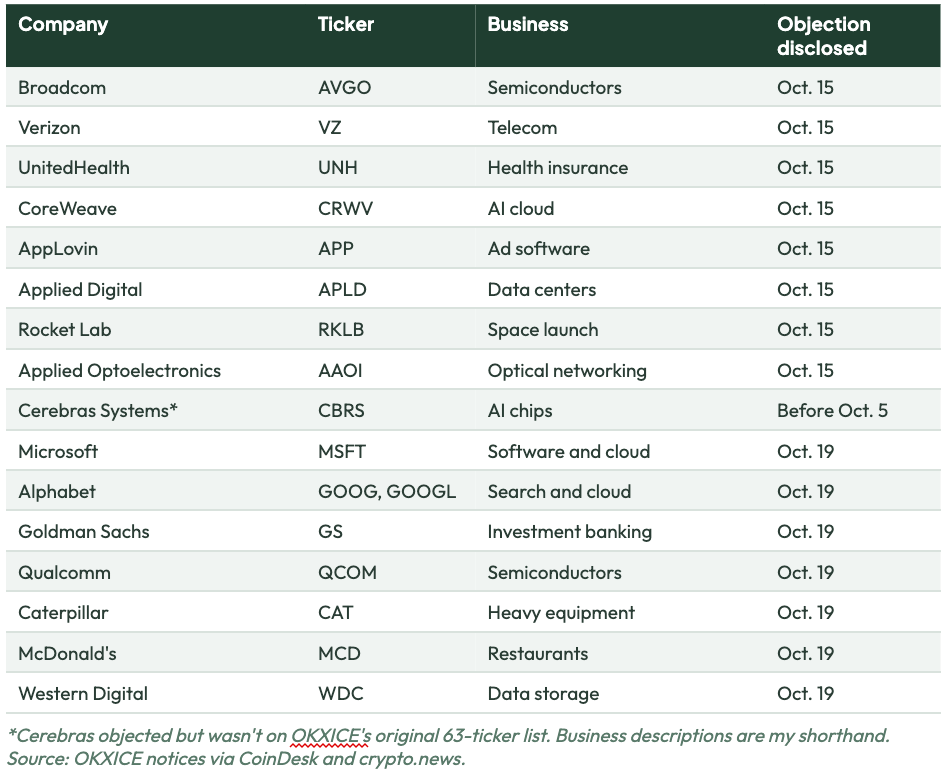
None of the notices give reasons, they simply opted out.
Applied Optoelectronics is the only one I’ve seen explain itself, and it pointed to uncertainty about its share price, its liquidity, and whether investors might read a listing as an endorsement.
Nasdaq’s reason for keeping its own shares off the venue came down to plumbing:
It doesn’t want its stock trading somewhere that doesn’t display the best available prices in real time or report to the consolidated tape, the public record of every U.S. stock trade.
Why a Board Says No
My read…er…hypothesis is that this is an incentive problem more than a technology problem.
First, it always helps to look at who gets paid.
The venue earns fees.
Liquidity providers, the firms that stock the trading pools, earn a cut of every trade. Traders get a Sunday-night market.
The company itself gets no capital benefit, no fee and no new shareholders it can identify, while its name sits on a crypto-linked venue whose administrators can pause trading or upgrade the contracts.
If something breaks, the headline carries the company’s ticker.
For the general counsel who has to sign off, that’s a decision with all downside and no upside. Saying “no” costs nothing, and it only applies to this one venue.
I’ve structured more than $250 million in Reg D offerings, and issuer counsel always asks two questions about any new channel for their securities:
who controls it, and
who picks up the phone when it breaks.
Thirty days is a short window to get comfortable with both answers from a venue that doesn’t exist yet.
The exposure being refused is also small. Tier 1 stocks, meaning S&P 500 and Russell 1000 names, are capped on any single venue at 0.25% of their average daily volume over the prior month.
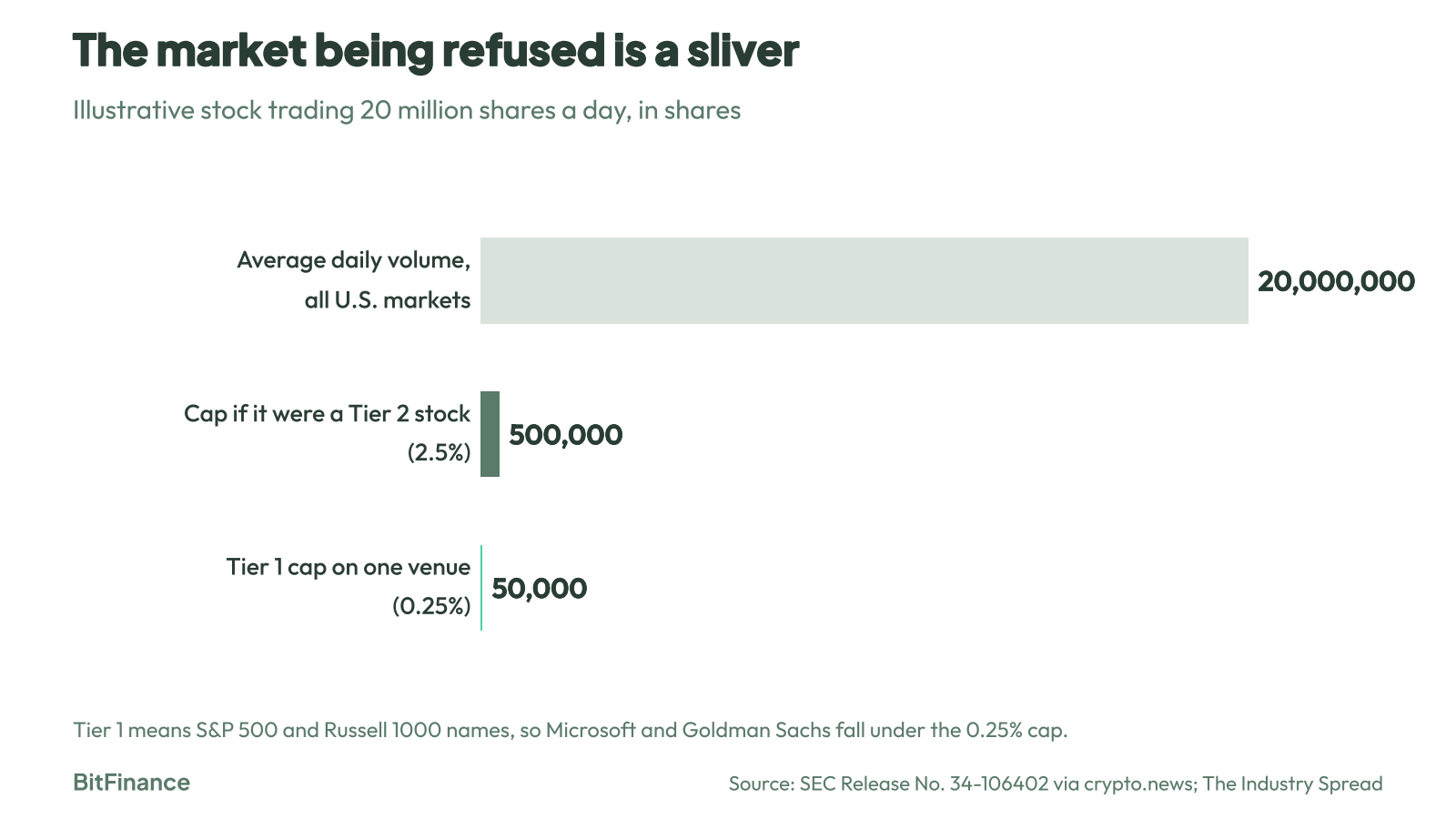
The 20-million-share stock is illustrative. On a straight scale the Tier 1 cap barely registers. Market impact this small is hard to object to, so I read the objections as being about control, which is my interpretation rather than anything the companies have said.
A stock trading 20 million shares a day could see 50,000 shares change hands on OKXICE before hitting the ceiling. I doubt Microsoft’s board worried that a fraction that thin would move its stock. My guess is it objected to the precedent of someone else writing the terms.
If you were hoping to buy Microsoft at 3am on a Sunday, you won’t be doing it on OKXICE - at least not right now.
What the Objections Cover
None of this means these companies have rejected tokenization, because objections are venue-specific. A “no” to OKXICE does nothing to the next venue, which has to send its own notice and wait out its own 30 days.
The other 47 companies on the list haven’t said “yes” either.
Silence isn’t consent under this framework, and some may still be working through the paperwork. As of this week, the names without an objection included the ones you’d expect to welcome it, like Coinbase, Robinhood and Circle, along with JPMorgan, Walmart and Costco.
TD Securities analysts said conversations with dozens of issuers turned up little interest outside a small group of crypto-adjacent companies. Several issuers hadn’t even heard of the framework when it was announced. The analysts’ bigger concern is that the framework rests on temporary relief, which a future commission could reverse.
OKXICE co-chair Andrew Cuomo sees it differently. He told Cointelegraph the notices aren’t objections in any meaningful sense, and he compared the holdouts to swimmers at the edge of a pool, waiting for someone else to test the water.
My Fair Reading
The skeptics here are public company boards, and they’re behaving rationally. They were handed a decision with no upside, a 30-day deadline and a structure several of them had never seen. Saying no first and asking questions later is what careful fiduciaries do.
The builders have a fair point too. Roughly 75% of the roster hasn’t objected, and 24-hour trading of real shares with real votes is new ground for everyone involved.
Two weeks of notices is a thin sample to judge an industry by.
My hypothesis is that venues reporting to the tape, showing real-time prices and giving issuers some say in the design will get a different answer than OKXICE did. The next venue to file a notice will test that, and so will Nasdaq, which has its own plan for tokenized shares on its regular order book.
A condo board that turns down a rental app usually isn’t against rentals so much as against strangers in the hallway on terms it didn’t write.
The first building to say yes will be the one that gets to write the house rules.
If you sat on one of these boards, would you have objected?
Reply and tell me why. I read every one. 🧐
In Case You Missed It

Last week, a Tesla Roadster drove up a ramp at SpaceX’s test site in McGregor, Texas, flipped upside down, launched off the end, turned itself around midair on cold-gas thrusters, and landed. Then Barclays put a date on the merger talk: a deal could be announced before Tesla’s annual meeting, which has to happen by December 6.
In What a $3.5 Trillion Tesla-SpaceX Merger Would Look Like, I walked through how much the two companies already share, from Grok in Tesla’s cars to Starlink in the Cybercab and a combined 30,221 bitcoin. I also covered what Rockefeller and Vanderbilt would recognize in the strategy, and why governance is where I’d spend my time. Musk sits on both sides of this table, so the exchange ratio he effectively negotiates with himself decides where Tesla’s value ends up.
If you own Tesla, it’s a quick read before any vote lands. 🚀
Matthew Snider is the founder of BitFinance and principal at Block3 Strategy Group, where he advises emerging digital asset fund managers and RIAs on fund operations and compliance frameworks. He holds both Series 65 and Series 7 licenses, and is the author of Warren Buffett in a Web3 World.
This material is for informational and educational purposes only and does not constitute investment advice, legal advice, a recommendation, or an offer to buy or sell any security. Nothing herein should be construed as a personalized recommendation. Tokenized securities and digital assets involve substantial risk, including total loss of principal, smart contract failure, and thin liquidity. The Innovation Exemption is temporary and conditional, and the venue discussed here has not launched. Consult your own financial, tax, and legal advisors before making investment decisions.
SOURCES
Microsoft, Alphabet and Goldman Sachs join objections to OKX-ICE tokenized stock trading (CoinDesk, October 20, 2026)
SEC tokenized stock framework faces issuer pushback as Broadcom, Verizon, Nasdaq object (CoinDesk, October 18, 2026)
Nine companies object to tokenized shares. Wall Street’s onchain rollout hits a limit (crypto.news, October 19, 2026)
Goldman Sachs, McDonald’s and Microsoft object to tokenized versions of their shares (Crypto Briefing, October 20, 2026)
Alphabet, Microsoft add objections to OKX-ICE proposed tokenized stock platform (Cointelegraph via TradingView, October 20, 2026)
Sixteen Companies Now Object to Tokenized Share Trading on Planned OKX-ICE Venue (citing Ledger Insights) (Northeast Times, October 20, 2026)
OKX and NYSE owner ICE plan 24/7 tokenized stock trading under SEC exemption (Decrypt, October 5, 2026)
Order Granting Temporary Conditional Exemptive Relief for Trading of Tokenized NMS Stock, Release No. 34-106402 (SEC, September 17, 2026)
Fact Sheet, Release No. 34-106402 (SEC, September 17, 2026)
Tokenized Trading of Listed Shares: What Public Companies Should Know About the SEC’s “Innovation Exemption” (O’Melveny, 2026)
SEC innovation exemption caps tokenised stocks at 75 and 250 symbols (The Industry Spread, 2026)