NFTs Are Back! This Time With Balance Sheets.

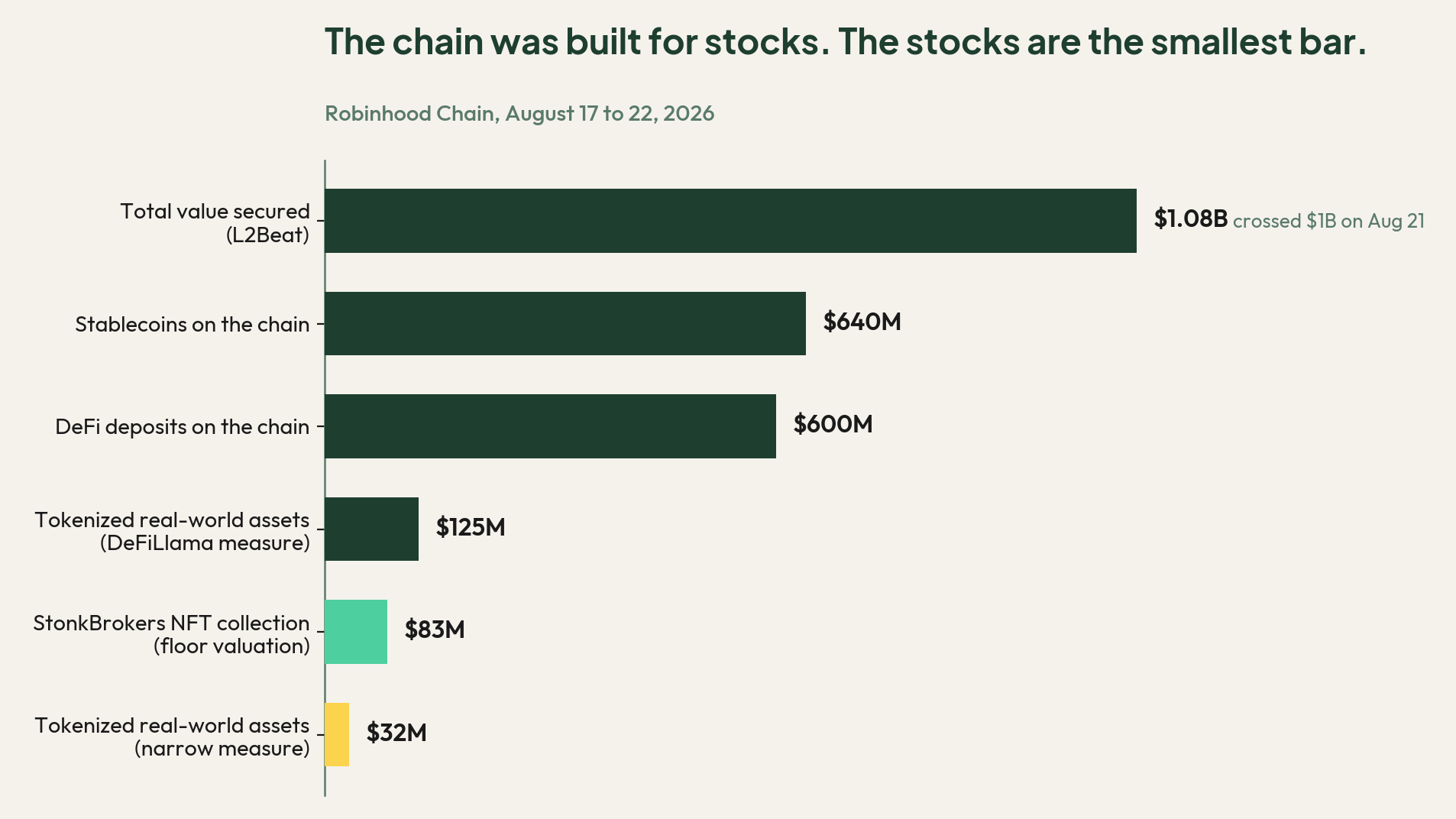
Robinhood Chain opened its public mainnet on July 1. On August 21, less than two months later, it crossed a billion dollars in total value secured, with L2Beat tracking the figure at $1.08 billion. Ten days before that it logged 11.6 million transactions in a single day, briefly putting it ahead of Base on user activity.
Needless today, things are cooking over at Robinhood so today, I thought I’d take you through some of the cool things that are being built.
Ultimately, Robinhood’s blockchain exists to put stocks onchain. Tokenized real-world assets sit at roughly $32 million by the narrow measure analysts have been using, which works out to somewhere between 5% and 6% of the chain’s DeFi deposits depending on which day you take the reading, down from nearly a third in early July. DeFiLlama’s broader definition puts the number closer to $125 million, and the two aren’t interchangeable.
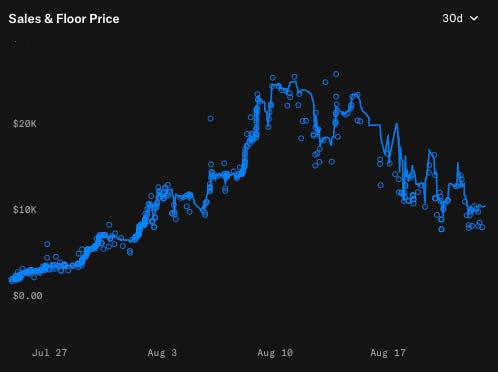
Meanwhile, 4,444 pixel-art stockbrokers that minted FOR FREE(!) in mid-July reached a floor of almost $25,000 on August 11, which put the collection’s floor valuation north of $100 million. To repeat…this was an NFT that was given away, for FREE.
The reason for the boom? People noticed the pixel art, but what they were bidding on is the wallet behind it, which arrived already holding a tokenized stock and can be switched on to collect a share of the protocol’s trading fees.
Honestly, it’s kinda strange to be writing about NFTs in 2026 because they spent four years as the punchline of crypto assets.
Monthly Ethereum NFT volume ran around $3.5 billion at the 2022 peak, bottomed near $480 million in 2024, and sits around $720 million in early 2026, so the recovery is real at roughly 50% off the bottom while the market is still about 79% below where it was.
What came back is built differently from what left, and Robinhood chain is where the difference is easiest to see.
NFTs as a Storage Unit
Anyone who has rented a storage unit understands the arrangement. The door is a numbered sheet of corrugated steel worth close to nothing. You’re paying for the space behind it and for the right to keep getting at it. Stop paying and the facility keeps the contents. Hand the lease to someone else and their rent clock starts at zero.
Nobody rents a unit for the door.
That’s roughly what’s happening to NFTs on Robinhood Chain, and it’s a different arrangement from the one that defined 2021. Back then the picture was the product.
A project minted a few thousand images, attached rarity traits, built a Discord, and hoped culture would hold a floor. Sometimes it did. More often, once trading slowed, there wasn’t much underneath, which is why the sector went so quiet for so long.
Quick vocabulary stop. The change runs on a standard called ERC-6551, usually described as a token-bound account.
In plain terms, it lets an NFT own a wallet of its own. That wallet can hold tokens, other NFTs, and a transaction history, and whoever holds the NFT controls what sits inside it. The old setup put the NFT inside your wallet. This one puts a wallet inside the NFT. None of that makes the NFT a legal company, a brokerage account, or a registered security, so treat the balance-sheet language here as a description of how the thing behaves rather than what it is under the law.
The picture becomes the door, and whatever’s stacked behind it is the reason anyone’s bidding.
Three Collections Worth Watching
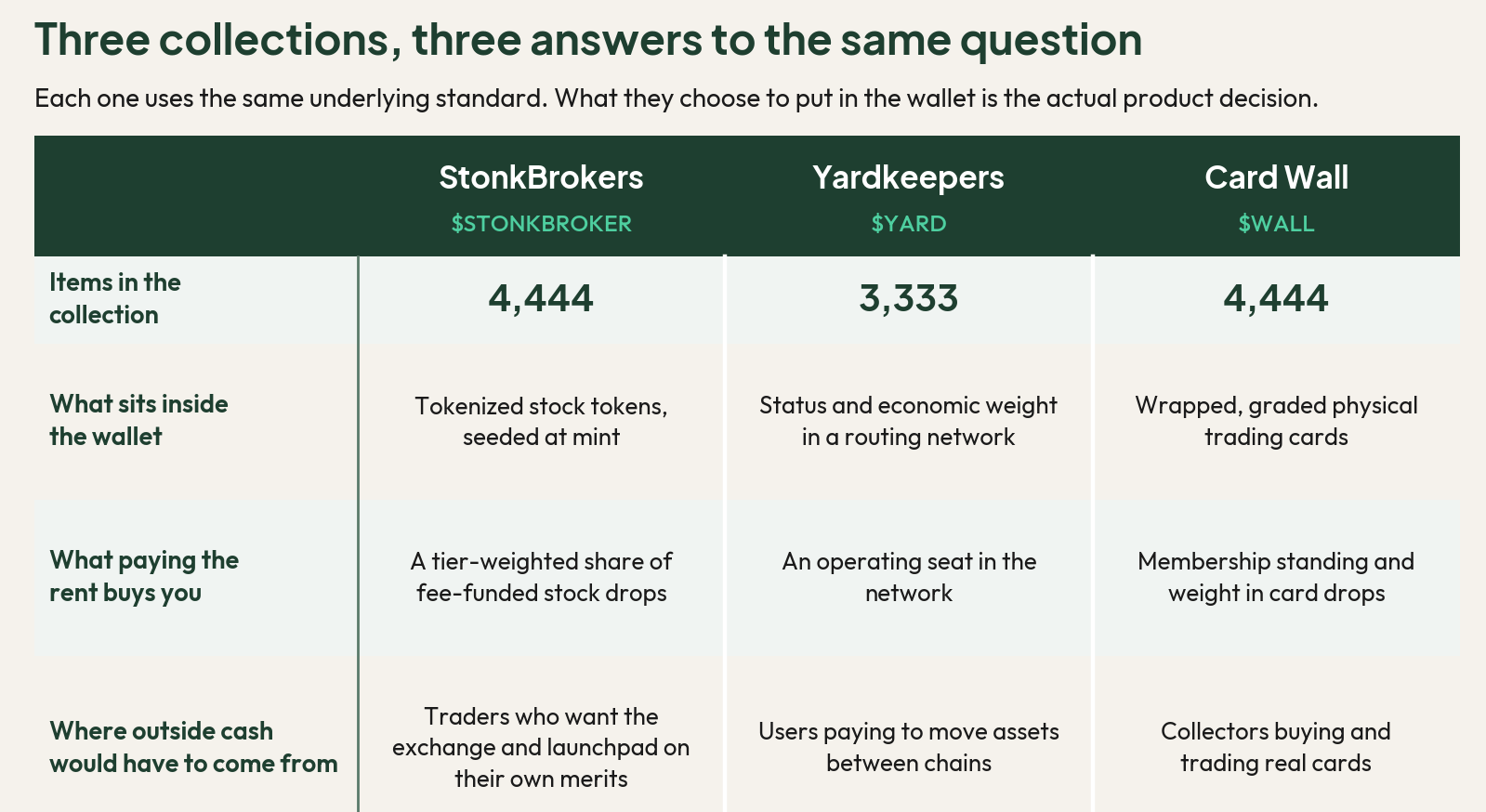
StonkBrokers is the most literal version. Each of the 4,444 brokers owns a wallet that was seeded at mint with a tokenized stock token. Pay a tiered activation fee in $STONKBROKER and the broker starts receiving fee-funded stock drops, weighted by tier, with half of every activation payment burned. Sell the broker and activation clears, so the next owner pays again.
Yardkeepers, from TickerYard, put something less tangible in the wallet. The 3,333 keepers are positioned as operating seats in a cross-chain routing network, with $YARD funding activation and status. TickerYard’s first shipped product moves Bitcoin exposure onto Robinhood Chain, and the project has said active keepers will share in that revenue.
Card Wall went the other direction, toward things you can hold in your hand. Its memberships control wallets that receive wrapped, graded physical trading cards, with the actual slabs sitting insured in a vault and redeemable. The project launched through an anti-snipe curve that graduated at the $1 million mark, raising 92.5 ETH in under an hour.
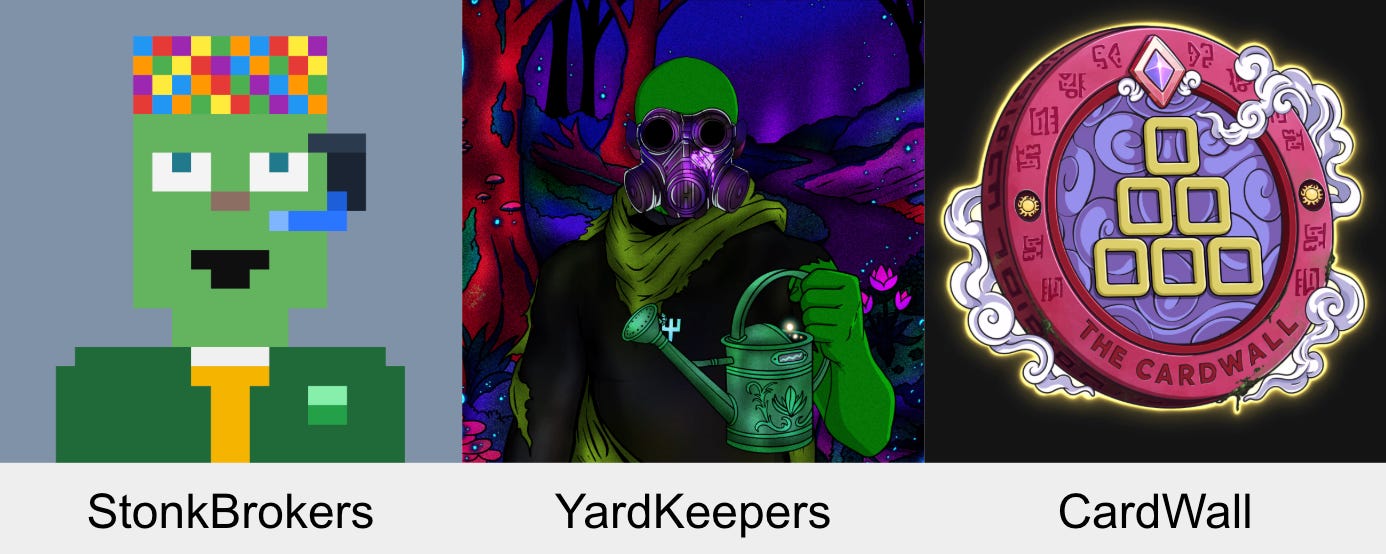
Same standard underneath, three different bets about what belongs inside.
How Holders Get Paid ($$$)
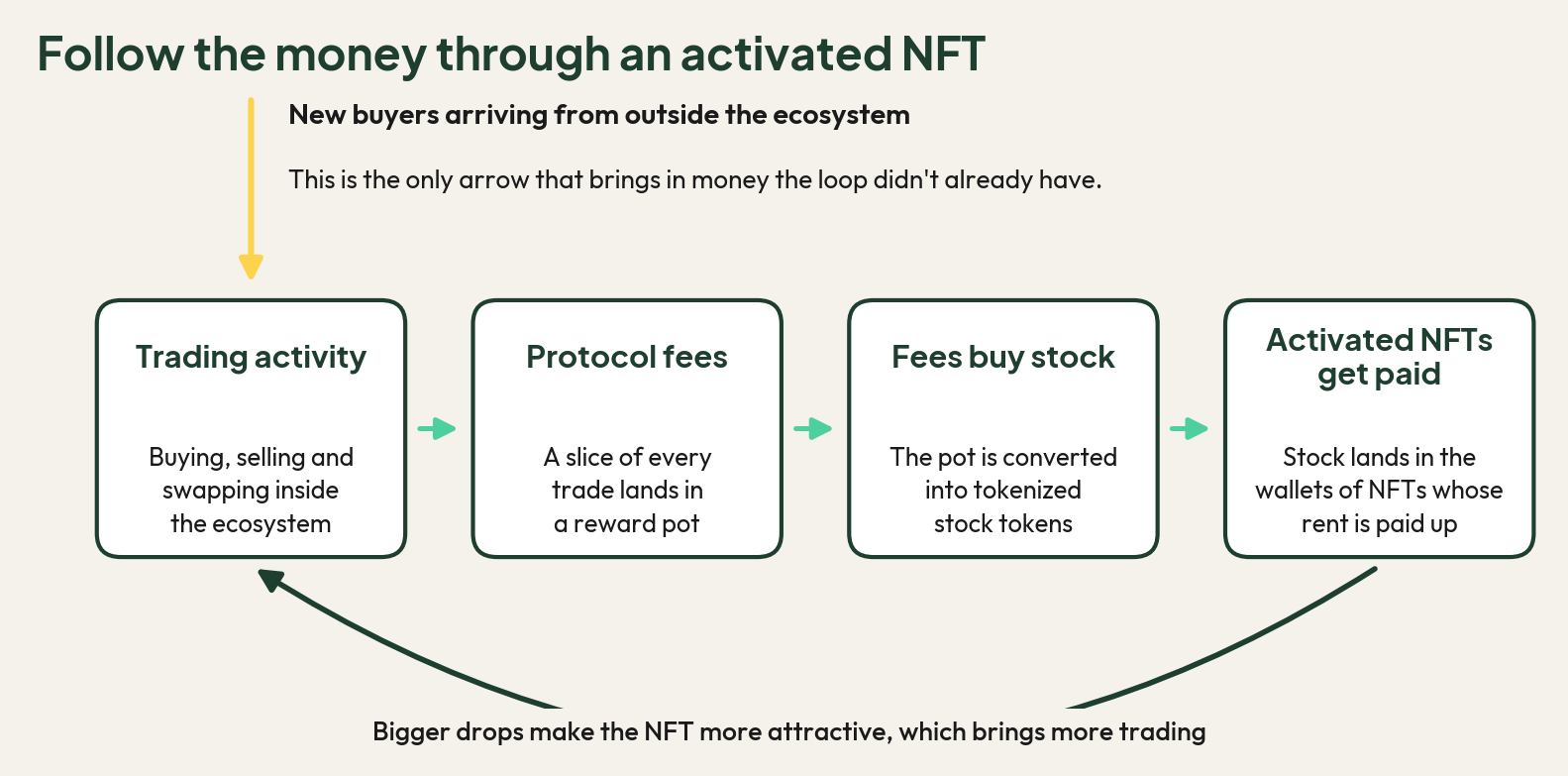
Trace the cash and the loop mostly closes on itself.
Traders buy and sell inside the ecosystem.
A slice of each trade lands in a reward pot.
The pot gets converted into stock tokens.
Those tokens go to activated NFTs by tier weight.
Bigger drops make activation look more attractive, which supports token demand, which supports the floor, which brings more trading.
Every one of those arrows moves money that was already inside the system. One arrow brings in money that wasn’t, and it’s labeled “new buyers.”
That doesn’t make the design a scam. Plenty of legitimate businesses run on internal circulation for a stretch. It does mean the payouts are a function of turnover, and turnover is a function of enthusiasm.
The Rent Waiting to Be Priced In
Activation is where this stops being an abstraction.
You’re paying - in a volatile token no less - for the right to receive drops, and that payment doesn’t travel with the NFT when you sell.
To know whether that’s a good trade you’d need one number: the realized daily payout per activated NFT. I’ve gone looking and I can’t find it published anywhere. Without it there’s no payback period on a five-figure entry plus a four-figure activation, and “yield” stays a word instead of a figure.
The most useful thing anyone in this ecosystem could ship right now is a public dashboard showing realized distributions per activated account, dated and verifiable by anyone who wants to check.
Read the Fine Print
Activation is denominated in the ecosystem token, so the cost of switching a unit on moves independently of what the unit produces. Between August 11 and late August, $STONKBROKER fell about 63% from its high while the NFT floor fell about 26%. 😬
Selling clears activation, which converts prior spending into a sunk cost. Thin liquidity makes a floor look sturdier than the price you’d get for hitting a bid. Bridges, token-bound accounts, oracles, custody providers, and smart contracts each add a failure point.
There’s a legal layer as well. Robinhood Stock Tokens are tokenized debt securities issued by Robinhood Assets (Jersey) Limited. They provide economic exposure to the underlying shares without granting any ownership rights in them, and they are not available to U.S. persons. The stock drops landing in these wallets are protocol-funded marketing rewards rather than corporate dividends. Terms like “revenue share,” “yield,” and “ownership” are carrying a lot of weight in project documentation, and they deserve a careful read before anyone treats them as contractual promises.
What You Should Takeaway
The design fixed something real. An NFT that custodies assets, receives distributions, and carries a role solves the problem that killed the last cycle, which was that the picture had to carry the entire economic argument by itself. That’s a better class of experiment than anything the 2021 wave produced, and it’s the reason this comeback deserves more attention than the floor prices are getting.
Whether these particular units hold their value depends on whether outside money shows up for a reason other than the units themselves. The facility collects rent either way, and the tenant only gets paid if somebody eventually wants what’s stacked behind the door.
If you’re in one of these collections, I’d like to know what your unit has paid you so far. Reply and tell me.
The door has a number on it.
The rent is the question.
Moving right along!…
In Case You Missed It

The SEC Just Made the Case for Letting You In Early To New Crypto Projects (August 19)
The SEC's Regulation Crypto Assets proposal runs past 400 pages, and its central move is to separate the investment contract from the token: the contract is temporary scaffolding on a building under construction, while the token is the permanent structure left standing. That distinction is what lets the Commission argue for earlier retail access, backed by a $5 million startup exemption, a $20 million Tier 1 cap on unaudited financials, a $75 million Tier 2 cap requiring audited statements, and a 30% ceiling on insider sales.
Better disclosure only helps investors who actually read it, and the 60-day comment period is the window for anyone who doesn't like the rules as drafted.
Market Winners 🏆
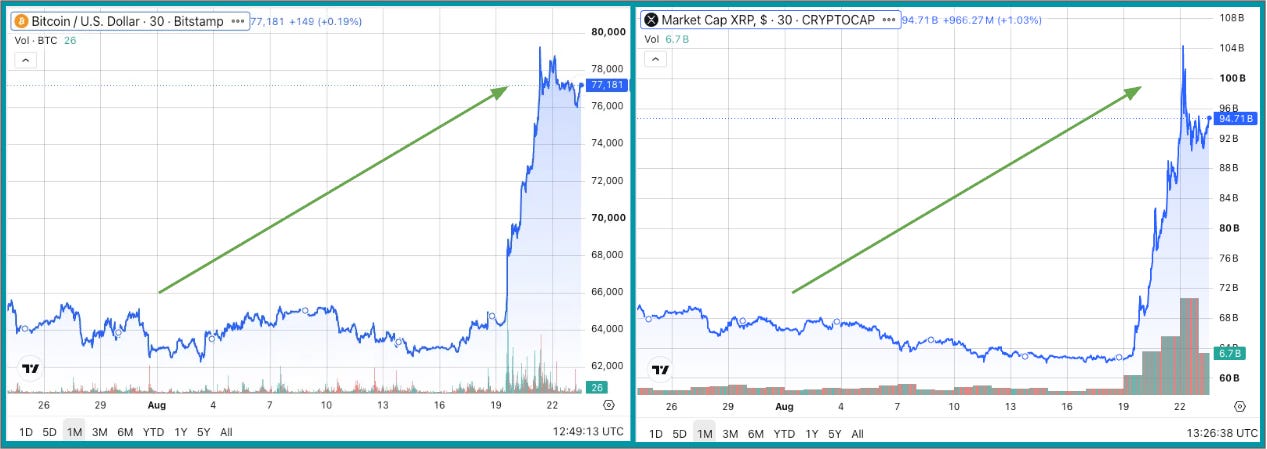
Bitcoin (BTC) and XRP. Bitcoin closed Friday near $76,944, up 22% on the week and its biggest gain in more than two years, while XRP ran roughly 50% to $1.50, a week after its first close under a dollar since November 2024. The move started Wednesday when Treasury yields fell on Bessent’s buyback surprise, then accelerated after Trump pressed Congress on the Clarity Act. Liquidity and legislation finally moved together, and what a sight to see.
Coinbase (COIN) and Circle (CRCL). Both gained roughly 10% Thursday after Trump met the CEOs of Coinbase, Robinhood, Ripple, Kraken, Gemini, and Chainlink Labs at the White House and called on Congress to pass the Clarity Act. Coinbase kept running Friday, reaching $180.54 by midday against $160.20 Thursday. These names trade as leveraged bets on Washington rather than on trading volume. Nothing in the underlying businesses changed this week; the odds of the SEC and CFTC turf war ending by statute did.
Home Depot (HD). Home Depot beat on both lines Tuesday, with revenue of $47.9 billion up 5.7% year over year, adjusted EPS of $4.92, and comparable sales up 1.7%. Shares rose about 1.7% premarket, pulling Lowe’s along. The number that matters is the comp: positive same-store sales in a week when July retail sales came in negative and the 30-year Treasury yield hit its highest since 2007 says the homeowner with equity is still spending. The K-shaped consumer showed up in the results.
Market Losers 📉
Walmart (WMT). Walmart fell about 9% Thursday, from $114.30 to $103.84, and roughly 11% for the week, its worst since 2022. The quarter beat: EPS of $0.81 against $0.74, revenue of $187.9 billion, full-year guidance raised. US comparable sales excluding fuel grew 2.6% against a 3.5% estimate, and that single line erased everything else. Walmart is priced as the defensive staple that takes share in a slowdown, so a comp miss breaks the thesis. TJX fell more than 7%, its worst week since 2021.
Klarna (KLAR). Klarna crashed 22% Tuesday and finished the week down more than 30%, its worst ever. Second-quarter results beat on both lines, but management cut full-year revenue guidance to $4.08 billion to $4.16 billion against a $4.42 billion consensus, blaming roughly $600 million of currency headwinds and a soft German consumer. The CFO and CMO both leave in early 2027. Delinquencies over 30 days improved by more than 20 basis points, which makes this a demand problem rather than a credit one.
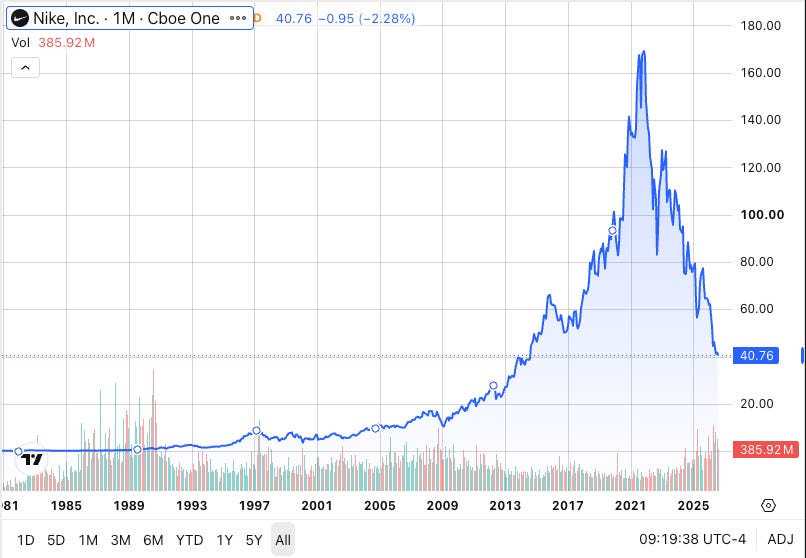
Nike (NKE). Nike closed at $39.09 Monday, its lowest since September 2014 and 78% below the November 2021 record of $177.51. The 4% drop came from On Holding’s revenue miss and the weight of JPMorgan’s August 4 downgrade. Greater China revenue has now fallen for eight straight quarters. A brand that loses a generation of consumers in Greater China doesn’t get them back with a product cycle. Nike now trades at its LOWEST level in 12 years…unreal that it’s gotten worse since I wrote about this very issue 4 months ago.
What to Watch Next Week 👀
Nvidia’s Q2 (Wednesday, August 26). Nvidia reports after Wednesday’s close, with consensus near $93 billion to $95 billion of revenue and roughly 96% year-over-year growth. Options are pricing an 8% to 12% move. Data center revenue already topped $75 billion last quarter, so the headline number is close to a formality. Listen to the Blackwell ramp commentary, because that’s what the AI leasing structures are underwriting.
Jackson Hole and Warsh’s Debut (August 27 to 29). Warsh delivers his first Jackson Hole keynote Friday, and this year’s theme is financial innovation and its implications for payments and policy. He’s said close to nothing since taking office in May, so markets are still assembling the dictionary. With the August jobs report and CPI still ahead of the September 16 meeting, he can stay data-dependent and commit to nothing.
The Clarity Act Window. The Senate returns from recess with the Clarity Act roughly nine votes short of the 60 it needed in July, and the White House now leaning on it directly. Crypto priced passage this week; a second failed cloture vote takes that back fast. Watch the vote count rather than the rhetoric, because the bill still needs nine senators who said no in July.
One More Thing: $40 Trillion Arrived 2 Years Early
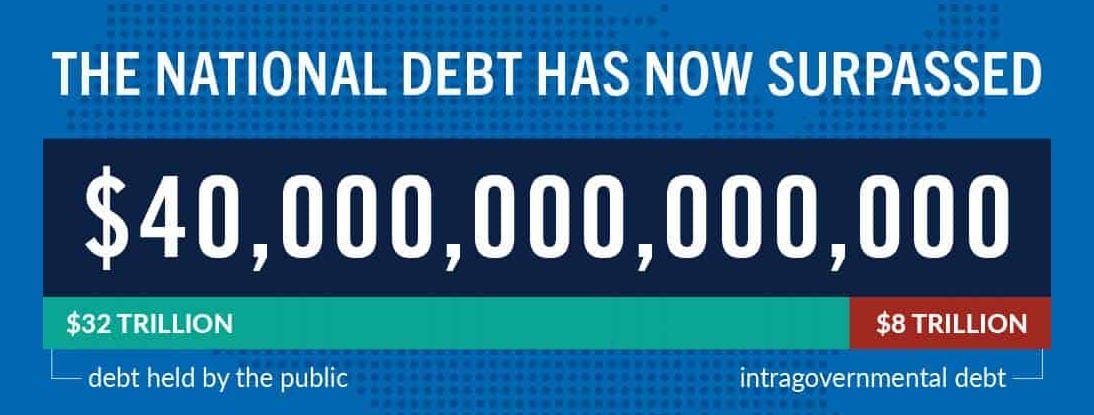
Gross federal debt crossed $40 trillion on Tuesday, August 18, roughly two years ahead of the Congressional Budget Office’s fiscal 2028 projection, with the last trillion taking five months. A $2 trillion annual deficit has to be funded in the same long-end market where the 30-year just hit its highest yield since before the financial crisis and the Treasury’s doubled buybacks bought one day of relief. The Committee for a Responsible Federal Budget’s 7% scenario points at $50 trillion by 2030, and everything priced off the long end, housing, private credit, and the terminal value of every growth equity, sits on that supply schedule. So yeah…there’s that.
Matthew Snider is the founder of Block3 Strategy Group, author of “Warren Buffett in a Web3 World,” and publisher of the BitFinance newsletter. He holds a Series 65 and MBA, and has been an active participant in digital asset markets since 2015. This article is for educational purposes only and should not be considered financial advice. Always consult with a qualified professional before making investment decisions.
Sources
CryptoBriefing, “Robinhood Chain crosses $1B in total value locked,
“Robinhood Chain TVL surges 45% in August as tokenized RWAs lose ground”
The Coin Republic, “Chain TVL Hits $536M as Tokenized Stocks Lag,”
“The Card Wall launches on Robinhood Chain and raises 92.5 ETH,” August 2026
CNBC: Bitcoin surges 22% for the week as investor optimism floods back
XRP leads broad altcoin rally as bitcoin’s biggest weekly gain in two years
Yahoo Finance: Bitcoin and ethereum prices today, Friday, August 21, 2026
24/7 Wall St.: Home Depot Just Delivered a Big Vote of Confidence in Its Business
Walmart Beat Earnings and Raised Guidance. So Why Did the Stock Crash?
CNBC: Treasury doubles debt buybacks as Bessent moves to steady bond market
Klarna stock plunges 22% on trimmed guidance as German retail sales slow
Nike Hits 12-Year Low: JPMorgan Says FY2028 Brings Stabilization, Not Recovery
Fed minutes July 2026: Officials saw need for rate hike if inflation doesn’t cool
Matterfact: It All Comes Down to Jackson Hole as the Fed Splits Nine to Three
History Says This Is What Will Happen to Nvidia Stock After Aug. 26