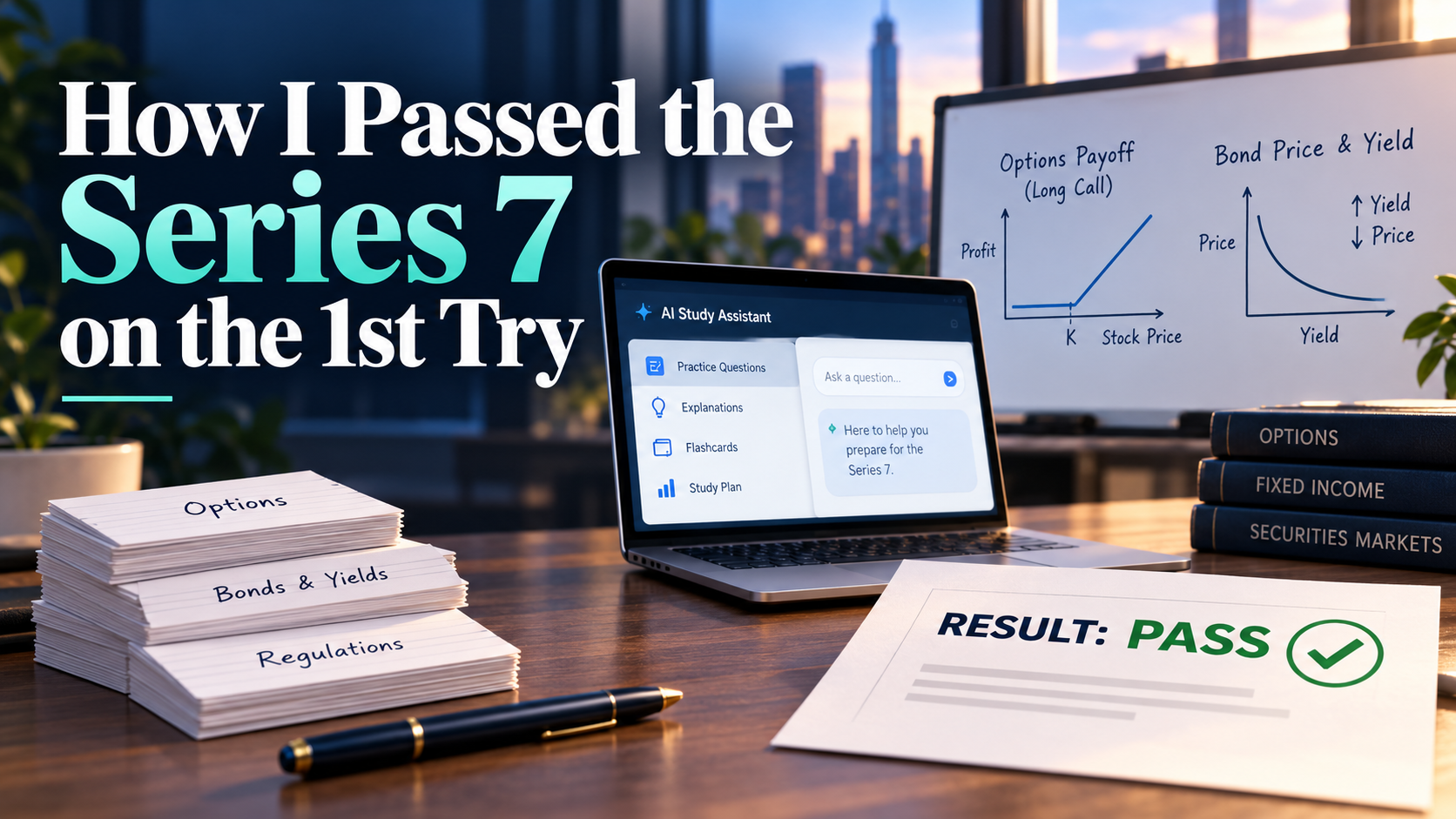
How I Passed the Series 7 on the 1st Try (with AI)
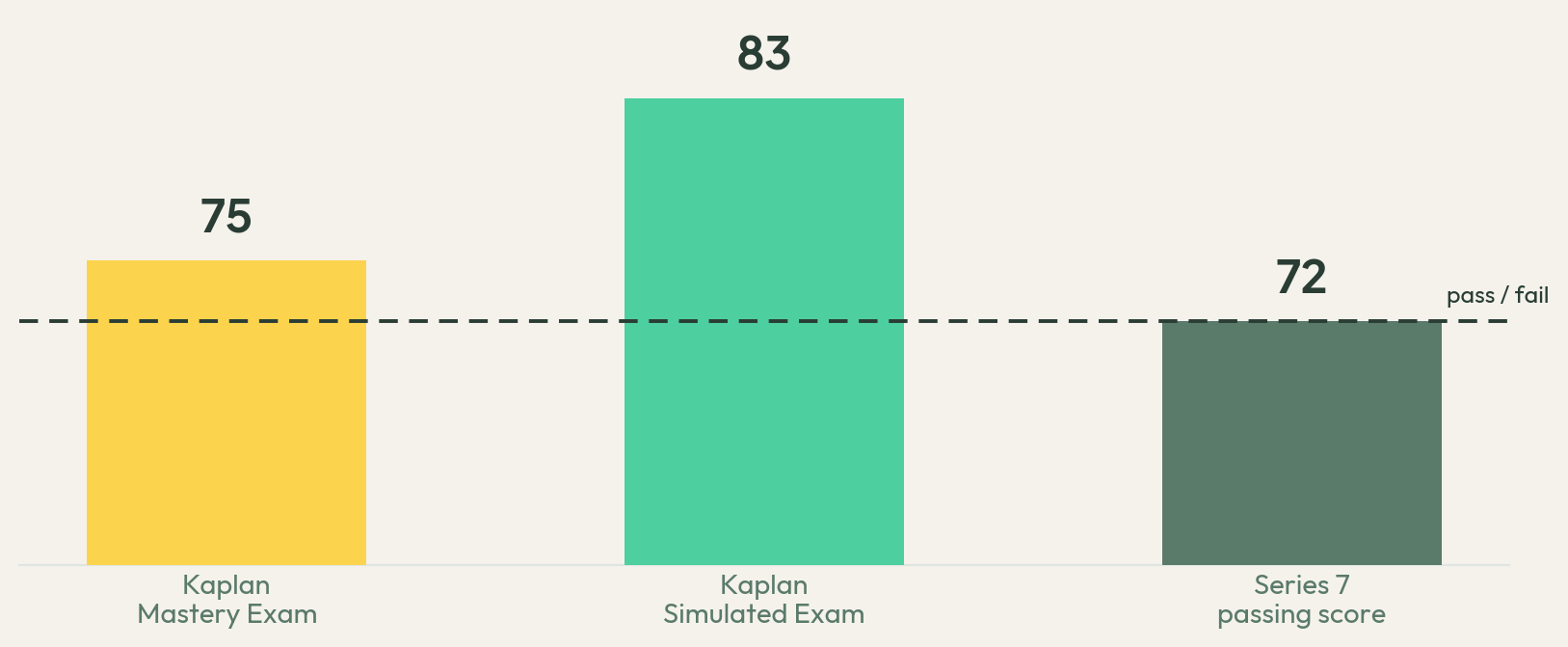
Two days before I sat for the Series 7 I scored a 75 on the Kaplan Mastery Exam; the passing score on the real exam is 72.
3 points of margin on a practice test everyone tells you runs harder than the exam was good…but still a bit unsettling in terms of preparation.
Two and a half hours into the real thing, sitting in a testing center with a dry-erase board and a headache, I honestly put my odds at a coin flip.
With about 30 seconds remaining out of a 3.5 hour test I hit the final submit button and closed my eyes hoping for the best.
Then I saw it:
RESULT: PASS
I’m writing this down because the search results for “how to pass the Series 7” are mostly ads, and because most of the method transfers. If you’re sitting for the SIE, the 63, or the 65 instead, keep reading.
The 7 is the one that hurts, but the system is the same.
One thing I won’t do is repeat exam content. FINRA candidates sign an attestation and I’m not walking up to that line. Everything below is method, plus material drawn from commercial prep sources and my own notes.
So let’s dive in!
About that Pass Rate
Every prep site quotes a Series 7 pass rate somewhere between 65 and 72%. It’s worth knowing where the number comes from, because it isn’t a live statistic.
FINRA doesn’t publish pass rates on any regular schedule. The last official figure surfaced in a 2019 FINRA conference presentation covering roughly 10,500 candidates who sat between October 2018 and March 2019, and it came in at 71% for people who had already cleared the SIE. Everything published since is a vendor estimate built on top of that one data point.
Treat it as a rough shape; call it three in ten walking out disappointed.
The number that isn’t an estimate is the passing score. 72% means 90 correct out of 125 scored questions, with 5 unscored pretest items mixed in that you can’t identify while you’re sitting there. Three hours and forty-five minutes on the clock.
Why the License was Worth 200+ Hours
I’ve written before about treating professional licenses as an AI hedge.
The short version: the drafting, summarizing, and structured-analysis layer of financial services is getting commoditized in front of us, and the regulatory perimeter is one of the few moats that’s statutory rather than technical. Software can’t sit for your Series 7 and it can’t file your U4.
There’s a second payoff. Since the SEC expanded the definition in 2020, holding a Series 7, 65, or 82 in good standing qualifies you as an accredited investor on credential alone, with no income or net worth test. That’s the cheapest door into Reg D private placements most people will ever find.
The exam pays twice. That helped on the nights when it stopped being fun.
What 200 hours looked like
I started in early August, and compressed roughly 200 hours into about a month.
Read the Kaplan textbook cover to cover. Twice.
Worked 1,500 QBank questions out of roughly 3,600 available.
Hand-wrote about 400 flashcards, one pass per chapter, on the second read.
Used Achievable as a second source for different phrasing on the same rules.
Sat the scheduled practice exams: 83 on the simulated, 75 on the Mastery.
I finished less than half the question bank. Volume wasn’t the variable that mattered because it turns out focusing more on what you missed is where you can pick up points.
Kaplan is the strongest of the providers I touched for this specific exam, and it isn’t close. The 7 covers an enormous surface area and Kaplan’s coverage is the most complete. Achievable is a useful second voice. Neither one gets you there alone.
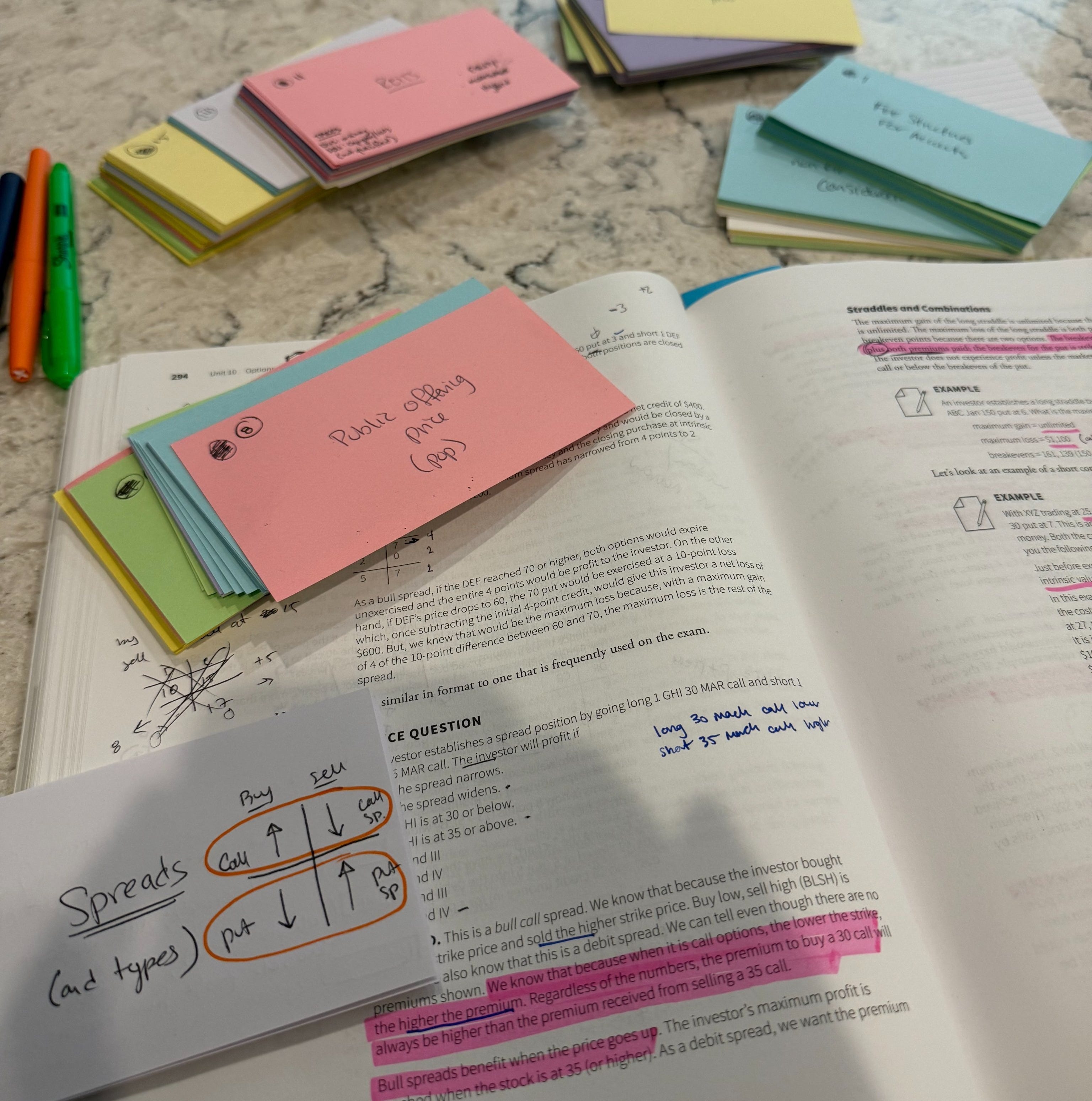
Quick note: I promise options spreads aren’t that bad once you put some systems in place. You got this!
The Loop that did the Actual Work
Here’s the whole method. Trust me…it’s boring, but not without good reason.
Rule #1: Miss a question? Don’t move on. Instead, batch the misses by topic until you have eight or ten, then paste the batch into Claude or ChatGPT with one instruction: explain this to me the way the book didn’t.
That’s the first half. The second half is where the leverage is.
Once the concept clicks, ask for drills. “I missed ten questions on margin account calculations. Write me fifty more, mixed difficulty, one at a time.” Answer them the next morning, cold, no notes.
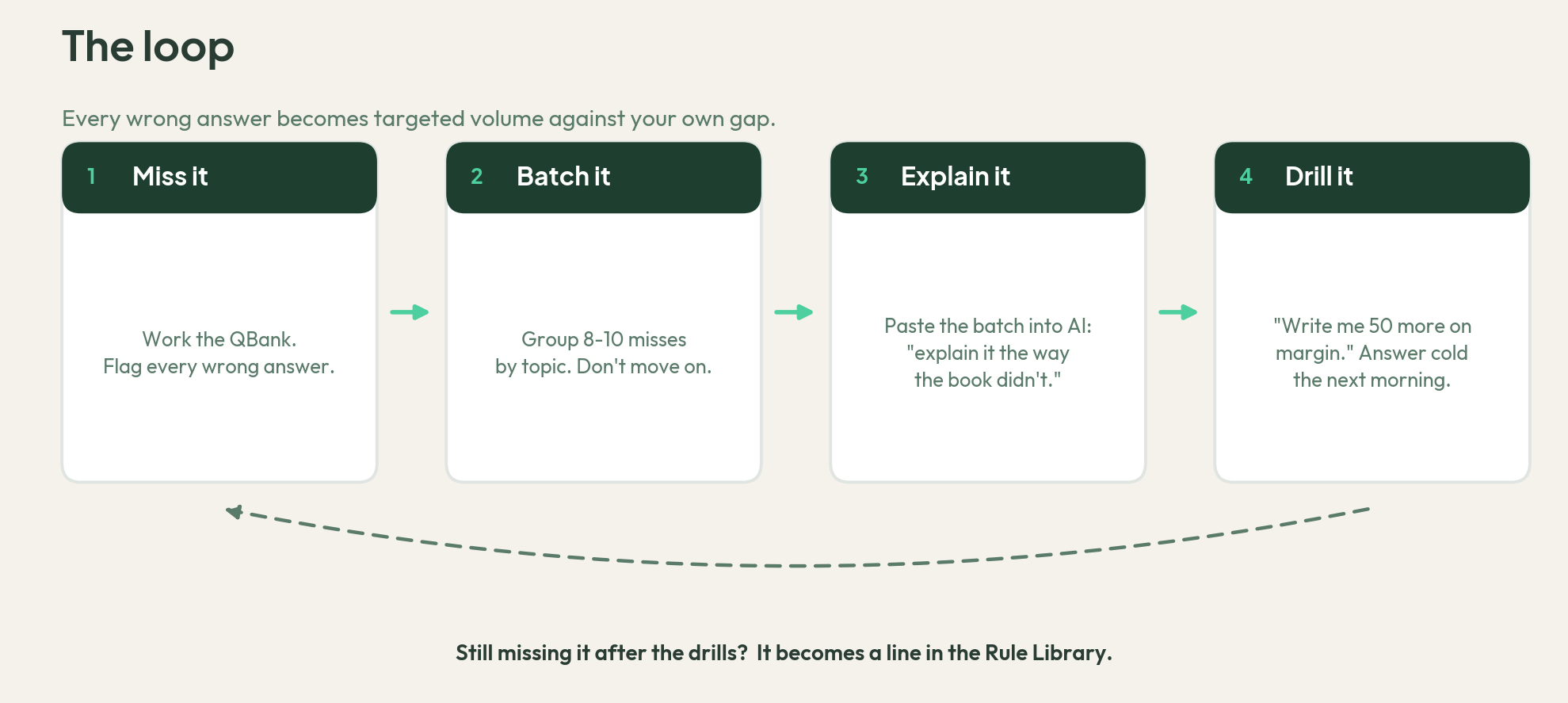
Four steps, repeated until the misses stop.
Reading an explanation is passive. Getting hit with fifty fresh questions on your one weak spot is not. A model can generate targeted volume against your specific gap faster than you can find it in any question bank, because no question bank knows what you personally keep missing.
One caution because this test requires accuracy to an Nth degree… I didn’t hit meaningful hallucination on Series 7 material, which surprised me somewhat.
The subtler problem is that the exam sometimes tests a prep provider’s convention rather than pure market practice. Equity options stop trading at 4:00 PM ET on expiration Friday, and Kaplan tests the OCC exercise deadline at 5:30 PM that same day. Both are defensible. Only one is the answer on test day.
When the model and the textbook disagree on a convention, the textbook wins until you’re licensed.
The Rule Library Got Smaller and Smaller
Out of that loop came a document I called the Bulletproof Rule Library. Every rule, formula, and trap I’d missed more than once, written as a single line I could read in four seconds.
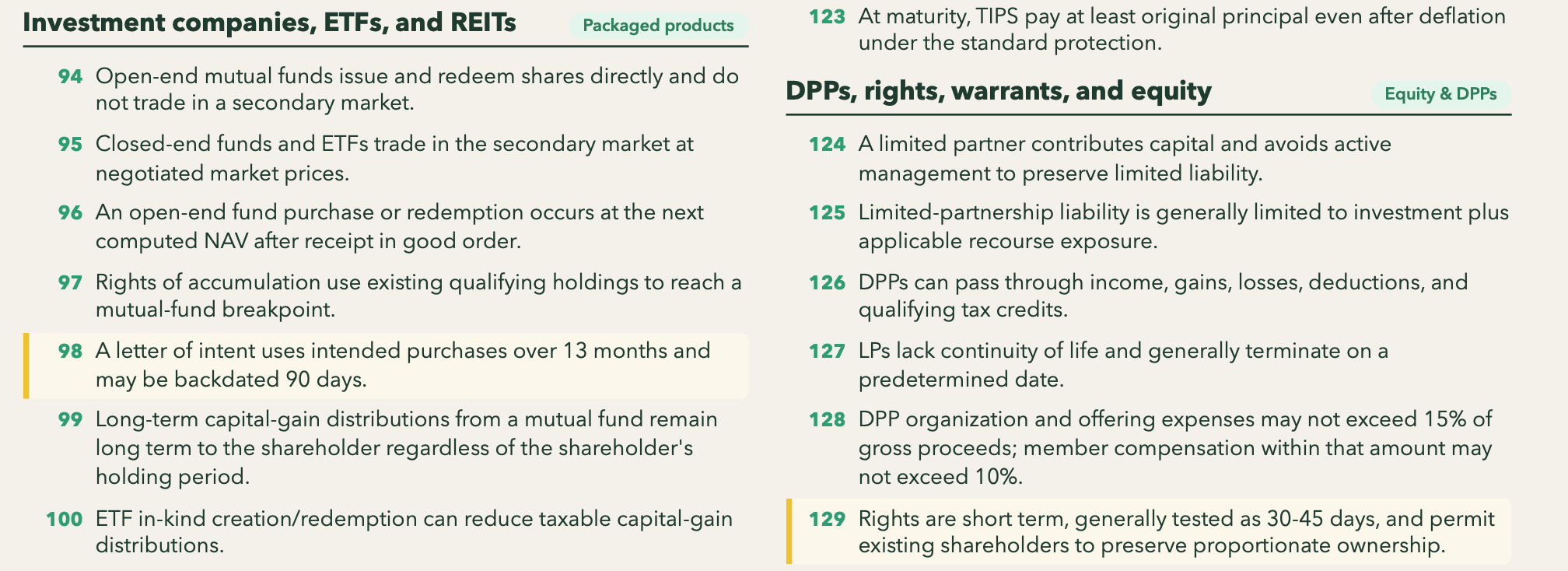
It started long. By the end it was 166 lines, after I stripped out 27 rules I’d marked green because I no longer got them wrong.
The file shrinking was the progress bar.
My version is in the downloads (linked below), but don’t study mine. My 166 are the intersection of my particular gaps and Kaplan’s particular phrasing. Yours will be a different 166.
Read mine for the shape of the thing, then build your tailored to your study needs.
Immerse Yourself with Every Hour You Have
Two days out, I converted the rule library into a format an AI assistant could read back to me out loud, then drove around listening to it.
Commute, errands, sitting in the car outside a coffee shop.
Same principle at night. I walk to hit 10,000 steps, so the flashcards came along. Four hundred cards is a lot of laps, and a full deck runs about two miles.
None of this replaces sitting down with the book. It stacks on top of it.
If You’re a Visual Person Like Me, Build Dashboards!
Several of the highest-frequency Series 7 concepts are spatial problems wearing a memorization costume. So I built things.
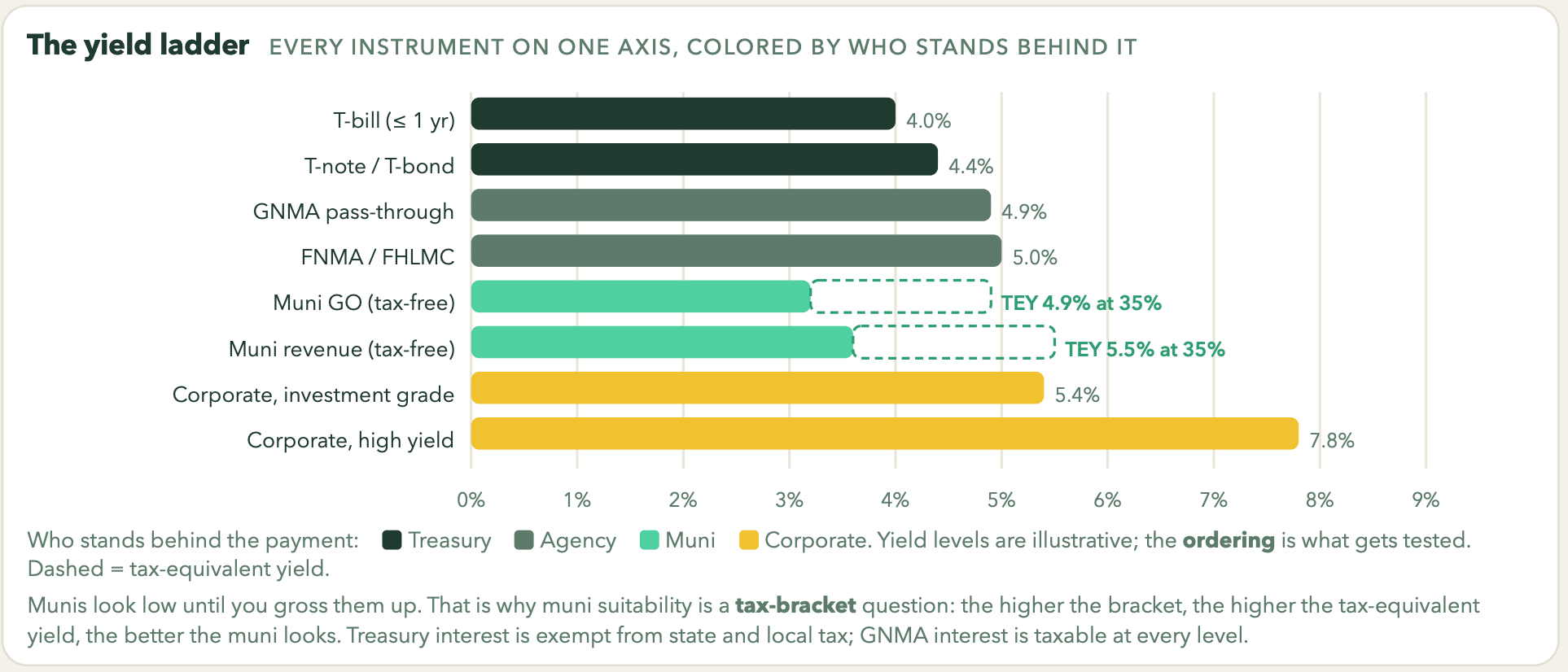
The Yield Ladder. Every debt instrument on the exam plotted on one yield axis, colored by who stands behind the payment. Fifteen separate memorization problems collapse into a single picture. A toggle for tax-equivalent yield sends municipals climbing into corporate territory, which is the whole reason muni suitability is a tax-bracket question.
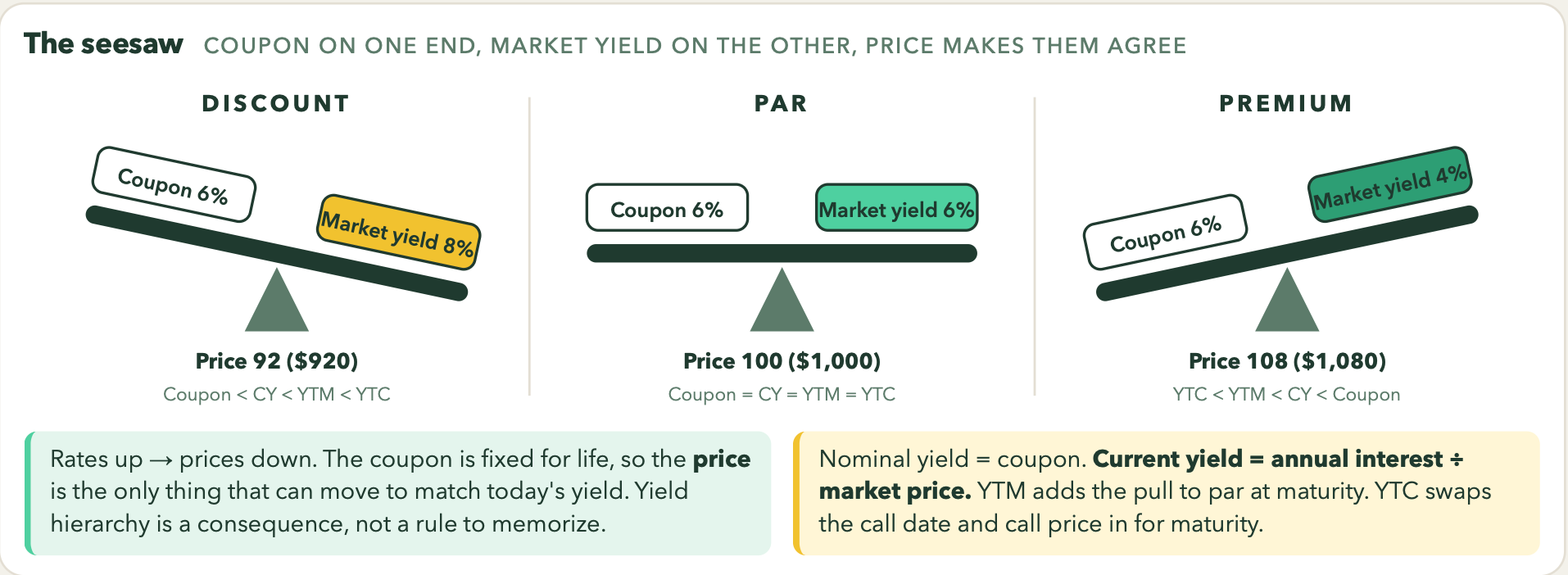
The seesaw. Coupon on one end, market yield on the other, price as whatever makes the two agree. Drag the yield and watch a 6% bond change identity from discount to par to premium. The yield hierarchy prints itself at the bottom as a consequence rather than a rule.
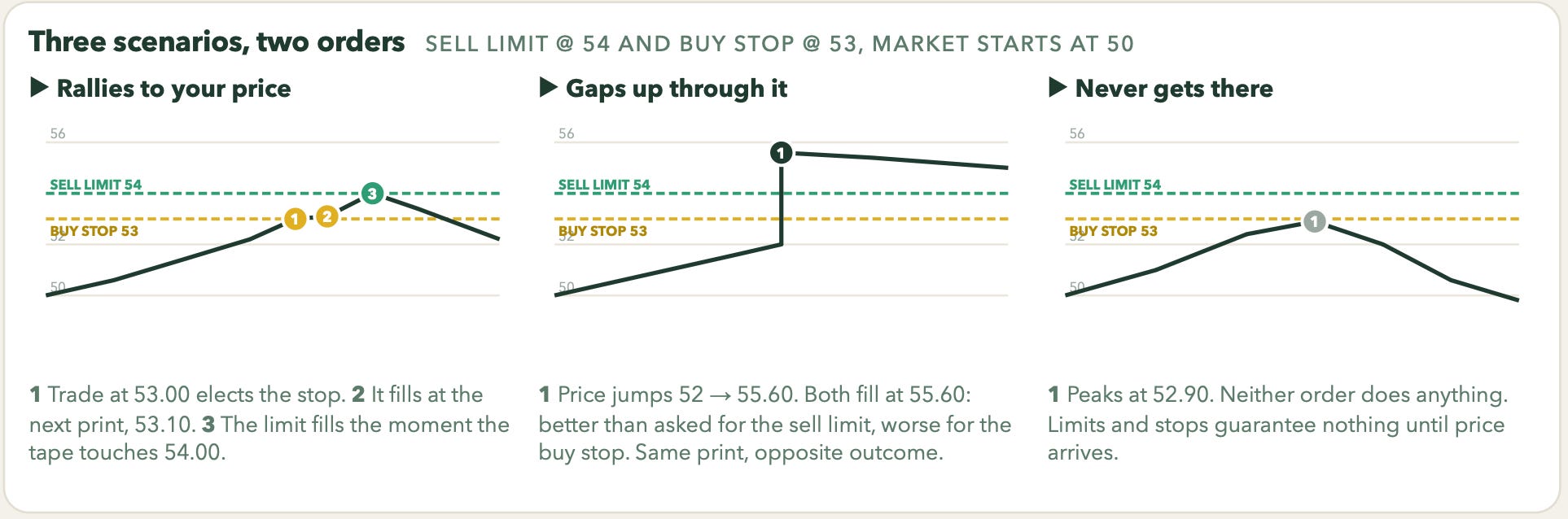
The order chart. SLoBS above the market, BLiSS below it, with three scenarios: the stock rallies to your price, gaps up through it, or never gets there. That’s the difference between guaranteeing price and guaranteeing execution, and no static diagram teaches it.
The options payoff scrubber. A slider walks the underlying across the range while P&L, breakeven, and outcome update live. Watching a position cross from loss into profit as continuous motion sticks better than a shape on a page.
I built all four while I was still struggling with the concepts, not after I’d mastered them. Building the thing was the studying. If you’re a builder, that’s your unfair advantage, and it beats another hour of passive review.
The Best Free Resource on the Internet
I have no connection to him and he doesn’t know I exist but man, Dean is the GOAT of helping people pass FINRA exams. I used him for the 65, the SIE and unconditioally during the 7. His calm demeanor and ability to explain complex concepts simply is a masterpiece for people struggling to understand these topics.
The night before my exam I came across this video (while simultaneously drafting TWO NFL fantasty football leagues I might add) was truly a gamechanger for reviewing topics before game day.

His final review runs about 90 minutes and it’s built to be watched twice, the day before and the day of. It’s the highest-value free thing I found, and the fact that a stranger made it and gave it away is a large part of why I’m writing this post.
Test Day
Physical center. I arrived an hour early and walked laps around the campus three times with the final review in my ears rather than sitting in the waiting room getting nervous.
They handed me laminated sheets and a dry-erase marker. First move after the tutorial screen was dumping formulas onto them from memory, before the clock could eat any of it. (Basically just my options matrix and SLoBS / BLiSS charts)
Then three hours and forty-five minutes. I took one break about 2.5 hours in.
It’s a slog, and anyone who tells you otherwise is remembering it wrong. I was answering questions until the last ten seconds.
Around the two and a half hour mark I was convinced it was a coin flip. That feeling isn’t diagnostic. The exam is calibrated to feel that way, and I’d tell anyone sitting in that chair to keep grinding rather than reading it as a signal.
The tactical stuff that helped: bank the easy points first, mark computational questions for a controlled second pass, write the formula down before touching the numbers, and don’t change an answer unless you can name the specific rule that disproves your first choice.
If you’re taking the SIE or the 65 instead…
All of it transfers. The loop, the shrinking rule library, the audio review, drills generated against your own misses. Those exams are smaller, which means the same system gets you there faster.
They’re also the ones you can take without sponsorship. The Series 7 and Series 3 need an affiliated firm willing to register you, which is a real barrier. Nothing stops you from studying first and showing up prepared.
What I Can Give You to Help! 4 Downloads👇
Four files, free, no email required.
Bulletproof Series 7 Rule Library. 166 rapid-review locks, the file I used.
Bonds and yields one-pager. Yield hierarchy, discount versus par at issuance, accrued interest conventions.
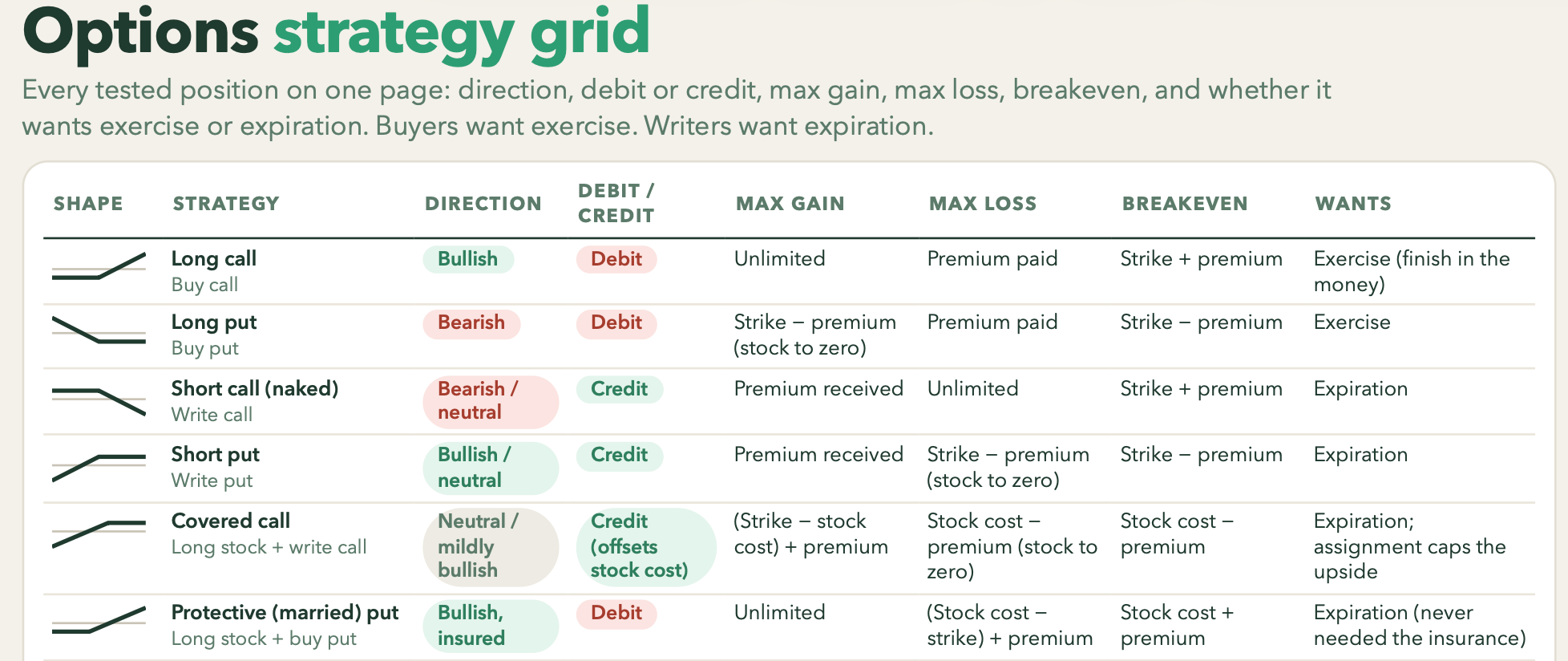
Options strategy grid. Direction, exercise or expiration, debit or credit, max gain, max loss, breakeven.
Order types one-pager. SLoBS and BLiSS, what each order guarantees, dividend reduction.
Take what’s useful. If it helps you pass, tell someone else what worked.
Two hundred hours is a lot of hours. It’s also about six weeks, and the license doesn’t expire the way most of what we learn does.
Stay curious and keep learning!
Happy Labor Day!
Matthew Snider is the founder of Block3 Strategy Group, author of “Warren Buffett in a Web3 World,” and publisher of the BitFinance newsletter. He holds a Series 65 and MBA, and has been an active participant in digital asset markets since 2015. This article is for educational purposes only and should not be considered financial advice. Always consult with a qualified professional before making investment decisions.