What Ripple’s Bank Charter Means for XRP Holders
Since January, the supply of Ripple’s dollar stablecoin, RLUSD, has grown 86%. Over the same stretch, XRP has fallen 37%.
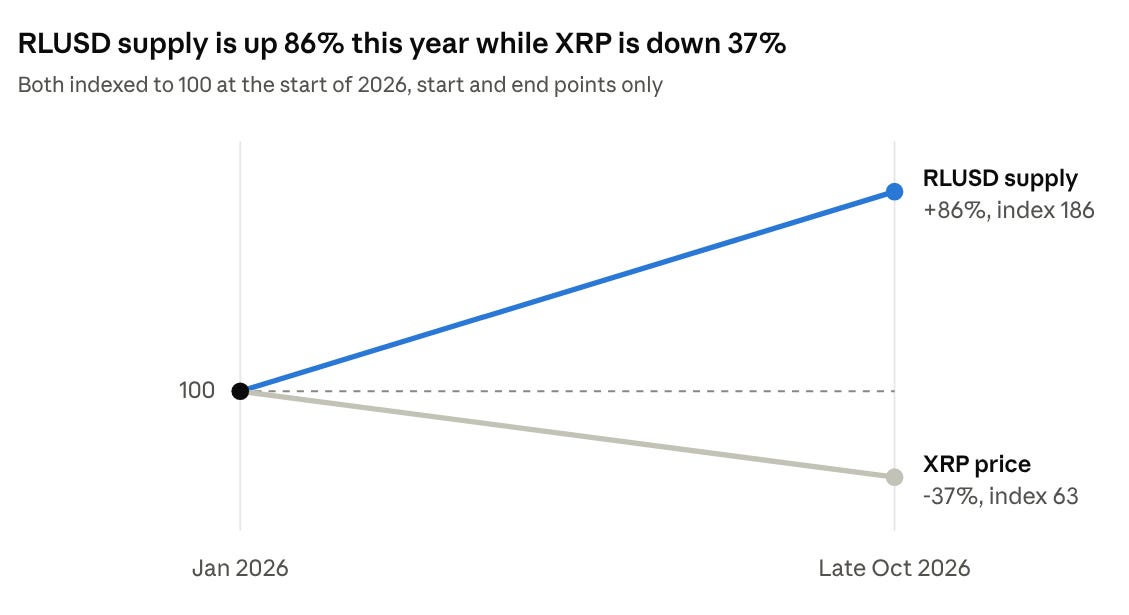
BeInCrypto, Oct 27, 2026
What to notice: the two lines start at the same point and end on opposite sides of it. This chart shows only where each one started and ended, so it hides the swings in between, and XRP’s path in particular was far bumpier than a straight line suggests.
Those are two products from the same company moving in opposite directions, and this week the gap got harder to ignore.
On Monday, the Office of the Comptroller of the Currency gave Ripple final approval for a national trust bank. On Tuesday, Robinhood announced it would put RLUSD in front of its 28.6 million funded customers.
XRP traded around $1.30 the morning after the charter news, slightly lower on the day. If you hold XRP, the market’s shrug raises a fair question: Ripple clearly had a great week, so what does any of it do for you?
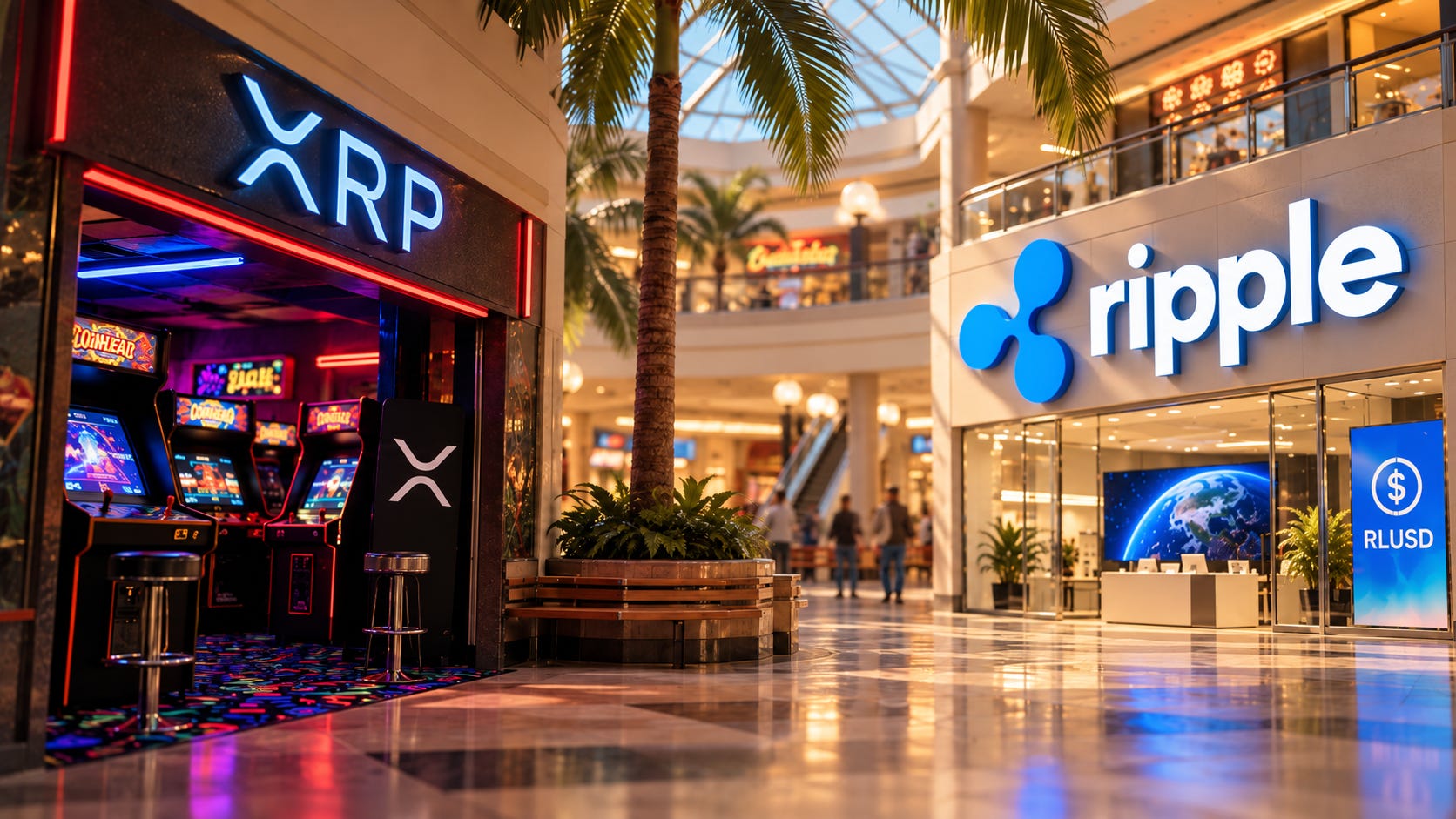
The Mall and the Arcade
As a kid, malls and arcades were the best spots to hang out with friends, grab a Wetzel Pretzel and shoot some zombies. The analogy here is fairly applicable…
Picture a developer who opened a small arcade years ago and has since built a full shopping mall around it. The arcade still runs on its own tokens. The new stores all take dollars.
That’s roughly where Ripple sits today and you can think of XRP as the arcade token.
Over the past two years, Ripple has added the anchor stores:
a prime brokerage in Ripple Prime,
treasury software in Ripple Treasury,
a dollar stablecoin in RLUSD, and now
a federally supervised bank to hold that dollar’s reserves.
This week it signed its biggest tenant yet.
A busier mall is good for the developer. Whether it’s good for the arcade depends on the floor plan, meaning how much of the new foot traffic walks past the arcade’s door.
Keep that picture in mind, because it’s the lens for everything below.
What Ripple Got This Week
The OCC’s final sign-off on October 26 completes a review that began with conditional approval last December. Ripple National Trust Bank has three jobs:
holding the segregated reserves behind RLUSD,
acting as trustee over those reserves for the people who hold the token, and
offering digital asset custody to institutions.
It’s a trust bank, so it can’t take deposits or make loans, and nothing held there carries FDIC insurance.
RLUSD will still be issued by Ripple’s New York-regulated trust company, with the new bank adding a federal supervisor on top. No opening date has been announced.
The Robinhood deal is the distribution half of the story.
RLUSD is live now on Robinhood Chain and Bitstamp by Robinhood, and it’s slated for the main Robinhood app later this year. Robinhood will also run its own global treasury on Ripple Treasury and deepen its financing relationship with Ripple Prime.
The timing isn’t an accident.
The GENIUS Act, the federal stablecoin law passed last summer, takes effect no later than January 18, 2027, and it requires issuers to keep reserves segregated and fully backed. Ripple will walk into that deadline with its reserves already under a federal charter, putting it in a small club alongside Circle, BitGo, and Fidelity Digital Assets.
How This Helps XRP
Robinhood is opening a door onto the XRP Ledger. The most concrete line in Tuesday’s announcement is that Robinhood will use RLUSD on the XRP Ledger for institutional settlement across Bitstamp. Every settlement there is a transaction on the ledger, paid for with a sliver of XRP that gets burned. The burn is tiny, but each RLUSD balance on the ledger also deepens the pool of dollars that XRP trades against on the ledger’s built-in exchange, and liquidity tends to attract more liquidity.
A sturdier Ripple is a better steward of XRP. Ripple still controls a large share of XRP’s total supply, much of it locked in escrow. My hypothesis is that a Ripple with diversified, federally supervised revenue has less reason to lean on XRP sales to fund itself, which would ease one long-running source of supply pressure. That’s a judgment on my part, since Ripple hasn’t announced any change to how it manages its holdings.
Custody could become an institutional on-ramp. The bank is approved to provide fiduciary custody of digital assets to enterprises, and law firm Davis Wright Tremaine notes that banks of this kind may, in some cases, serve as qualified custodians. I spend a lot of my week with registered investment advisers, and qualified custody is usually the first box they need checked before an asset can go near a client portfolio. Ripple hasn’t said whether XRP will be on the custody menu, but if it is, advisors get a federally supervised place to hold it.
The ecosystem is already building on RLUSD. As I covered in the Evernorth piece earlier this month, the XRP treasury company plans to use RLUSD as an on-ramp into XRP Ledger DeFi. A regulated, Robinhood-distributed dollar makes that on-ramp easier to sell to institutions.
The Case That This Doesn’t Help XRP…
XRP has no role in the charter. The trust bank’s mandate covers dollar reserves and custody, and nothing in it requires a client to hold or touch XRP. The charter strengthens Ripple’s dollar business, and XRP benefits only where that business happens to run on the ledger.
Much of the foot traffic goes to another wing. Most RLUSD lives on two blockchains, the XRP Ledger and Ethereum, and the split between them keeps moving. In July, 56% of RLUSD sat on the XRP Ledger. By early September, Ethereum held 57%, a lead of roughly $350 million, as most new minting went there. RLUSD activity on Ethereum burns no XRP and adds no liquidity to XRP’s markets.
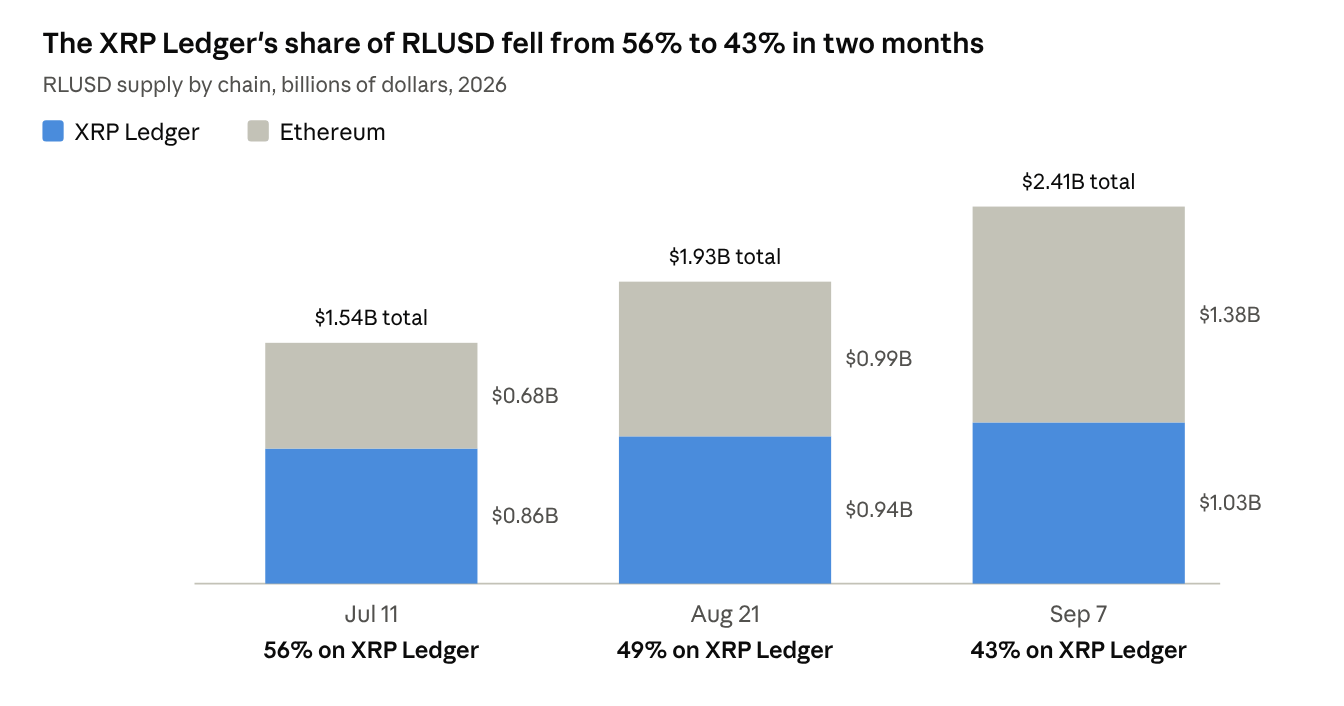
TheStreet (DefiLlama data), Jul 11
What to notice: RLUSD on the XRP Ledger kept growing in dollar terms, from about $0.86 billion to $1.03 billion, yet its share of the total fell because Ethereum grew faster. The three snapshots come from different trackers, so treat the trend as directional rather than precise.
The bridge is being rebuilt in dollars. XRP’s original job in Ripple’s payments was to act as a bridge: convert dollars into XRP, send it across the world in seconds, and convert out into pesos on the other side, so banks didn’t need money pre-parked in every country. A regulated stablecoin can do the same job with no price swings in the middle, and many Ripple products already run on RLUSD or conventional fiat rails. My hypothesis is that as RLUSD grows, XRP’s role inside Ripple’s own payments business narrows, even if its role on the ledger grows.
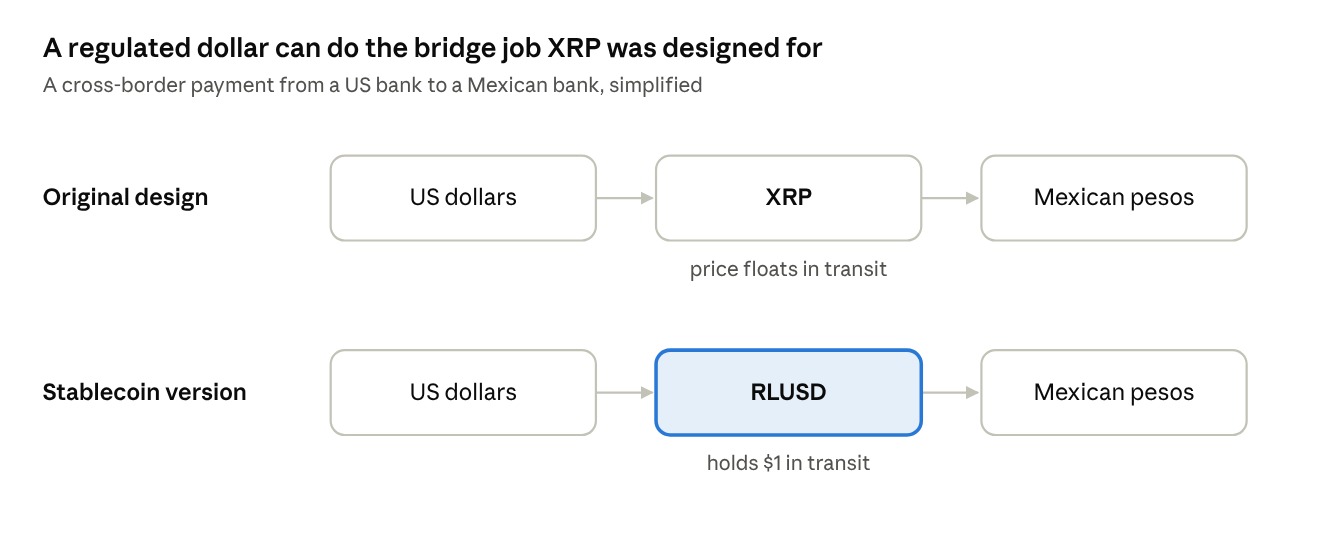
Bridge-currency flow, original design vs. stablecoin version · illustrative
What to notice: the only box that changes is the one in the middle. Everything else about the payment looks the same to the banks on either end, which is why the swap is so easy to make.
The scoreboard so far. XRP’s muted reaction this week says the market agrees, at least for now, that the charter is a Ripple story first. The charter’s legal footing also isn’t fully settled: a community bank group sued the OCC in federal court on October 2, challenging the March rule that made crypto trust charters like this one possible. The bank hasn’t opened its doors yet either.
The XRP Holder’s Scorecard
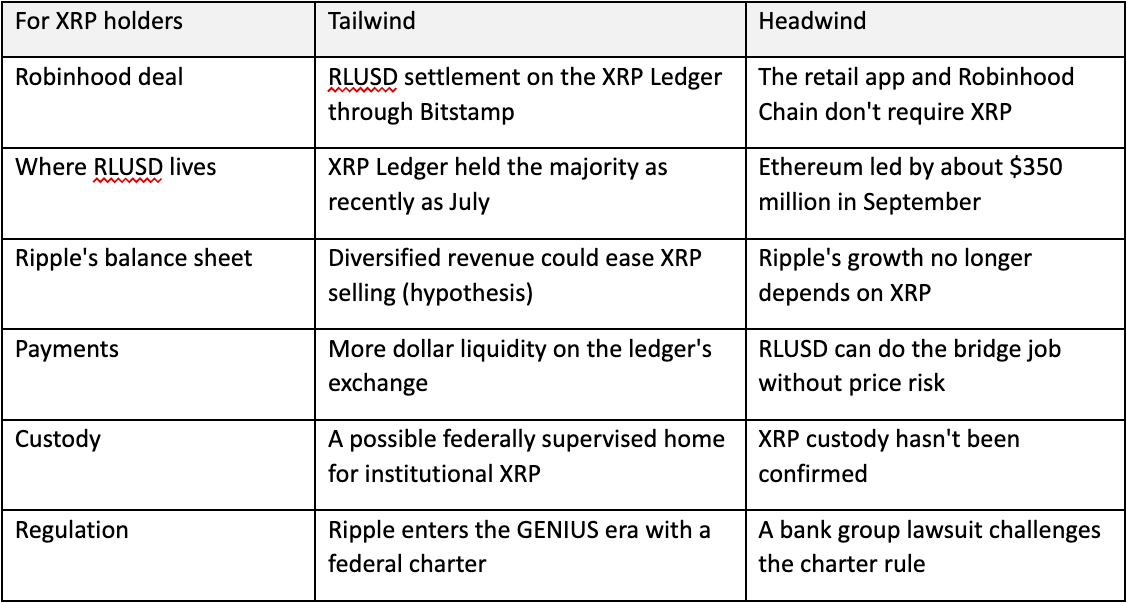
Put the two columns together and the read is fairly even.
Ripple the company is clearly winning. It now has a regulated dollar, a federal supervisor over that dollar’s reserves, and one of the largest retail brokerages in the country as a distribution partner. XRP’s share of that win runs through a few specific, measurable channels rather than through the headline.
That brings us back to the mall.
The developer just signed a marquee tenant, and the arcade sits right next to one of its entrances, the institutional settlement door Robinhood is opening on the XRP Ledger. Whether shoppers wander in depends on choices that haven’t been made yet: which chain new RLUSD gets minted on, how much Bitstamp settlement volume runs over the ledger once it’s live, and whether the trust bank ends up holding XRP for institutions.
Those are the numbers I’ll be tracking in this series, the same way I’ve been tracking Evernorth’s XRP per share.
For XRP holders, this week is a vote of confidence in Ripple and an open question about how much the token still matters to it. Both things can be true at once.
Which way do you read it? Hit reply and tell me whether you think the floor plan tilts toward the arcade or away from it.
Matthew Snider is the founder of BitFinance and principal at Block3 Strategy Group, where he advises emerging digital asset fund managers and RIAs on fund operations and compliance frameworks. He holds both Series 65 and Series 7 licenses, and is the author of Warren Buffett in a Web3 World.
This article is for informational and educational purposes only and is not investment, legal, or tax advice. Digital assets are volatile and can result in the total loss of principal. Figures cited reflect the dates noted and change quickly. I may hold positions in assets discussed. Consult your own financial, legal, and tax advisors before making any investment decision.
Sources
Ripple: Ripple Receives Final OCC Approval to Establish National Trust Bank
CNBC: Ripple strikes deal with Robinhood to expand its RLUSD digital dollar
Business Wire via StockTitan: Ripple and Robinhood Partner (Oct 27, 2026)
BeInCrypto: Who Gains From Ripple’s New Bank Charter? (Oct 27, 2026)
Crypto News Flash: Ripple Gets Its Bank Charter and a Seat at Wall Street
Unchained: Ripple Gets Final Federal Approval for a Trust Bank (Oct 26, 2026)
Tradingpedia: Ripple Wins OCC Approval for National Trust Bank (Oct 27, 2026)
TheStreet: RLUSD supply by chain, XRP Ledger vs. Ethereum (Jul 11, 2026)
U.Today: Ethereum Flips XRP Ledger in RLUSD Supply (Aug 21, 2026)
Coinpaper: Ethereum Leads XRP Ledger by $350M in RLUSD Supply
Sullivan & Cromwell: OCC Proposes Regulations to Implement the GENIUS Act
Community Banks File Suit Against OCC Over Bank Charters to Crypto Entities