The SEC Just Made the Case for Letting You In Early To New Crypto Projects
Yesterday, the SEC published a 400-plus page rule proposal called Regulation Crypto Assets. No open meeting, no advance fanfare. Four days earlier the Commission had scheduled a public vote on the same rulemaking and then canceled it, citing a scheduling issue.
The proposal showed up anyway.
Coverage since has fixated on two numbers, $5 million and $75 million. Those are the offering caps, and they matter to founders. If you are an individual investor rather than a founder, they are close to the least interesting part.
Think of a token project as a building under construction. The scaffolding is the investment contract: the promises a team makes about what it will build, the reason you handed over money before anything worked. The building is the token itself.
For nine years the SEC treated the scaffolding and the building as one object, which meant a token sold with promises attached stayed a security more or less forever. This proposal separates them, and it puts a filing date on the day the scaffolding comes down.
4 Pieces That Matter Most
A startup exemption lets a project raise up to $5 million over four years without registering, with public filings at the start and end of that window. Airdrops are explicitly covered, which resolves a question that has been open since 2020.
A fundraising exemption modeled on Regulation A runs two tiers.
Tier 1 allows $20 million in any twelve months with unaudited financials.
Tier 2 allows $75 million with audited statements and ongoing reports on new forms called 1-KC, 1-SC, and 1-UC.
Both caps adjust for inflation on a 5-year cycle, so they won’t erode the way Reg A’s did.
An investment contract safe harbor lets an issuer file a transition report certifying it has finished or permanently stopped the essential managerial efforts it promised. If the conditions hold, the contract is deemed to have ceased to exist and the token is no longer subject to it.
A “qualified purchaser” definition preempts state registration for these offerings and, notably, for certain secondary trades, so long as the issuer stays current on its federal filings.
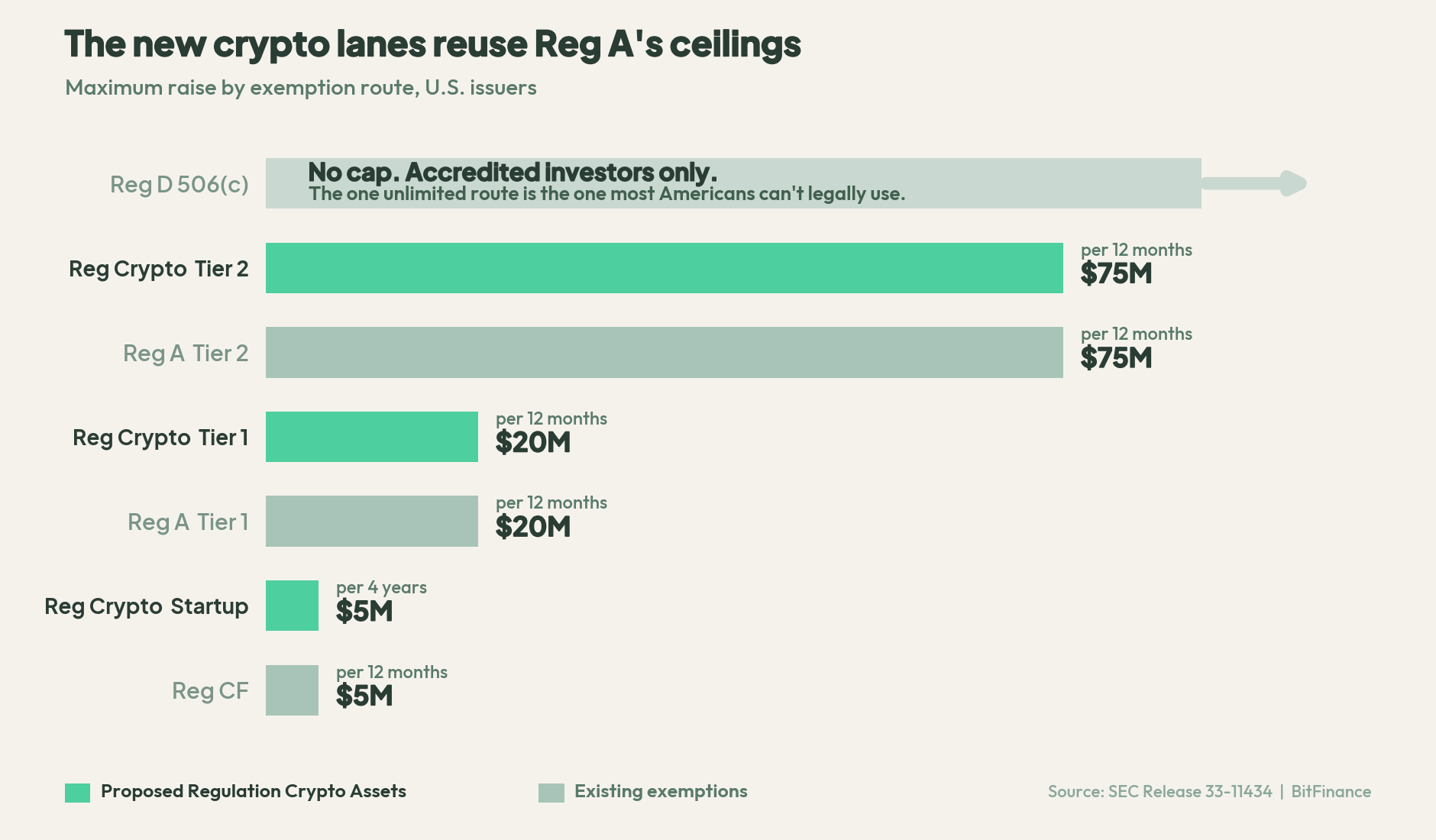
The two new lanes borrow Reg A’s ceilings. The route with no ceiling is the one closed to most Americans.
The Part Written for You
Rule 103 is where an individual investor should spend their time. It requires principles-based narrative disclosure across ten areas, and the list reads like someone finally asked what token buyers need to know: total supply and allocation, lockup and unlock schedules, governance, source code and security audits, the network’s stage of development, use of proceeds, the ecosystem, conflicts of interest, and the identities of founders, promoters, employees, contractors, and advisors, defined collectively as “related persons.”
That last category is the sleeper. If a project pays a promoter, the promoter has to be named. The disclosure also has to be consistent with what the issuer says on its website and its official social accounts, which puts whitepapers and X threads inside the liability perimeter for the first time.
There is a bad actor bar too. Securities fraud convictions or sanctions among the issuer or its insiders make the exemptions unavailable, and antifraud liability applies to everyone regardless.
The Insider Math
Tier 1 caps sales by issuer affiliates at $6 million of the $20 million.
Tier 2 caps them at $22.5 million of the $75 million. Both work out to 30 percent.
For the first time there is a number attached to the “team sold into the raise” problem. Thirty percent is not a small allowance, but it is a disclosed, bounded allowance rather than a discovery you make on a block explorer six months later.
The Day the Scaffolding Comes Down
Form TR is the piece nobody is covering well. An issuer that believes it is done building files a public certification with a written analysis supporting it. That filing doubles as notice to holders that the team has wound down its promised work.
You have never had that signal before.
Decentralization has been a thing founders assert, lawyers argue about, and regulators evaluate in hindsight. Now it becomes a dated document with a name on it.
Read it in both directions. “We have permanently ceased the essential managerial efforts we promised” is a regulatory milestone. It is also a team telling you they have stopped working on the thing you own.
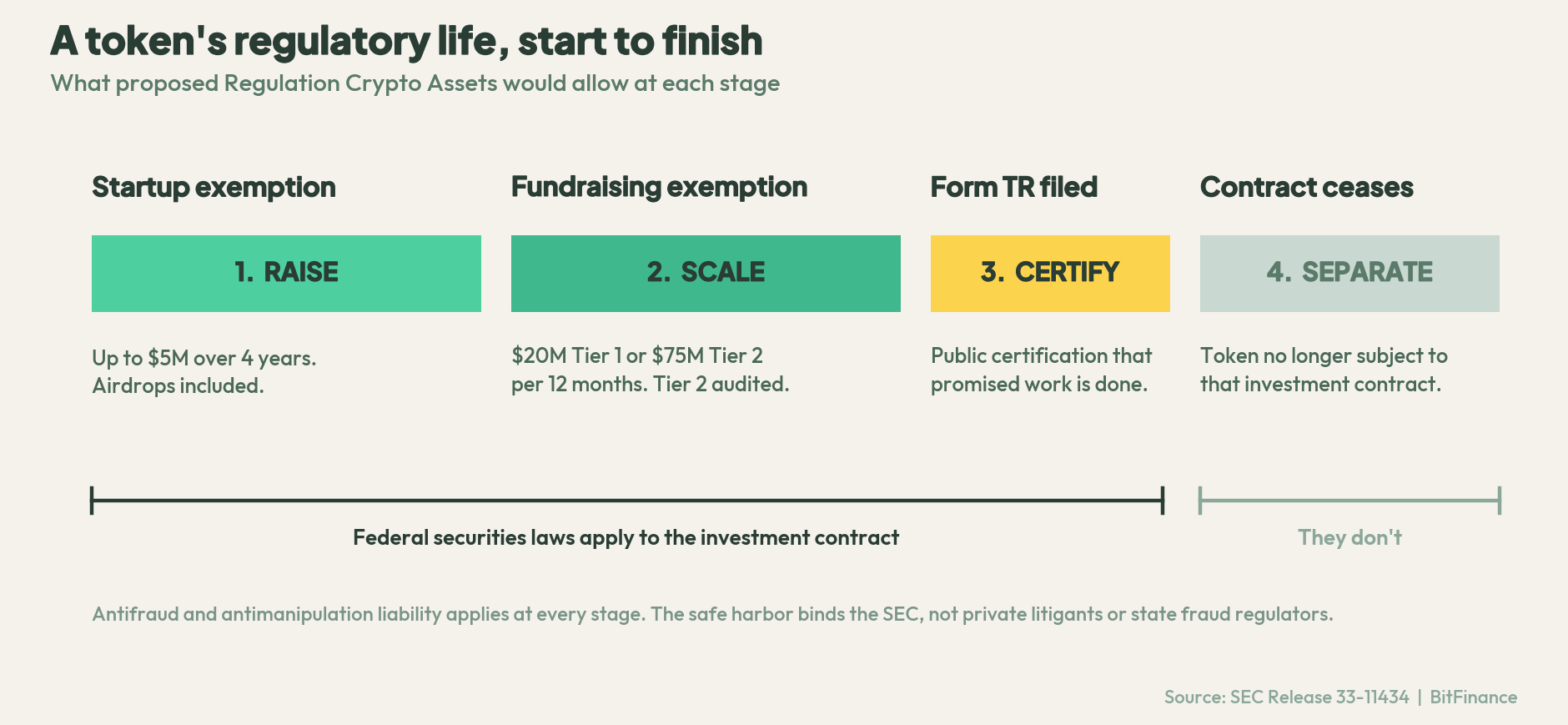
The proposal treats a token as something that changes status over time, which existing exemptions were never built to do.
The Argument Underneath
Buried on page 10 of the release is the sentence that makes this proposal worth an article rather than a news item. The Commission notes that its existing exemptions limit how much issuers can sell to retail buyers, which can produce “concentrated (rather than widespread) holdings” and impede the network effects these assets depend on for value.
Read that as policy and it’s a reversal.
Accreditation gates exist because Congress decided in 1933 that ordinary people should be walled off from the earliest, riskiest offerings. The SEC is now arguing that for this asset class the wall is itself a defect, because an asset whose worth depends on wide ownership cannot be built by twenty family offices.
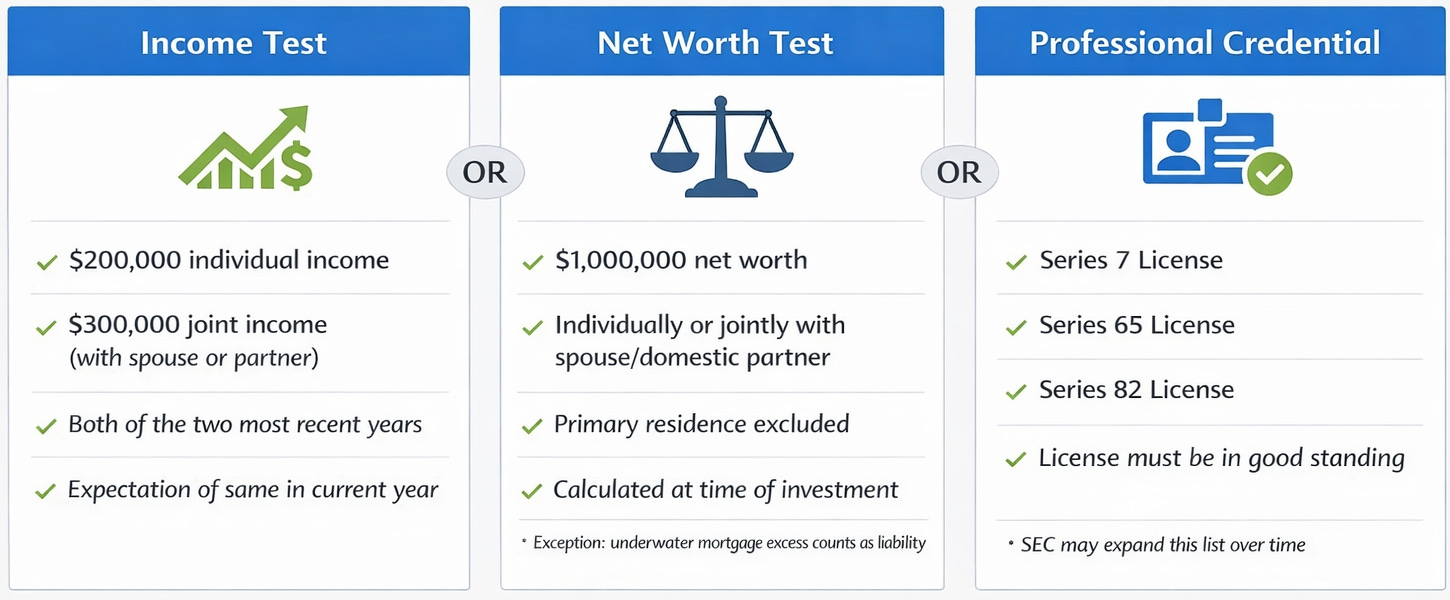
Whether you agree with the accreditation rules or not, the argument has real merit.
Offshore token sales have been open to everyone except Americans for years, and the practical result of protecting U.S. retail was that U.S. retail bought the same tokens later, at worse prices, with no disclosure at all.
The counterargument has merit too.
Cheaper compliance means more issuance, and more issuance means more tokens competing for the same retail dollars, most of which will go to zero regardless of how good the disclosure was. Reg A’s own history is instructive here, since better paperwork raised the floor on fraud without doing much for returns.
One open item worth watching: whether Tier 2 carries a Reg A-style investment cap for non-accredited buyers, typically 10 percent of the greater of annual income or net worth. Early reporting suggests some retail limits exist. I have not confirmed the specific mechanic in the release text, and it is the kind of detail that will move during the comment period.
THE BUFFETT FRAMEWORK QUESTION
When the scaffolding comes down and the builders walk away, what is left that produces something of value for the person still holding it?
What This Doesn’t Do
To be clear, nothing changes today.
These are proposed rules and public comments will run for 60 days after Federal Register publication.
The safe harbor binds the Commission and nobody else. The SEC reserves the right to challenge a certification it thinks misstates the facts, private litigants can still argue a token remains an investment contract, and state fraud authority survives the preemption of state registration.
“Essential managerial efforts” carries most of the weight in the whole framework and its edges are undefined. A team that ships a v2 after filing Form TR has a problem, and the release does not tell you how big a problem.
Chairman Atkins was direct about the fragility of all of it, saying legislation is still needed so this work cannot be undone by “a future rogue regulator.” The CLARITY Act remains stalled in the Senate with a procedural vote expected mid-September and midterms after that. The Commission moved because Congress did not.
Where That Leaves You
Scaffolding is temporary by design. The useful question was never whether it was permitted, but whether anything worth occupying got built inside it.

What changes for an individual investor is the quality of the information available while the work is happening, and a dated, public moment when the team says it is finished. Whether more access at better prices with better disclosure produces better outcomes depends on what readers do with the disclosure.
Most people will not read the tokenomics section (please do!)
The ones who do will have an edge they did not have last week.
Stay curious,
Matthew
Matthew Snider is the founder of Block3 Strategy Group, author of “Warren Buffett in a Web3 World,” and publisher of the BitFinance newsletter. He holds a Series 65 and MBA, and has been an active participant in digital asset markets since 2015. This article is for educational purposes only and should not be considered financial advice. Always consult with a qualified professional before making investment decisions.
SOURCES
SEC Press Release 2026-76, SEC Proposes New Regulation Crypto Assets (Aug. 18, 2026)
Proposed Rule, Regulation Crypto Assets, Release Nos. 33-11434; 34-106150, File No. S7-2026-27
Chairman Paul S. Atkins, Fit-for-purpose Exemptions for Crypto Market Innovation (Aug. 18, 2026)
Commissioner Hester M. Peirce, Filling the Regulatory Tank (Aug. 18, 2026)
Commissioner Mark T. Uyeda, Statement on Regulation Crypto Assets (Aug. 18, 2026)
Crowdfund Insider, Regulation Crypto Assets: SEC Proposes New Rules For Crypto (Aug. 18, 2026)