The Coming Robotics Boom Runs on Joints, and Most of Them Are Made in China
Two important things to know about me.
I like finding investment opportunities related to pics and shovels.
I think Terminator 2 is one of the greatest films of all time.
Consequently, I’ve been hooked on robotics for a while now. Back in June, I wrote about RoboStrategy ($BOT), the closed-end fund that put Figure AI, Apptronik and other private humanoid makers behind a Nasdaq ticker.
That piece was about the brains of the robot boom: the famous names building the machines, priced at venture marks the public can’t check.
The article sent me further down the rabbit hole. 🐰
I stopped asking which robot company wins and started asking what all of them have to buy before a robot can take a single step.
Silly example, but think about all the processes that happen when you decide to jump up from your couch after the Chicago Bears get another win…
Your brain makes the call, but your knees do the work.
They carry the load, keep the motion smooth, and stop you from tipping over.
Ask anyone over 40 which body part they think about more often, and it won’t be the brain….or so they tell me.
Robots split the work the same way, and the joints turn out to be where most of the money goes. The companies making them look a lot like the picks-and-shovels sellers of every gold rush before this one. As of this fall, there’s an ETF that owns them.
Inside 1 Robot Joint
In robotics, a joint is called an actuator. Each one pairs a small motor with a precision gearbox, called a reducer, that turns fast, weak spin into slow, strong torque. Sensors report where the limb is, and a controller decides how much power to send.
A full-size humanoid has 25 to 35 of these, with roughly 28 reducers spread across its arms, legs and waist.
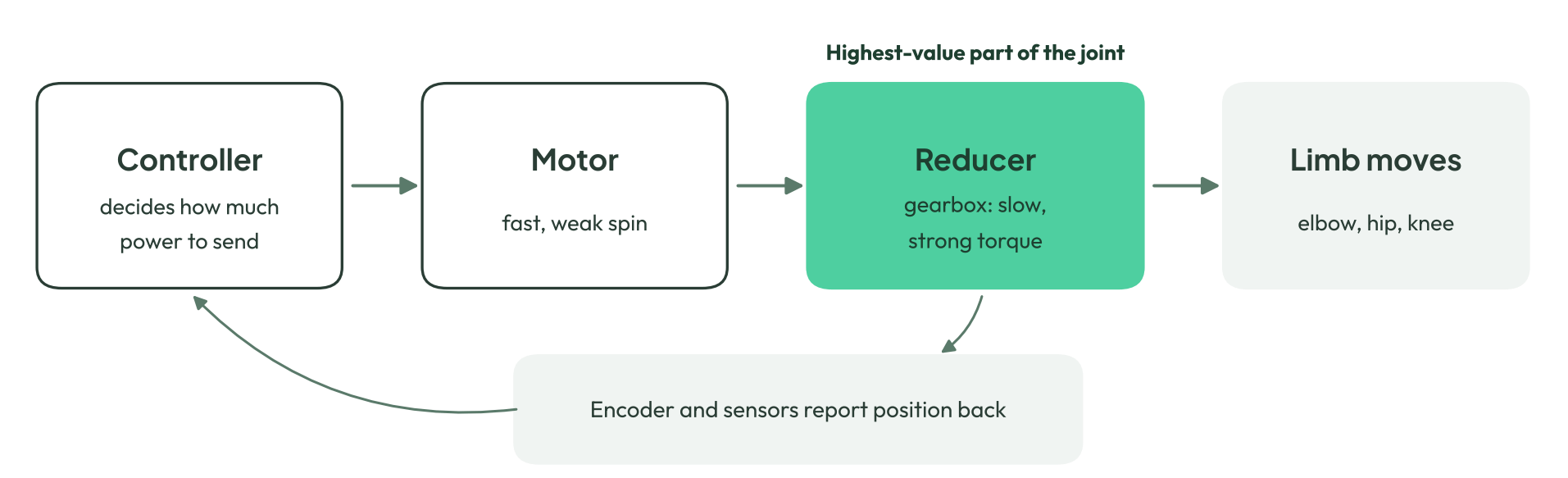
Every powered joint in a humanoid repeats this loop, and the reducer is the hardest piece to make and the most expensive. Sources: McKinsey, Humanoid Guide.
The Joints Make Up Most of the Robot
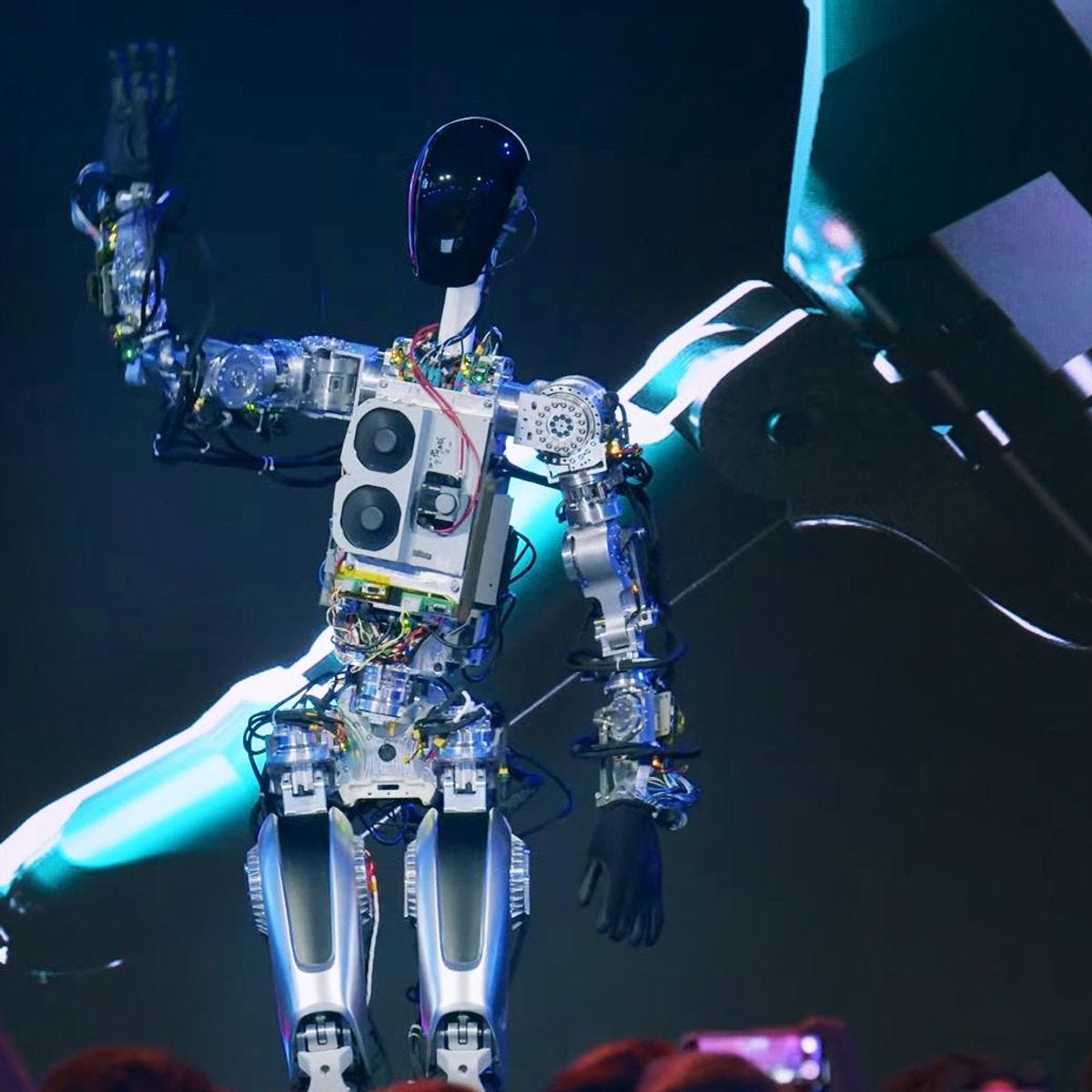
Morgan Stanley estimates a Tesla Optimus Gen 2-class robot costs about $55,000 to build, and actuators make up about 56% of that bill.
That’s roughly $31,000 of joints in every robot.
I mean…just take a look at this thing…it’s pretty much ALL joints and actuators.
McKinsey’s range across humanoids is 40% to 60%, and it pegs the gearbox alone at 30% to 50% of each actuator’s cost.
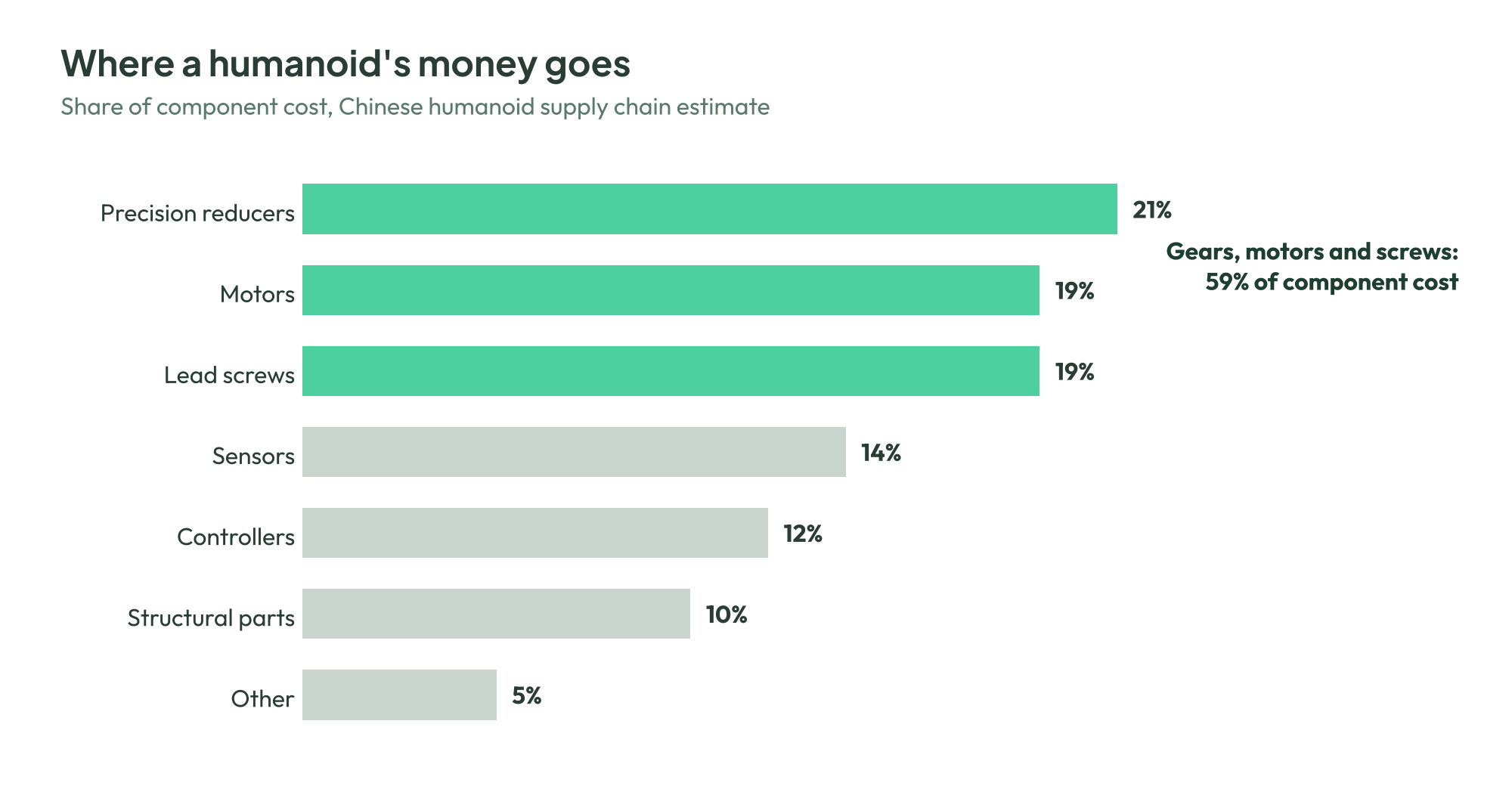
Reducers, motors and screws, the guts of every joint, account for nearly 60% of component cost in this estimate. Splits vary by robot design. Source: Chinese supply chain breakdown via Humanoid Guide.
Now compare who’s earning what.
In June, Figure carried a $39 billion mark on revenue estimated in the low tens of millions. Leaderdrive, a Chinese reducer maker most American investors have never heard of, grew revenue 47% in 2025 to ¥570.7 million (about $80 million) and more than doubled net profit to ¥124.4 million.
The company making the knees already books a profit, while the most famous brain in robotics is still valued on what it might become.
Meet TORK
KraneShares launched the KraneShares Actuator ETF on the Nasdaq on September 24, 2026, under the ticker $TORK.
It holds 19 companies that make reducers, motors, screws, sensors and motion controls. The net expense ratio is 0.65%, which reflects a voluntary 35 basis point fee waiver the adviser can end at any time, against a gross figure of 1.00%. KraneShares positions it as a complement to KOID, its humanoid robotics ETF.
The fund can hold private companies, but as of November 3 every position was publicly traded. That’s a meaningful difference from BOT, because you’re buying businesses with public financials and daily prices instead of private marks updated on a lag.
Quick Disclaimer: This is NOT an offer to buy/sell this ETF and I am currently NOT a holder of this ETF. This article’s intention is to only provide education about its mechanis.
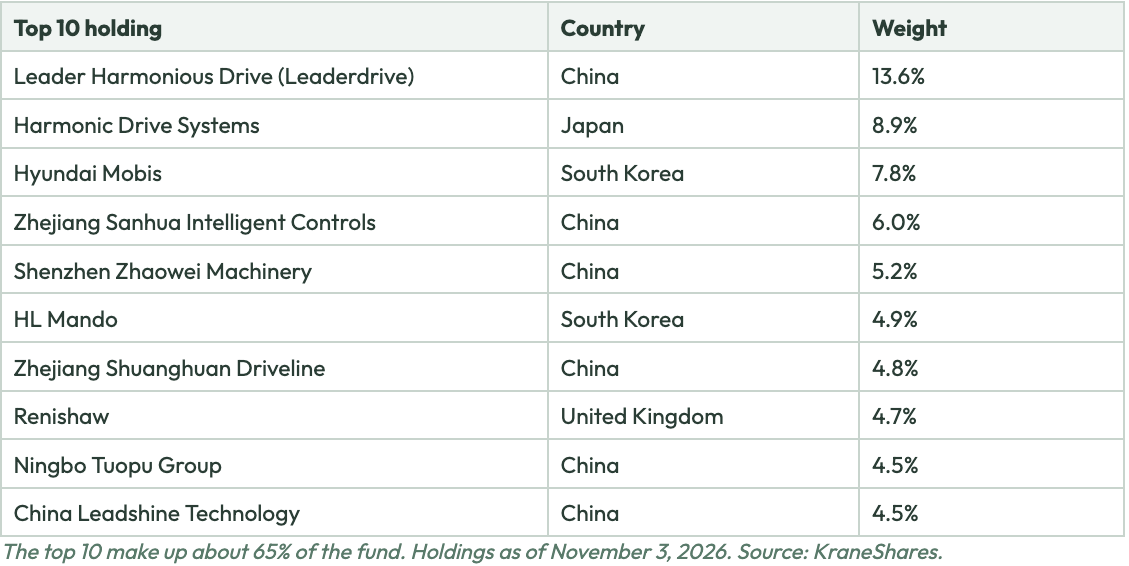
The rest of the lineup reads like a parts catalog.
Nabtesco builds the precision reducers inside many industrial robots.
THK and Hiwin make linear guides and ball screws.
Yaskawa and Inovance make servo motors and drives.
Renishaw makes the encoders that tell a joint where it is.
Size is the other thing to know. TORK had about $2.3 million in assets as of November 3, while KraneShares cites a Morgan Stanley projection that humanoids could be a nearly $5 trillion market by 2050. A tiny fund is chasing an enormous story, and that gap cuts both ways.
Zero American Companies…ZERO!
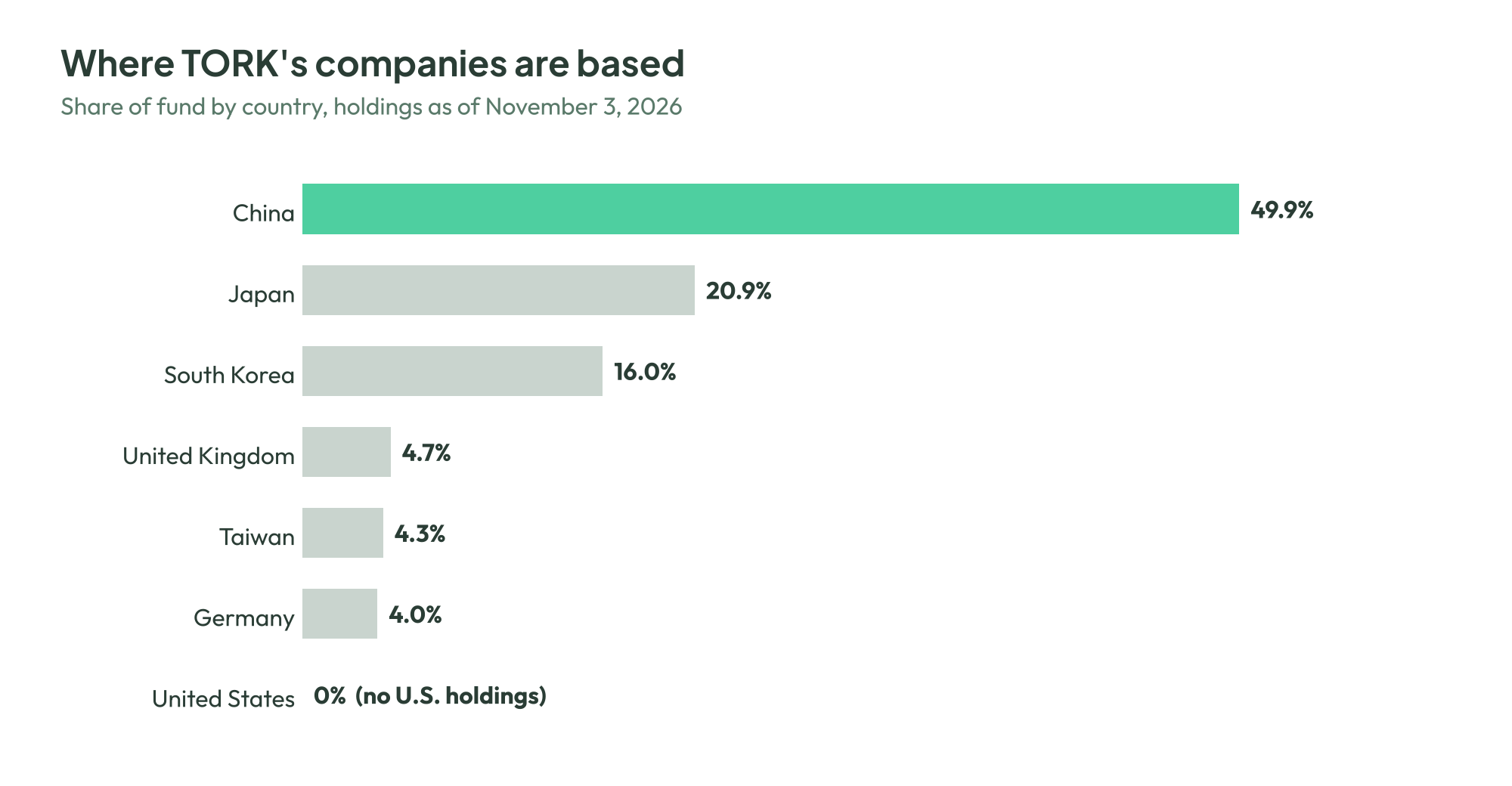
Half the fund sits in Chinese companies and more than 90% in Asia.
Source: KraneShares holdings file, November 3, 2026.
That map reflects where the parts get made.
Leaderdrive, the fund’s largest position at 13.6%, holds 30% to 40% of China’s harmonic reducer market, according to J.P. Morgan. China also processes about 90% of the world’s permanent magnets, which high-torque motors depend on.
McKinsey ran the obvious stress test. Pull Chinese suppliers out of an Optimus Gen 2 and the estimated bill of materials rises from about $46,000 to $131,000.
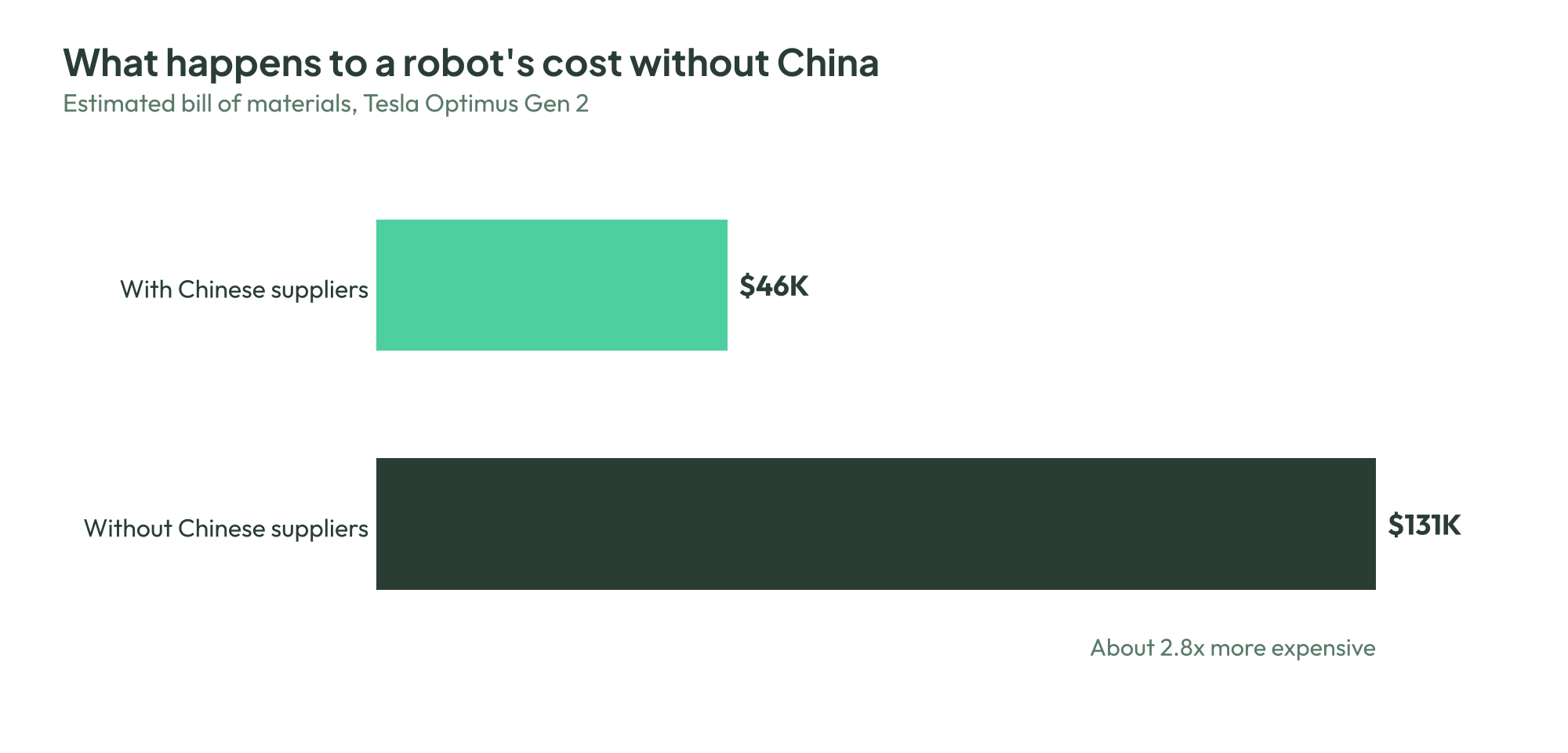
An American-designed robot nearly triples in cost without its Chinese supply chain. Source: McKinsey.
My hypothesis: at the joint level, the American humanoid story is an Asian manufacturing story. Anyone who wants the shovels has to accept China A-shares, tariffs and geopolitics as part of the package.
A Gear Crunch in the Making
Some back-of-envelope math on Tesla’s aim to build 50,000 Optimus units in 2026.
At roughly 15 harmonic reducers per robot, that’s about 750,000 reducers. Harmonic Drive Systems, the industry incumbent, has capacity for about 2.14 million a year, and Leaderdrive has scaled from 330,000 to 790,000.
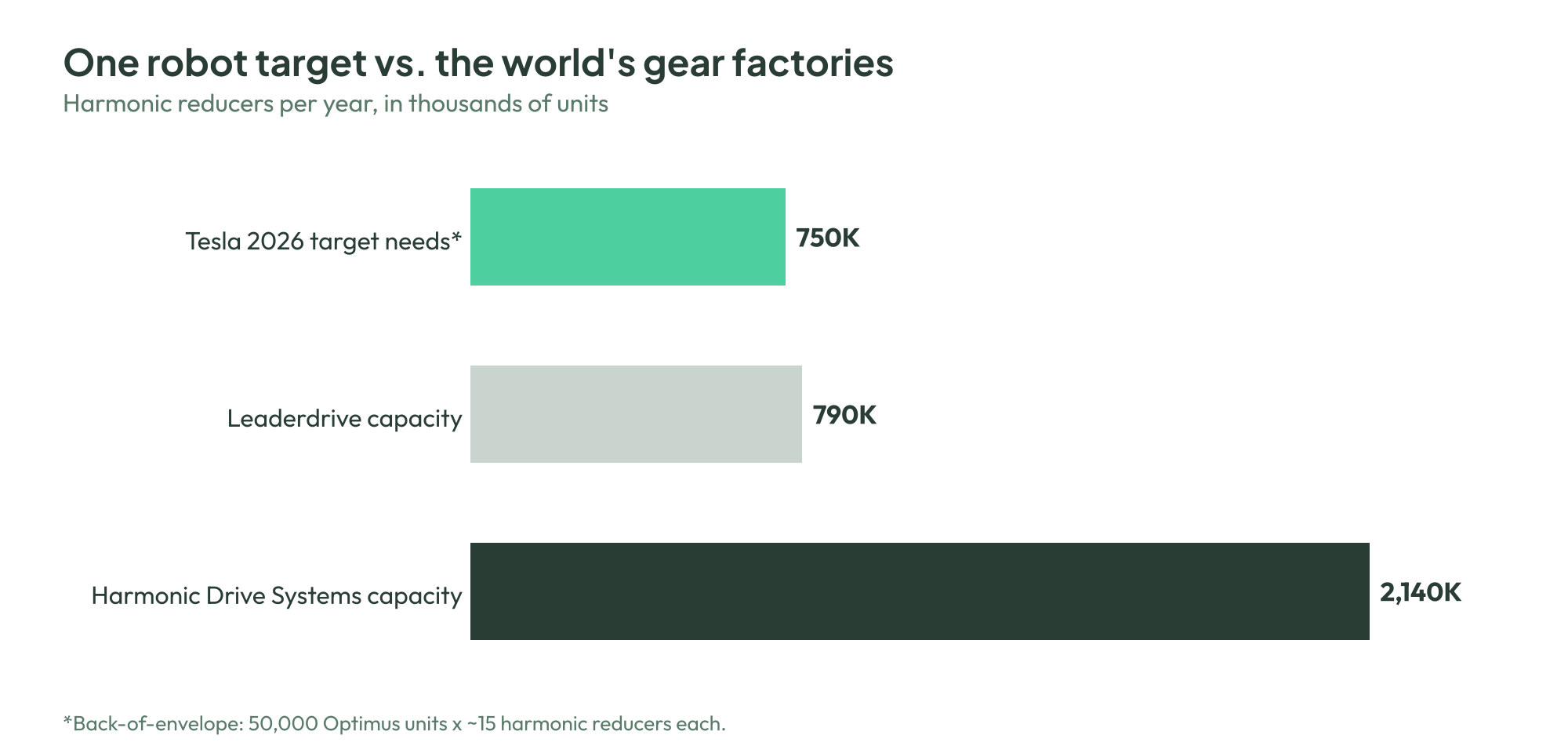
One company’s production target would absorb about a third of the incumbent’s annual output. Sources: Humanoid Guide, author’s math.
If humanoid volumes scale the way forecasts claim, gear capacity becomes a constraint, and constraints tend to hand suppliers pricing power. Schaeffler, also in TORK, plans to scale its own production starting in 2027.
What Could Break the Thesis
Shovel sellers only win if they keep their margins, and hardware has a habit of getting cheaper fast.
As an example, Unitree’s average selling price fell about 72% between 2023 and 2025. Chinese harmonic reducers already sell for 30% to 50% less than premium imports. Volume growth and price wars can arrive together.
Robot makers may also build their own joints.
McKinsey expects actuator sourcing to stay largely in-house until volumes become predictable, with off-the-shelf modules more likely around 2035.
The fund carries its own risks so trade accordingly:
Concentration. The top 10 holdings are about 65% of assets.
Geopolitics. Half the fund sits in Chinese stocks exposed to tariffs and shifting market-access rules.
Purity. By my read, several holdings, including Hyundai Mobis, Schaeffler and Tuopu, are large auto suppliers where robots are a small slice of revenue today.
Size. At $2.3 million in assets, wide trading spreads and closure risk are real possibilities.
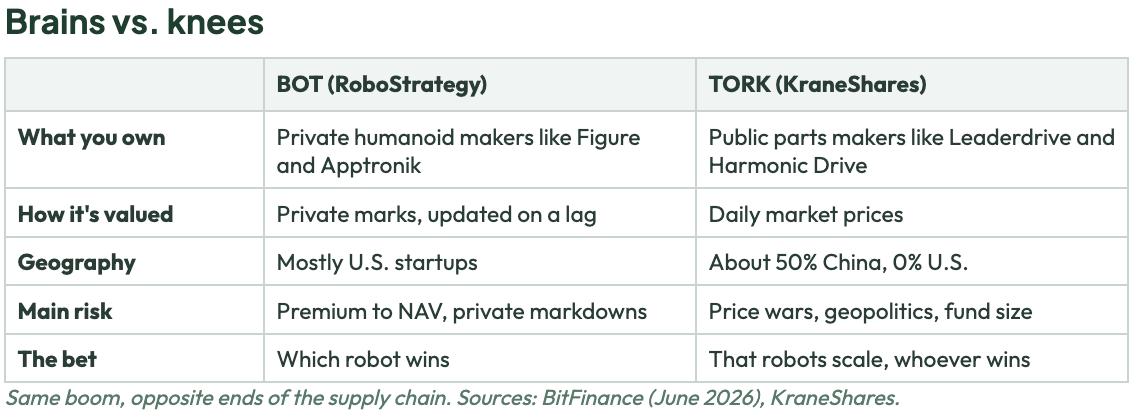
Brains vs. Knees
Where This Leaves Us
BOT and TORK make opposite bets on the same boom. BOT asks you to pick the brain. TORK asks you to believe robots ship in volume, and to own the parts they can’t move without.
The case for TORK is clean: most of a robot’s cost sits in its joints, the companies making them already have revenue and profits, and supply looks tight if the forecasts hold. The case against is just as clear. Hardware commoditizes, the biggest robot makers may build in-house, and the fund is small, concentrated and heavily exposed to China.
Back to the knees.
They do the heavy lifting, and they’re also the part that wears out first. Gearboxes wear too. My second hypothesis is that if humanoid fleets grow, replacement demand could turn joint makers into something closer to a recurring-revenue business. That one’s further out, and I’ll report back as the data comes in.
So which would you rather own, the brain or the knees? Hit reply and tell me.
Matthew Snider is the founder of BitFinance and principal at Block3 Strategy Group, where he advises emerging digital asset fund managers and RIAs on fund operations and compliance frameworks. He holds both Series 65 and Series 7 licenses, and is the author of Warren Buffett in a Web3 World.
This article is for informational and educational purposes only and does not constitute investment, legal, or tax advice, or a recommendation to buy or sell any security or digital asset. The securities discussed here, including newly launched funds with limited trading history and foreign stocks, are volatile and can result in the total loss of principal. Past performance does not guarantee future results. Consult your own financial, legal, and tax advisors before making any investment decision.
Sources
McKinsey: Turning Humanoid Supply Chain Constraints into Billion-Dollar Wins
Humanoid Guide: What Does a Humanoid Robot Joint Cost? Inside the Actuator Bill of Materials
Humanoid Guide: Leaderdrive Harmonic Reducers Surge as Humanoid Demand Lifts Shares
VnExpress: Chinese Brothers Behind Robot Joint Maker Leaderdrive Become Billionaires (April 2026)