Wall Street Just Turned Privacy Into a 2.5% Fee
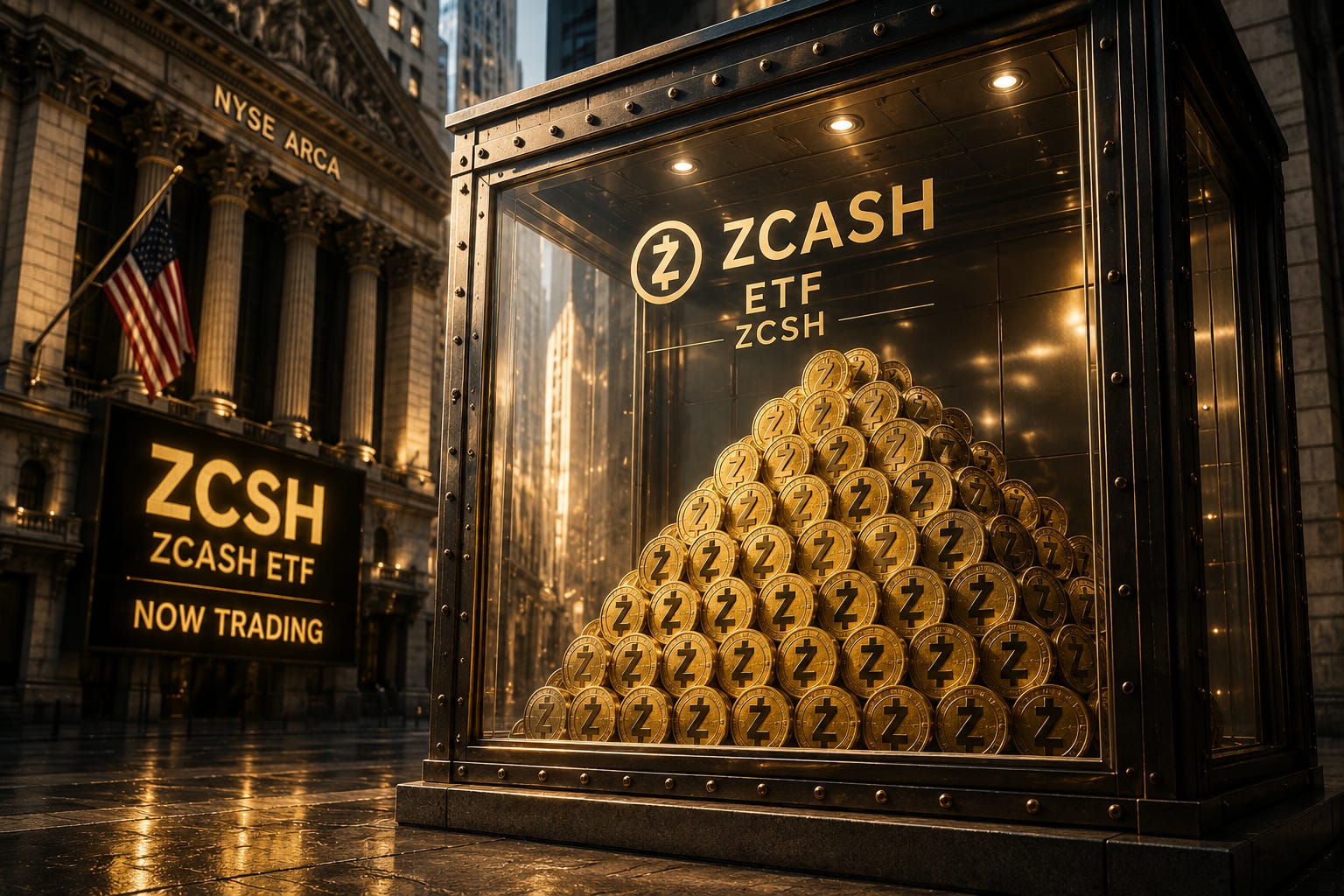
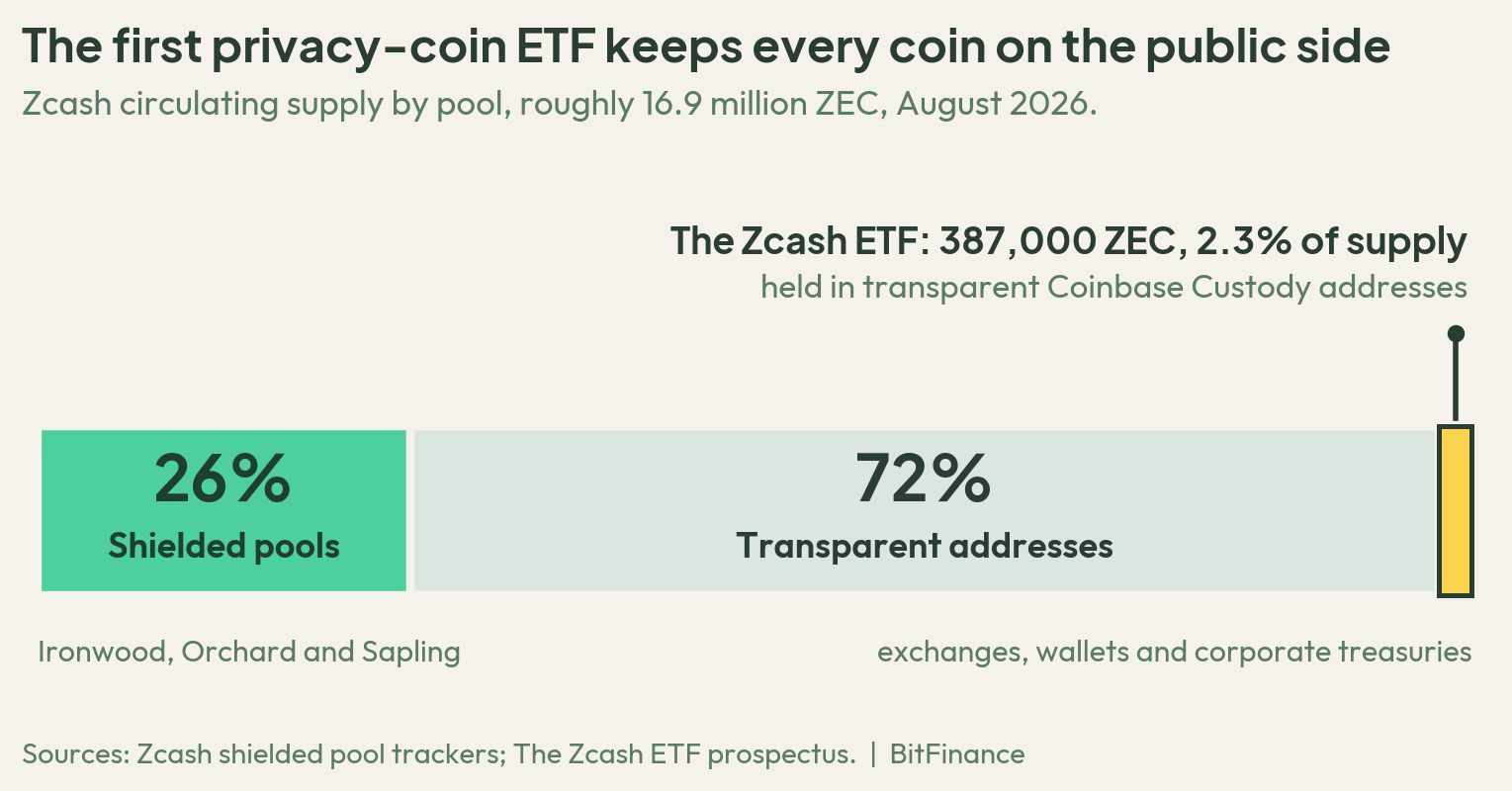
The Zcash ETF began trading on NYSE Arca on Tuesday holding roughly 387,000 ZEC, about 2.3% of circulating supply. Every one of those coins sits in a transparent Coinbase Custody address, on the fully public layer of the Zcash blockchain where any observer can read balances and transaction history.
That’s the first U.S. exchange-traded fund built on a privacy coin, and it stores its coins in the one configuration where Zcash’s privacy is switched off.
Quick Primer: Zcash launched in 2016 as a cryptocurrency with a switch. Holders can send coins on a public ledger the way Bitcoin works, where anyone can read the amounts and the addresses, or they can send them shielded, where cryptography hides the sender, the receiver and the amount while still proving the payment is valid.
Picture a bank that puts its vault door in the lobby window. The steel is real, the contents are real, and the entire purpose of the display is that you can see it. Grayscale built a glass vault for an asset whose selling proposition is that nobody can see inside.
What an ETF Buyer Owns
ZCSH trades on NYSE Arca with Coinbase as custodian and prime broker, BNY Mellon as administrator, and Jane Street and Virtu as authorized participants. NAV comes off the CoinDesk Zcash Benchmark Rate. Shares are created and redeemed in baskets of 10,000, with in-kind creations available but in-kind redemptions not currently permitted.
The fund holds real ZEC.
Grayscale’s own risk language is blunt about what that gets you: an investment in the fund is not a direct investment in ZEC, and the fund isn’t registered under the Investment Company Act of 1940, so it doesn’t carry the protections that apply to registered ETFs and mutual funds.
The functional inventory is short. A shareholder gets price exposure inside a brokerage account, with no keys to manage and no exchange withdrawal to worry about. A shareholder does not get a shielded address, cannot send a shielded transaction, cannot use selective disclosure to reveal a payment to an auditor while hiding it from everyone else, and cannot spend a single unit of private money.
Zcash was designed so users choose between transparent and shielded. The ETF removes the choice and leaves the setting on transparent forever.
You can buy the privacy trade.
You can’t buy the privacy.
The Fee is the Product
The fund carries a 2.5% annual sponsor fee, roughly 10x the rate on the largest spot bitcoin ETFs. The fee is paid in ZEC.
Paid in kind means no cash bill arrives.
The coin count behind each share shrinks instead.
Hold 5 years and roughly 12% of your ZEC per share is gone.
Hold 10 and it’s about 22%. (yikes!😳)
Those figures assume nothing about price, because they don’t depend on price.
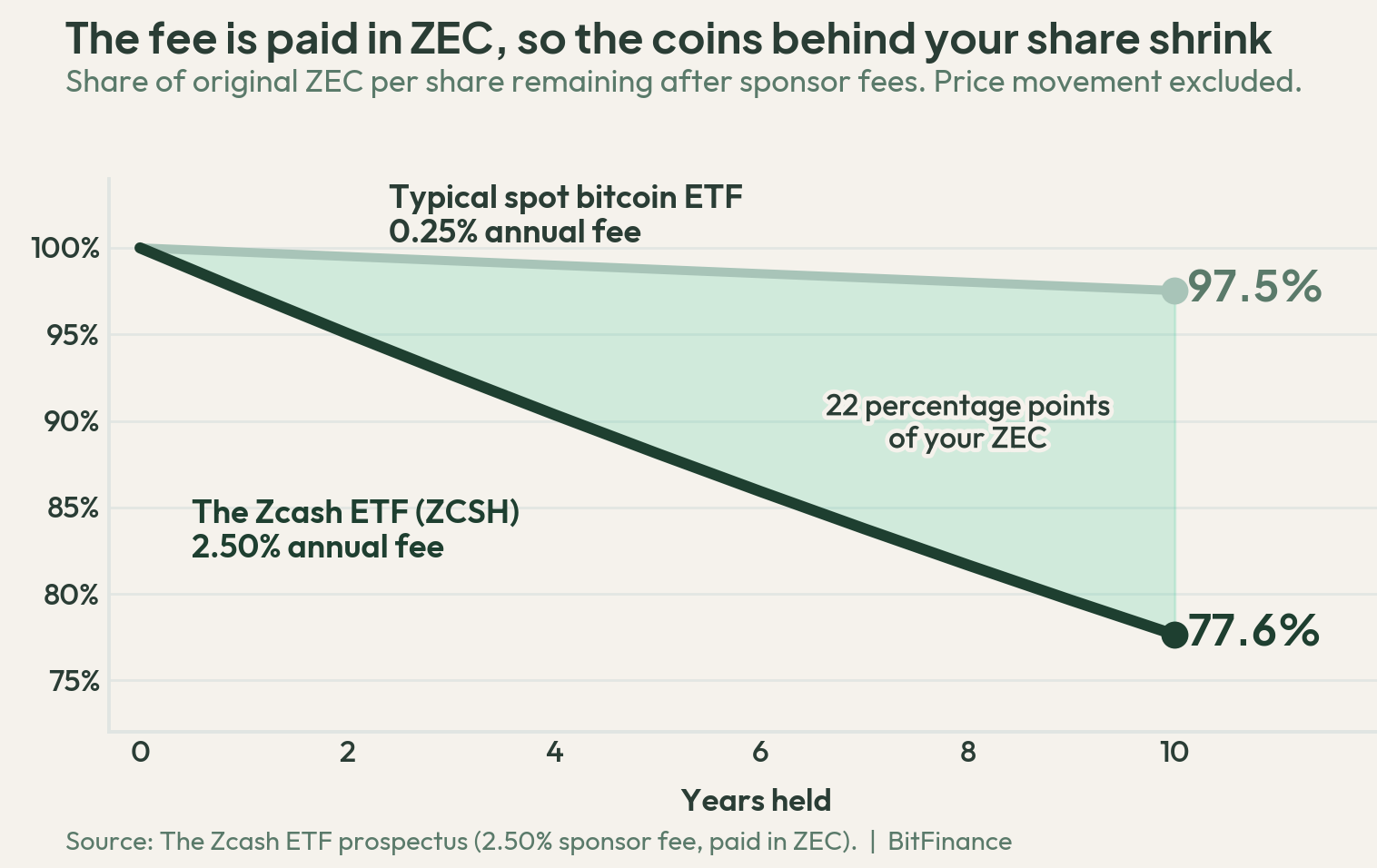
An in-kind fee compounds against the coin count, not the dollar value.
Grayscale has an answer for where the money goes:
Fee revenue will be directed back into the Zcash ecosystem for network development and marketing, and
The firm intends to use 100% of the management fee for marketing, education and awareness in year one.
That’s a real commitment, and it’s worth naming plainly: the ecosystem funding comes out of shareholder returns rather than out of Grayscale’s pocket.
There’s a concentration disclosure worth reading alongside it. Grayscale said it was in non-binding discussions with DCG International Investments, a subsidiary of parent Digital Currency Group, about contributing roughly 200,000 ZEC in exchange for shares.
Under a June 30 snapshot, that stake would represent about 34% of the enlarged fund. Since in-kind redemptions aren’t permitted, an affiliate unwinding a third of the fund would be redeemed in cash, which means the trust selling ZEC into the market to fund it.
The Invisible Counterfeiting Scare
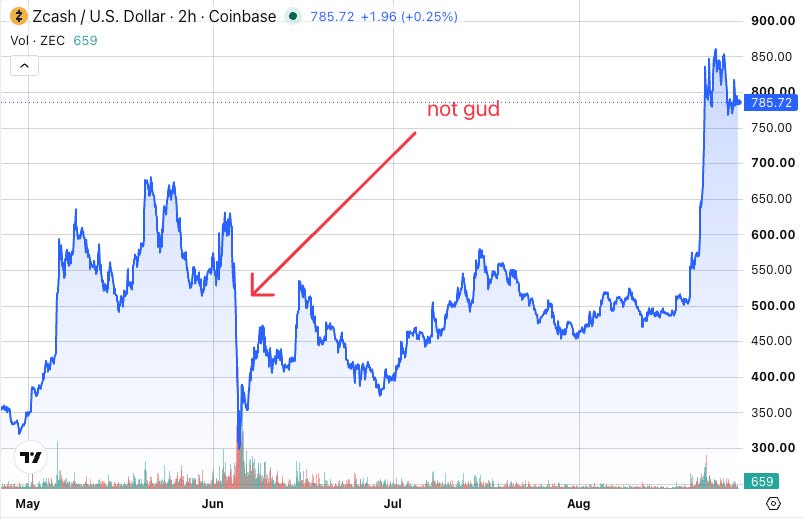
3 months before this listing, Zcash had the worst possible quarter for an asset whose value rests on cryptographic soundness.
On May 29, Shielded Labs researcher Taylor Hornby found a flaw in the Orchard shielded pool using Anthropic’s Claude Opus 4.8 alongside a custom auditing agent he pointed at the halo2 circuit code. The bug had been live since Orchard activated in May 2022. Hornby wrote a working proof-of-concept and minted counterfeit ZEC in a local test environment.
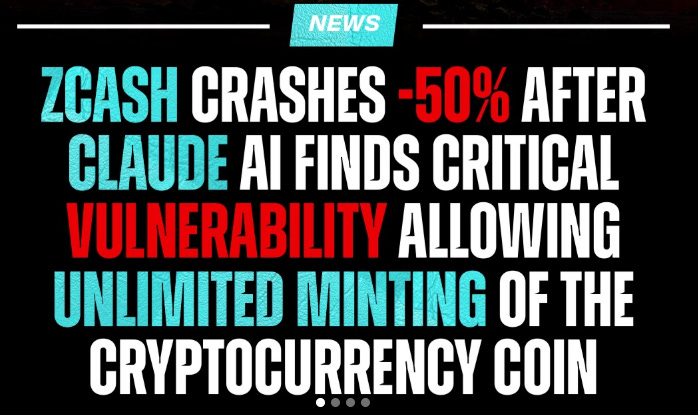
Soundness, in this context, means the system accepts only transactions that are mathematically valid. A soundness failure inside a shielded pool means someone could create coins from nothing without leaving a trace, because the design exists to hide the trace.
Developers moved in two stages:
A June 2 soft fork that disabled Orchard transactions,
Then the NU6.2 hard fork on June 3 with a corrected circuit.
ZEC fell roughly 38% on disclosure.
The patch didn’t settle the question.
Because Orchard’s data is shielded, nobody can independently verify that no counterfeit ZEC was created before the fix. If that doesn’t give you a chuckling sense of irony - what will? That’s the trap at the center of private money, where the same property protecting users prevents the network from proving its own supply is clean.
Zcash activated Ironwood, formally NU6.3, on July 28, permanently sealing the Orchard pool and opening a replacement at zero. Funds migrating out pass through a public accounting checkpoint called a turnstile, designed to stop any hypothetical excess coins from crossing.
A machine-checked proof of more than 2,700 theorems confirms Ironwood cannot create undetectable counterfeit ZEC under its design assumptions. Developers found no evidence the original flaw was ever exploited. All of it is disclosed in the prospectus.
The structural irony gets a second layer here.
The fund’s coins were never in Orchard, since transparent custody kept them out of the shielded pool entirely. The ETF was insulated from the specific risk while its NAV fell anyway, because price is shared even when exposure isn’t.
The Fair Read
The case on the other side is stronger than the irony suggests.
Privacy usage is growing rather than shrinking. The Orchard migration has passed 85% completion, with Ironwood holding more than 3.7 million ZEC and only about 3% of total supply still sitting in the old pool. Shielded balances across all pools ran near 26% of supply in August. The people who want shielded money are still using it, and they moved fast when asked to.
The regulatory door opened before the ETF walked through it. The SEC closed its long-running probe of the Zcash Foundation in January 2026 with no enforcement action, removing an overhang that had kept privacy assets out of regulated vehicles for years.
Wrapper economics cut both ways, too.
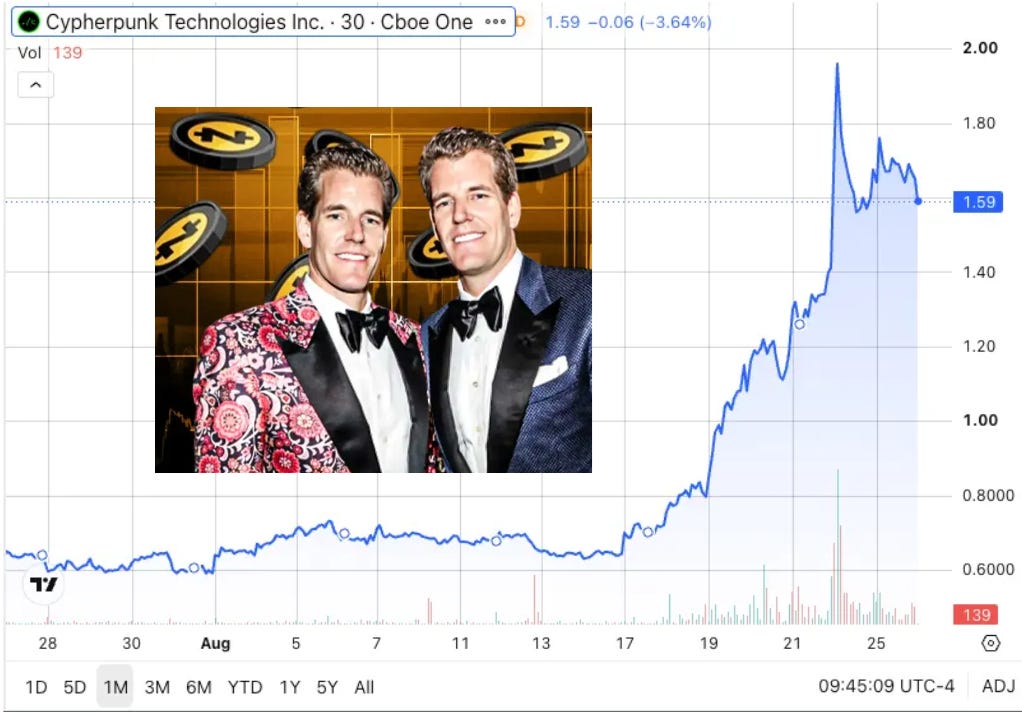
Cypherpunk Technologies, the Winklevoss-backed treasury company, holds 323,394 ZEC, about 1.9% of circulating supply, and has spent much of this year trading below the value of the coins on its balance sheet.
A fund that tracks NAV closely at a disclosed fee is a structurally cleaner instrument than a corporate wrapper trading at a discount to its own assets. Cost and value destruction are different things.
The Buffett Framework Question: Who is getting paid, and for what?
Grayscale collects 2.5% of the fund’s ZEC every year, in ZEC. The Zcash ecosystem receives that revenue in year one. Coinbase earns custody and prime brokerage. Jane Street and Virtu earn the spread. The shareholder receives price exposure to an asset whose defining feature the structure cannot deliver, minus all of the above. Every party is doing legitimate work.
The question worth answering is which service you think you’re buying.
What the Launch Signals 👀
Wall Street didn’t adopt financial privacy this week. It built a fully identified, KYC-gated, publicly auditable way to speculate on whether other people will want financial privacy later.
Those are different products carrying different risks.
The privacy thesis says shielded transactions become necessary infrastructure as AI makes financial surveillance cheap, an argument Grayscale’s own head of index made on launch day.
The trade says a scarce asset with a 21 million cap and a compelling story goes up. You can hold the second without ever touching the first.
Back to the vault in the window. The steel is real, and the coins behind the glass are real, auditable down to the last satoshi, which is why the structure works at all.
The vault holds the money.
The privacy stayed outside.
Matthew Snider is the founder of Block3 Strategy Group, author of “Warren Buffett in a Web3 World,” and publisher of the BitFinance newsletter. He holds a Series 65 and MBA, and has been an active participant in digital asset markets since 2015. This article is for educational purposes only and should not be considered financial advice. Always consult with a qualified professional before making investment decisions.
Sources
The Zcash ETF (ZCSH) fund page, Grayscale
The Zcash ETF prospectus, SEC EDGAR (Rule 424(b)(3), filed August 24, 2026)
Grayscale fourth and fifth amended S-3/A registration statements, SEC EDGAR
“Grayscale debuts first Zcash ETF of its kind as privacy coin surges,” The Block
“Grayscale Zcash ETF Debuts Tuesday” TechTimes
“The first privacy coin ETF: inside Grayscale’s Zcash filing,” crypto.news
ZIP-0257 and Ironwood upgrade documentation, z.cash and Shielded Labs
“Zcash Seals $1.7 Billion Shielded Pool as Ironwood Upgrade Activates,” CoinDesk
Cypherpunk Technologies SEC filings and press releases