What a $3.5 Trillion Tesla-SpaceX Merger Would Look Like
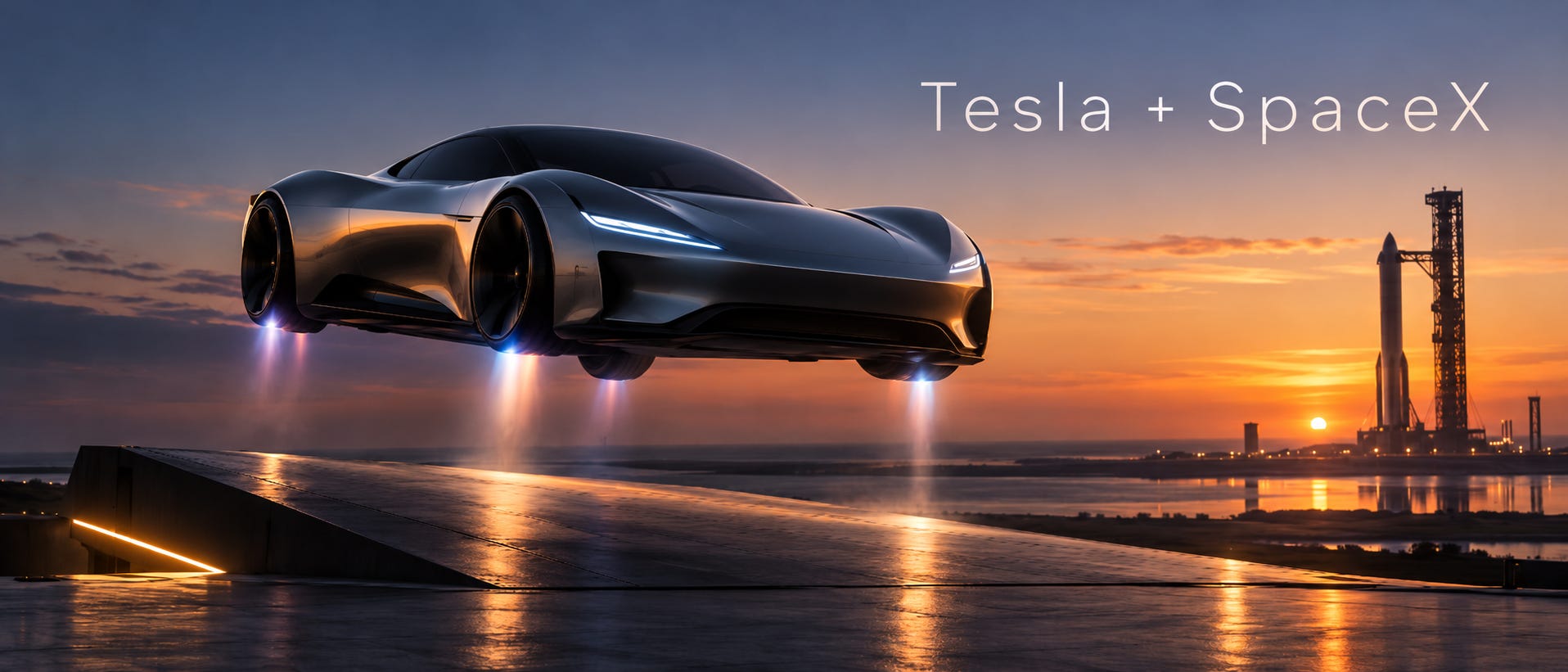
Apparently where we’re going we don’t need roads…
Earlier this week, a Tesla drove up a curved ramp at SpaceX’s rocket test site in McGregor, Texas, rolled upside down, launched off the end, turned itself around midair on cold-gas thrusters, and landed. Nobody was inside.
The demo car was remote-controlled, the flying version isn’t street legal, and Musk says production starts in 2028. (shut up and take my money!)
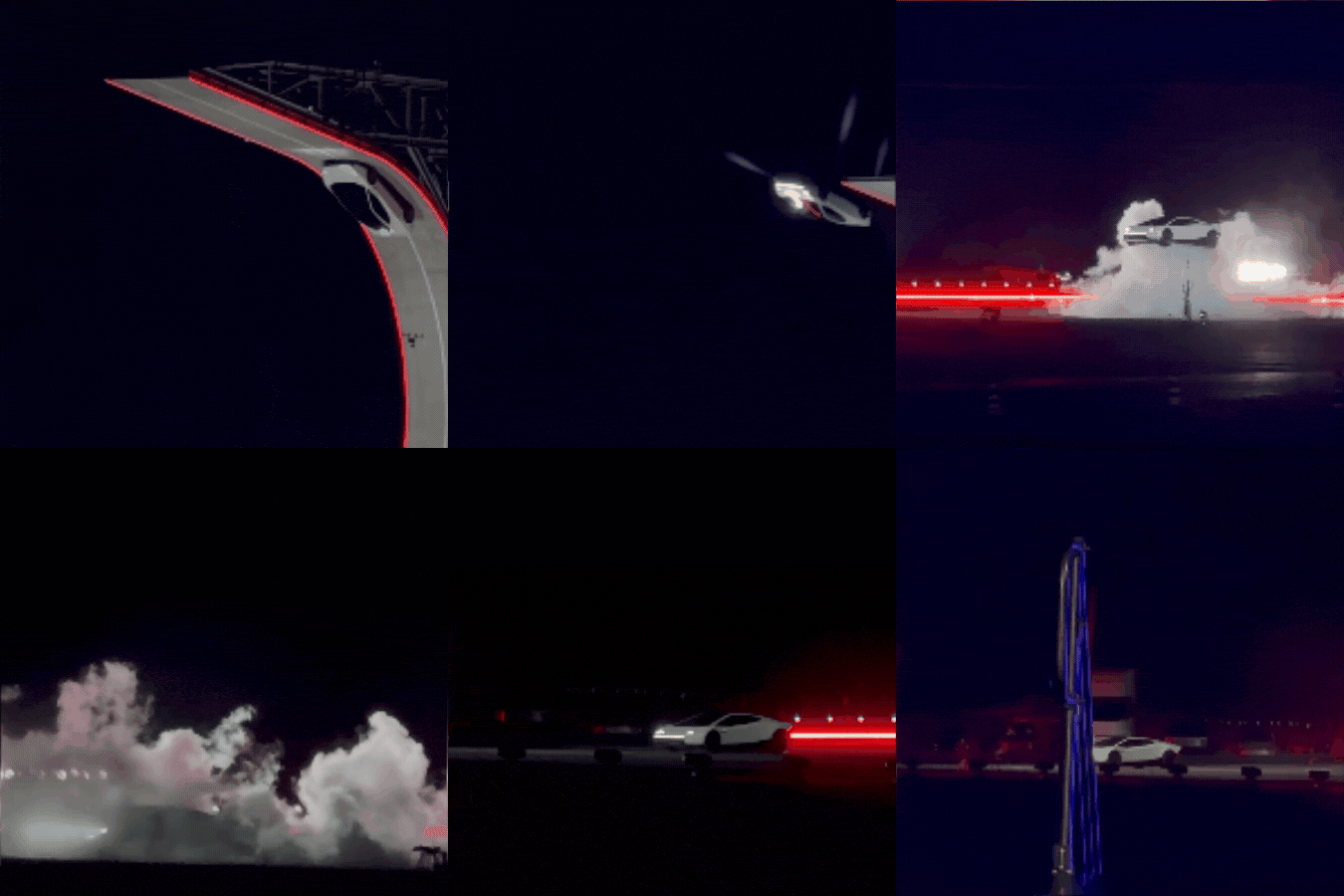
As a car and technology lover, I continue to watch the videos in awe of the engineering required to accomplish this feat.
Tesla’s website framed the night as a reversal: it already put a Roadster in a rocket, and now it’s putting a rocket in a Roadster. That’s a nod to 2018, when a Falcon Heavy carried Musk’s own cherry-red Roadster into orbit around the sun. Musk shared the livestream with three words: “Tesla x SpaceX.”
Read between the lines…the car is the merger in miniature.
Tesla built the body, battery and software, SpaceX built the propulsion, and the stunt only worked because the two companies were already sharing hardware. Analysts now expect the same thing to happen to the companies themselves.
The Roadster is a corporate strategy you can watch do a backflip.
Merger Rumors: What’s Being Reported
Barclays put a date on the idea Wednesday. Analyst Dan Levy wrote that a merger could be announced before Tesla’s annual meeting, which has to happen by December 6. His base case is SpaceX buying Tesla in an all-stock deal at roughly 0.7 SpaceX shares per Tesla share, plus a premium.
Quick vocabulary stop: “all-stock” means no cash changes hands. Tesla shareholders would swap their shares for SpaceX shares at a fixed exchange ratio and end up owning a slice of the bigger company.
Barclays expects the pitch to be AI integration, tying Tesla’s Robotaxi and Optimus robots to SpaceX’s Grok and Macrohard programs. Levy called Terafab, the chip fab the two are building in Texas, a key driver, since Musk believes both companies will need its output.
Then Thursday, Musk raised his own forecast (as he is wanton to do from time to time).
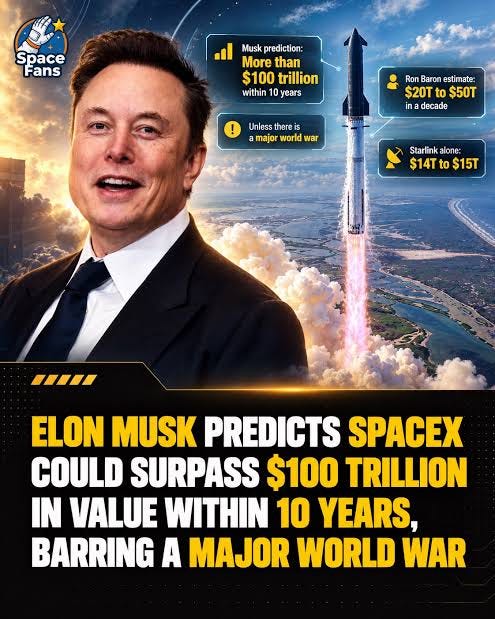
Ron Baron had predicted SpaceX would reach $20 to $50 trillion, and replying to a clip of that, Musk posted that SpaceX probably passes $100 trillion within ten years unless there’s a major world war. For scale, SpaceX’s market value was about $2.07 trillion at Wednesday’s close, and the IMF projects the entire global economy at $126 trillion this year.
Eight months from the xAI deal to a Barclays deadline call. The gold marker is the latest date Tesla can hold its annual meeting, which is why analysts are circling it.
They Already Behave Like One Company
Strip out the headlines and the operational overlap is pretty compelling.
Grok (the underlying AI frontier model) runs in Tesla vehicles.
Starlink is being built into the Cybercab.
SpaceX buys Megapacks to smooth power demand during AI training runs.
Tesla’s $2 billion investment in xAI turned into roughly 19 million SpaceX shares when SpaceX bought xAI.
On Tesla’s July earnings call, Musk said there’s “more and more overlap” between the two. He then added that combining companies isn’t something he could discuss on an earnings call.
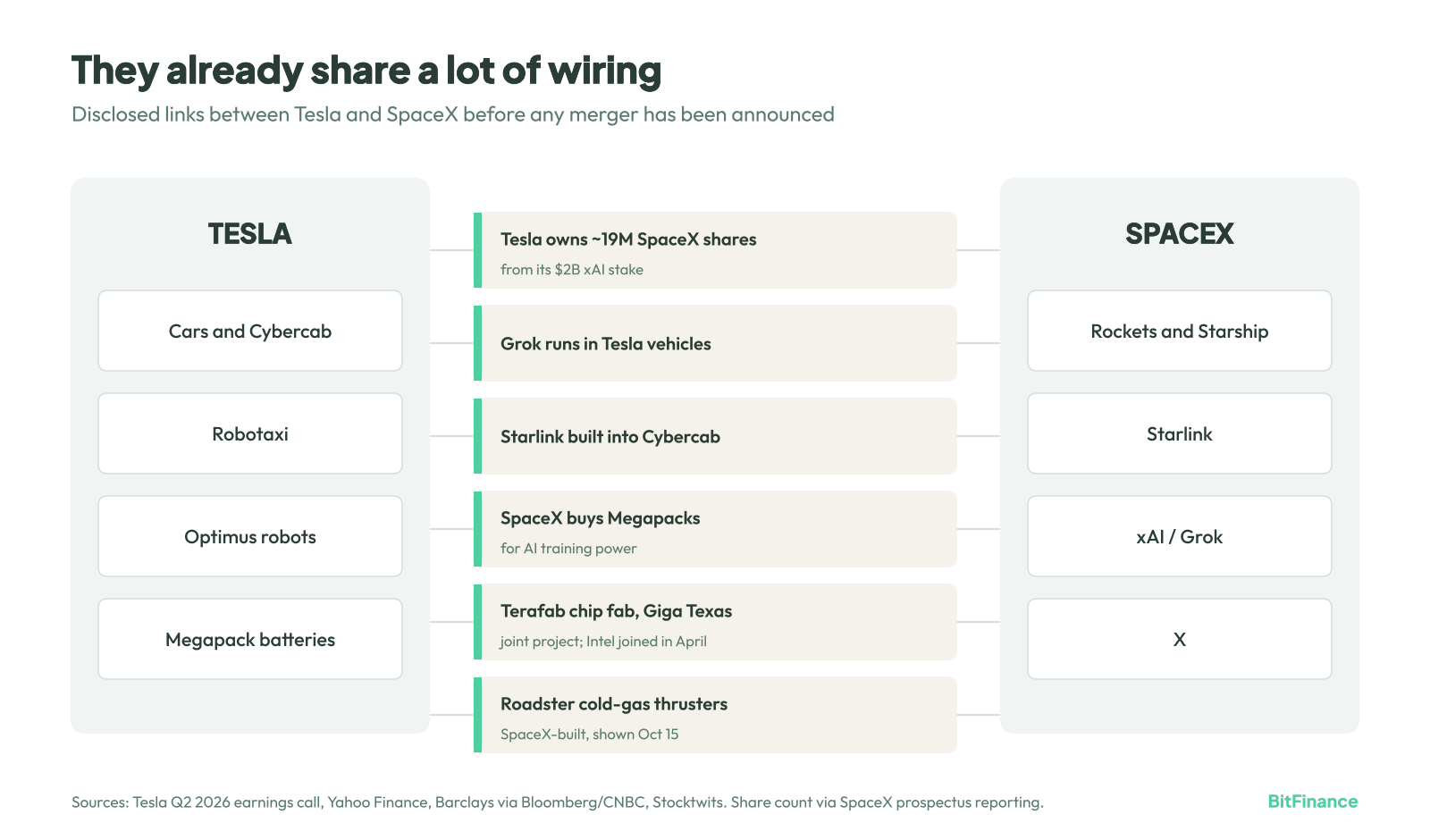
Every link in the middle column exists today. A merger would formalize these connections more than it would create them.
The Rockefeller Comparison
Love him or not, (and plenty of people land firmly on “not,”) what Musk is assembling has a historical shape.
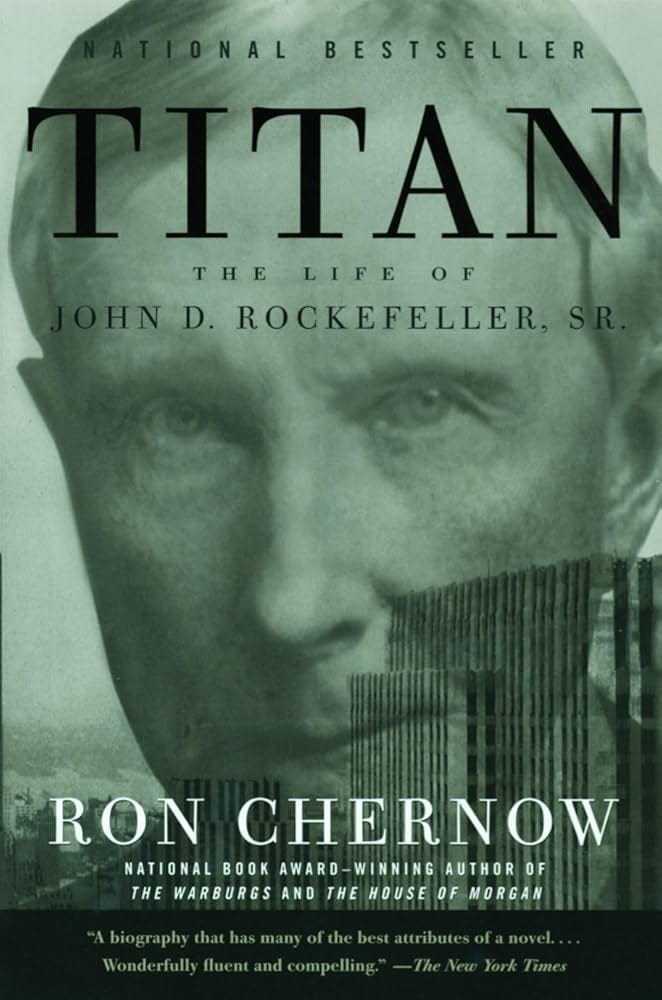
Within a decade of 1870, John D. Rockefeller bought 22 of Cleveland’s 26 refineries. He then moved into pipelines, tankers and warehouses so Standard Oil controlled every step from the well to the customer. Cornelius Vanderbilt did something similar with rails, merging the New York Central and Hudson River Railroad in 1869 and folding his other lines underneath it.
Quick PSA - READ THIS BOOK; 11/10 would recommend.
Musk’s version runs from launch pads to satellites to AI models to chips to cars to robots to batteries. Those men would recognize the strategy, even if the products would baffle them.
The comparison cuts both ways, and it should. Standard Oil was broken up in 1911. Empires built around one person tend to attract regulators, and they tend to depend heavily on that person.
What 1 Musk Co. Would Look Like
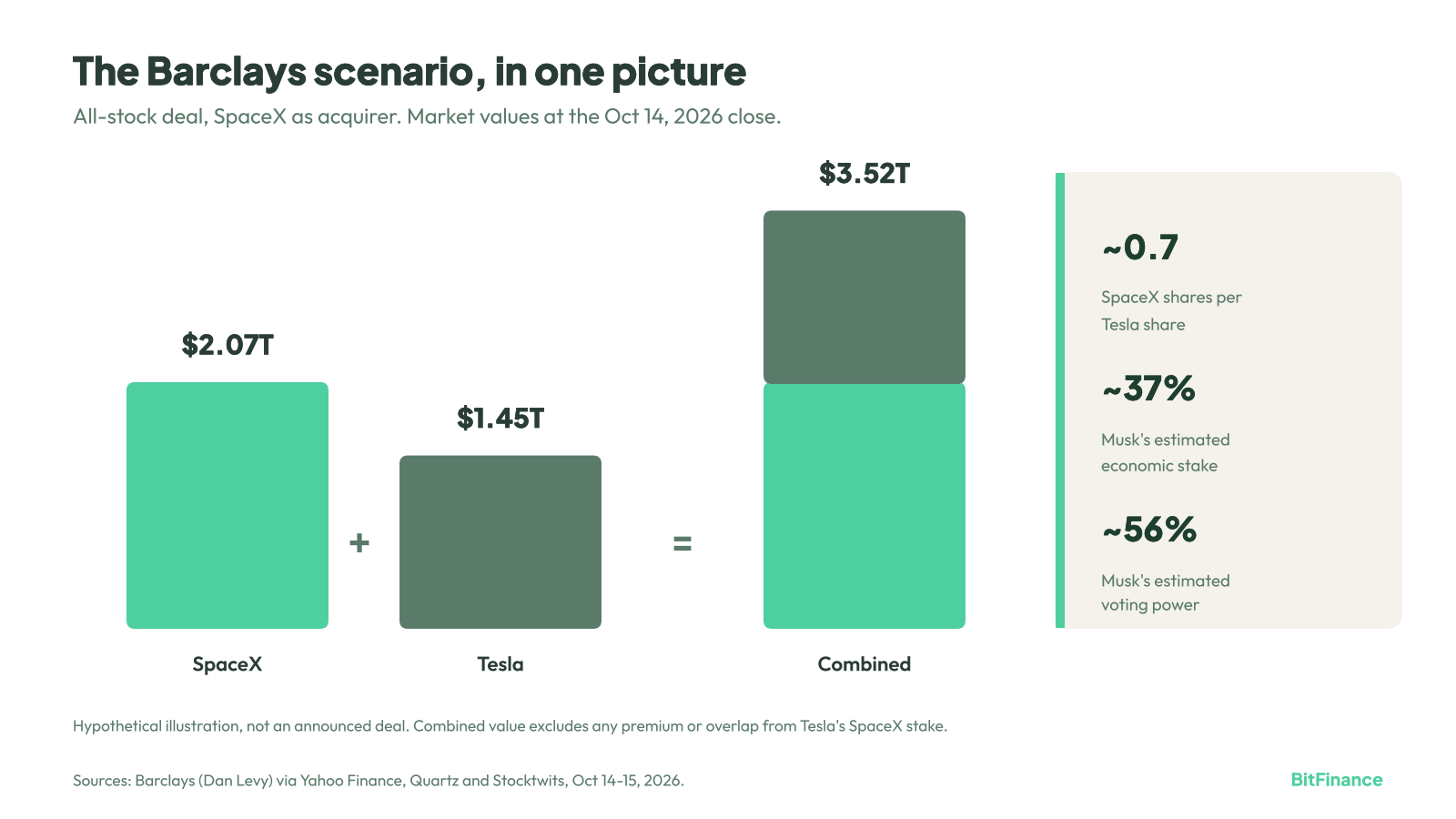
Barclays’ scenario at Oct 14 prices. The combined bar is a simple sum. A premium for Tesla holders and Tesla’s existing SpaceX stake would both change the final math.
On Barclays’ numbers, the combined company would be worth roughly $3.5 trillion before any premium. Musk would own about 37% of it and control about 56% of the vote. Together the two hold 30,221 bitcoin, 18,712 at SpaceX and 11,509 at Tesla. That would put the merged balance sheet among the largest corporate bitcoin treasuries in the world.
The revenue is younger than the valuation. SpaceX reported $7.8 billion of second-quarter revenue, up 92% from a year earlier, alongside a $541 million net loss. Musk has told analysts SpaceX internally projects $1 trillion of revenue in 2030, roughly 30 times today’s annualized pace.
Where the Friction Lives
Barclays calls shareholder approval the central obstacle, since both companies would likely need a vote. At Tesla’s 2025 meeting, broker non-votes, which count against a proposal, made up about 11% of outstanding votes.
There’s also a national-security wrinkle, given SpaceX’s government contracts and Tesla’s large operations in China.😬
Governance is where I’d spend the most time.
Musk sits on both sides of this table. He controls the large majority of SpaceX’s voting power and a much smaller share of Tesla’s. The exchange ratio he effectively negotiates with himself decides how much of Tesla’s value moves where.
The commentary is split. Ross Gerber posted after the demo that the deal “has become obvious.”
Gene Munster saw an engineering flex with little commercial value beyond embarrassing other automakers, though he read it as Musk signaling he wants the companies combined. Wedbush’s Dan Ives puts the odds of a deal closing in 2027 at 80% to 90%, while prediction markets gave it 24% odds by year-end. Nothing has been announced or filed.
The Buffett Framework Question
If you couldn’t sell for ten years, would you rather own Tesla and SpaceX as two companies sharing a CEO, or as one company with that same CEO? Then ask who sets the price of finding out. When the buyer and the seller report to the same person, the exchange ratio is where shareholders win or lose, whatever the synergies look like.
Sticking the Landing
That Roadster stayed in the air for a few seconds on a tank of compressed gas.
The engineering was real, the hardware was shared, and the landing held. Whether it becomes a car people drive is a separate question with a 2028 answer.
The merger case looks similar to me.
The overlap is documented, the AI logic hangs together, and Musk has built industries before. A demo can’t show what Tesla holders would accept on price, or how much control they’d give up. It also can’t show whether one company can carry this many moonshots on one person’s attention. Fans will see a modern Vanderbilt and skeptics will see key-man risk with a ticker symbol, and both are looking at the same machine.
If this gets announced before December, would you vote for it as a Tesla shareholder?
Hit reply, I’d like to hear where you land.
Matthew Snider is the founder of BitFinance and principal at Block3 Strategy Group, where he advises emerging digital asset fund managers and RIAs on fund operations and compliance frameworks. He holds both Series 65 and Series 7 licenses, and is the author of Warren Buffett in a Web3 World.
This article is for informational and educational purposes only and does not constitute investment, legal, or tax advice, or a recommendation to buy or sell any security or digital asset. Digital assets and the securities discussed here are highly volatile and can result in the total loss of principal. Past performance does not guarantee future results. Consult your own financial, legal, and tax advisors before making any investment decision.
Sources
KWTX: ‘A rocket car’: Elon Musk unveils new flying Tesla Roadster in McGregor (Oct 16, 2026)
Stocktwits: Munster on the Roadster as a Tesla-SpaceX clue (Oct 16, 2026)
Benzinga: Ross Gerber says SPCX-TSLA merger is obvious (Oct 16, 2026)
Quartz: Barclays says Tesla-SpaceX merger could be announced before AGM
CNBC: SpaceX-Tesla merger is an appealing idea to management, Barclays says
Stocktwits: Musk sees SpaceX topping $100 trillion in under 10 years (10.15.26)
Benzinga: Musk says SpaceX could top $100 trillion within a decade (10.15.26)
BigGo Finance: SpaceX market cap vs. IMF global economy projection (Oct 2026)
Yahoo Finance: What it would take for SpaceX to be worth more than Earth’s economy (Oct 2026)
Yahoo Finance: Elon Musk hints at Tesla-SpaceX merger (Oct 2026)
Yahoo Finance: Barclays merger call vs. prediction-market odds (Oct 15, 2026)
Reuters via Investing.com: Musk keeps Tesla-SpaceX merger speculation alive
PurePowerPicks: Tesla’s SpaceX stake and merger timeline (Oct 2026)
BitcoinTreasuries: SpaceX confirms it held all 18,712 bitcoin through Q2 2026
Journal of Petroleum Technology: John D. Rockefeller, the man who built America
National New York Central Railroad Museum: New York Central history