The $4 Trillion Handoff: What AI Agents Should Never Do With Your Money

More than $1 trillion a year in financial services revenue is about to be up for grabs. By 2035, that figure could reach $4 trillion.
That’s the projection from a new model by Joseph Chalom, CEO of the Ethereum treasury company SharpLink, and it describes a shift most people haven’t noticed yet. Millions of everyday money decisions are moving from people to software: where your cash sits, when your loans get refinanced, what gets sold for a tax loss, and what gets borrowed against.
Every bank, broker, payments network and crypto platform wants to own the agent that makes those calls for you. Chalom counts Visa, Mastercard, Stripe, Coinbase and Robinhood among the firms already competing, with JPMorgan and BlackRock watching closely.
Whoever wins, Chalom writes, “decides which products the agent may recommend and which fund your idle cash could get swept into.”
The prize is your inattention.
A $180 Billion Blind Spot
By Chalom’s estimate, American households keep roughly $15 trillion in checking, savings and short-term deposits, and miss out on at least $180 billion a year in interest.
YEs, you read that right…$15 TRILLION in cash or cash equivalents.
With interest rates rising this makes a lot of intuitive sense. Why bother making risky plays with your cash when it can earn up to ~4% in some savings instruments.
The FDIC’s national average for interest checking was 0.07% this month, and savings averaged 0.37%. A government money market fund, which holds short-term Treasury debt and pays close to current rates, yielded 3.63% the same week.
Ironically however, folks can earn higher yields using stablecoins with standard rates at exchanges hovering above 4%.
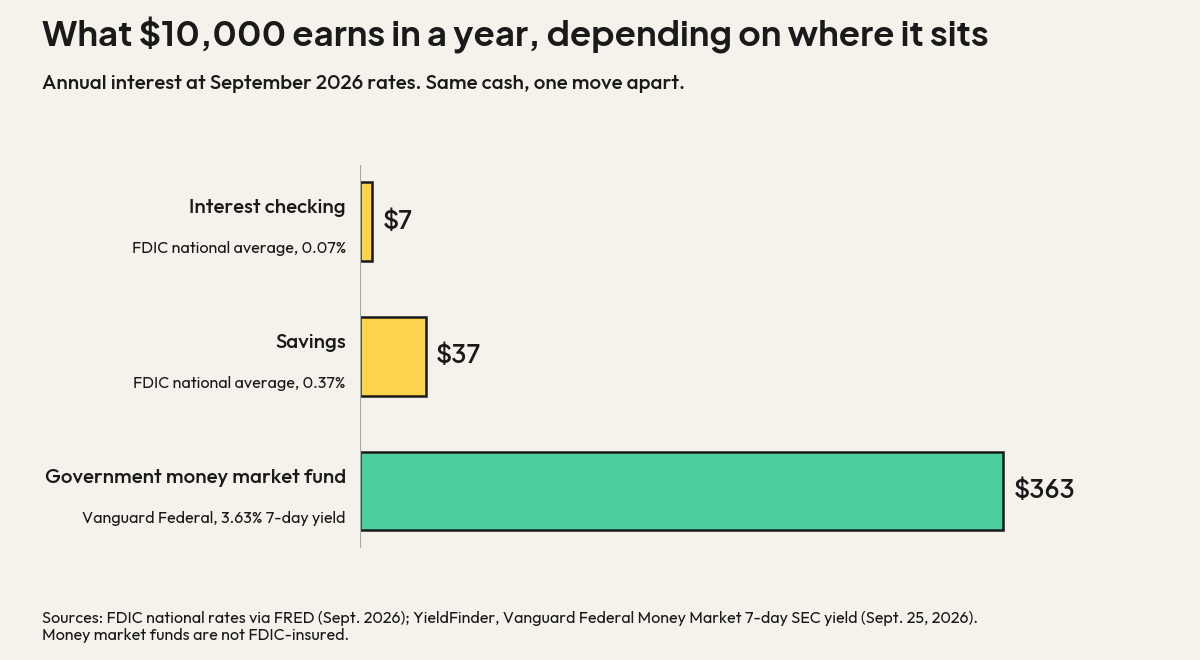
One move separates $7 from $363. Money market funds aren’t FDIC-insured, which is the trade-off to understand before switching.
Nobody chooses to earn $7 on $10,000. It happens because a CD matures and sweeps back into checking, and life gets busy. An agent doesn’t get busy. “An agent does not forget,” Chalom writes, and for this kind of mistake, memory is the cure.
I’d let an agent fix that tomorrow. The same agent that sweeps your cash, though, is being built to do a lot more.
The $19 Billion Day
Chalom’s model goes further down the list. He describes agents that lend out your tokenized stocks for extra income, pledge them as collateral, and borrow against them so you can “access liquidity without selling.”
Borrowing against an asset means a lender holds it as collateral. If the price falls far enough, the lender sells it automatically to get repaid, which is called a liquidation. You don’t get a vote, and you don’t get the asset back.
On October 10, 2025, more than $19 billion of leveraged crypto positions were liquidated in 24 hours, the largest single-day event on record, according to CoinDesk research. The systems that did it worked exactly as designed, which is the uncomfortable part.
Each of those positions had been set up so that one bad day couldn’t be undone.
I’ve watched a small version of this on my own screen. Earlier this year I built a paper-trading bot to accumulate a crypto position on a schedule. It never got tired, never got bored, and followed its rules to the letter.
In a 30-day replay it lost 0.6%, while holding the same asset and doing nothing gained 1.15%.
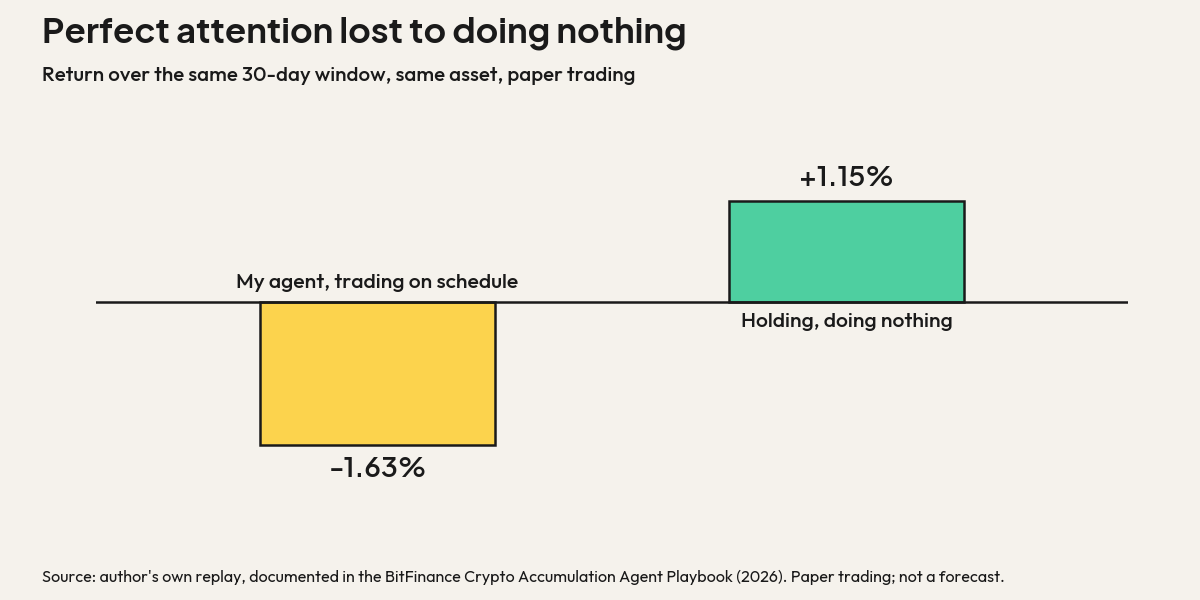
My own replay, paper trading only. A small sample, but a clean illustration of attention without judgment.
The rules were the weak point, and more attention only meant the bot acted on them more often. This is problematic for accounts that pay fees on transactions and a case for just buying and holding in some cases.
As Buffett once said: “hyperactivity is the pickpocket of enterprise”.
Every Money Decision is a Door
Jeff Bezos has the best language I know for the difference.
In his 2015 letter to Amazon shareholders, he split decisions into two kinds. Some are “one-way doors,” consequential and nearly irreversible, and he said those should be made “methodically, carefully, slowly.”
Most are two-way doors. If you get one wrong, you walk back through and try again.
Moving idle cash into a money market fund is a two-way door. Borrowing against your stock portfolio at 2 a.m. because a model liked the rate is a one-way door.
My hypothesis, is that personal finance has two kinds of expensive mistakes.
The first is omission: the cash you forgot, the CD that rolled over, the rebalance you never got around to.
The second is commission: the leverage you took on, the stock you sold at the bottom, the loan you signed because the rate looked good that week.
Agents are built to erase the first kind, and they can make the second kind happen faster.
The Reversibility Ladder
So instead of asking whether an agent should manage your money, ask which doors it’s allowed to open alone. I sort Chalom’s own list into three tiers.
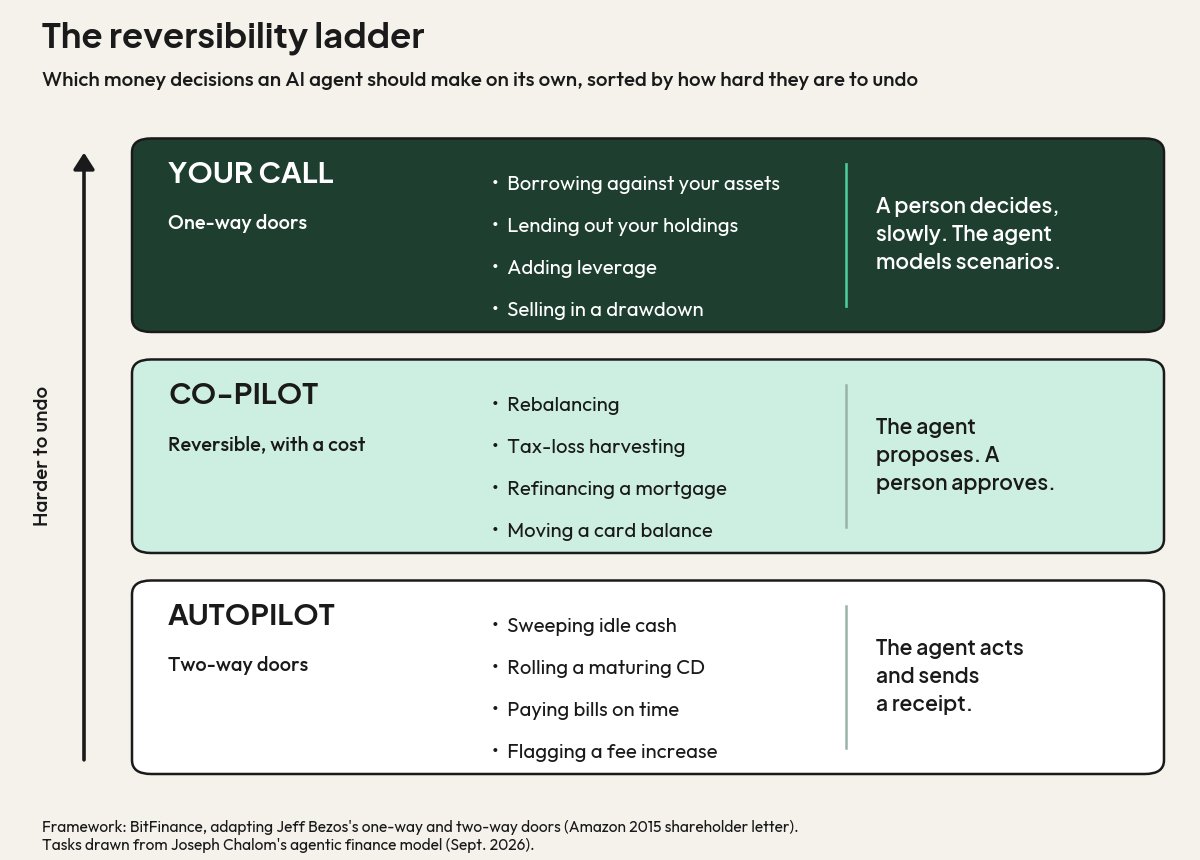
Sorted by how hard a mistake is to undo. The line between tiers will move as agents improve, but the order shouldn’t.
Autopilot. Two-way doors with small stakes: sweeping idle cash, rolling a CD, paying bills on time. Let the agent act and send you a receipt.
Co-pilot. Reversible, but with tax or cost consequences: rebalancing, tax-loss harvesting, a refinance, moving a card balance. The agent runs the analysis and proposes, and a person approves.
Your call. One-way doors: borrowing against assets, lending out holdings, adding leverage, selling in a drawdown. The agent can model scenarios all day, and a person makes the decision, slowly, the way Bezos described.
Where Your Advisor Stands
That top tier is where I think your investment advisor’s job ends up.
Rebalancing and cash management are turning into commodity tasks, and an advisor charging 1% a year mainly for those should feel the floor moving.
Sitting with a client before a one-way door, and sometimes talking them out of walking through it, gets more valuable as agents make every door faster to open.
AI plus an advisor beats AI alone because the advisor stands at the one-way doors.
The agentic protocols I’ve spent time with this year point the same way.
At Sherwood Protocol, whose founders I spoke with this month, an agent can only propose a trade, and shareholders can vote it down before it runs.
Ownership matters here too. An agent with unlimited attention still works for somebody, so find out who before you hand it the keys. In fairness, the same applies to Chalom: SharpLink holds ETH, and his conclusion that agent activity will concentrate on Ethereum fits that position.
There’s a fair case against my ladder.
Agents will get better at judgment, and some guardrails can be written into code, like a hard cap on how much of a portfolio can ever be borrowed against. People aren’t great at one-way doors either, advisors included, and plenty of investors would do better with an agent’s discipline than with their own instincts in a panic. I’d expect the line between co-pilot and your call to move over time.
The $4 trillion handoff is coming, and most of it will be good for savers. Agents will close the $180 billion blind spot and a lot more. At every door that only opens one way, I’d still want a person and a plan written on a calm day.
Which money door would you never let an agent open for you?
Reply and tell me. I read every response.
Matthew Snider is the founder of BitFinance and principal at Block3 Strategy Group, where he advises emerging digital asset fund managers and RIAs on fund operations and compliance frameworks. He holds both Series 65 and Series 7 licenses, and is the author of Warren Buffett in a Web3 World.
This material is for informational and educational purposes only and does not constitute investment advice, a recommendation, or an offer to buy or sell any security. Nothing herein should be construed as a personalized recommendation. Digital assets involve substantial risk, including total loss of principal. Past performance is not indicative of future results. Consult your own financial, tax, and legal advisors before making investment decisions. The author may hold positions in assets discussed.