5 AI Investments Beyond NVIDIA Advisors Don't Know

Ask a financial advisor to name five AI stocks and you will get some version of the same list: NVIDIA, Microsoft, Alphabet, Meta, Amazon. Maybe Tesla if they are feeling adventurous. Maybe Broadcom if they read Barron’s last weekend.
Don’t get me wrong, these are important companies doing some pretty epic things. But it’s incomplete in a way that matters for portfolio construction.
The AI investment landscape in 2026 has expanded well beyond the hyperscaler CAPEX cycle.
There are companies building AI applications in healthcare that have nothing to do with GPU demand.
There are infrastructure plays outside the United States that most domestic allocators have never evaluated.
There are ETFs providing thematic exposure to corners of the market that do not appear in any standard screen.
My thoughts below to not constitute a recommendation list. Instead, it’s intended to be a framework for thinking about where the AI value chain extends, and five names that illustrate each layer. Some are speculative. Some are volatile. All of them are worth understanding.
1. THE APPLICATION LAYER
Tempus AI (TEM)
Precision Medicine Meets Machine Learning
Price: ~$53 | Market Cap: ~$9.5B
2025 Revenue: $1.27B (+83% YoY)
2026 Guidance: ~$1.59B revenue, ~$65M Adjusted EBITDA
Net Revenue Retention: 126%
Balance Sheet: $760M cash | 63% gross margin
Most AI investment conversations start and end with infrastructure. Who is selling the picks and shovels. Tempus is a reminder that the more interesting long-term question might be: who is building something with those tools that actually changes outcomes?
Founded in 2015 by Eric Lefkofsky after his wife’s breast cancer diagnosis, Tempus has assembled one of the world’s largest libraries of multimodal healthcare data: over 200 petabytes of de-identified clinical records, genetic profiles, and imaging data.
The company partners with more than 2,400 hospitals and works with 19 of the top 20 pharmaceutical companies. It’s the largest cancer testing company in the United States.
The business model has a flywheel structure that Buffett would recognize. Every diagnostic test generates data. That data improves the AI models. Better models attract more hospital and pharma partners. More partners generate more tests. The information advantage compounds.
Tempus recently acquired Ambry Genetics (germline testing) and Paige.AI (digital pathology), deepening the moat further. The Data & Services segment is approaching 70% margins, which is software-like economics layered on top of a healthcare testing business.
Why It Belongs on Your Radar
The AstraZeneca deal to build a foundation model using Tempus’s entire 400-petabyte database tells you something about how pharma values this data. Roughly 30% of solid tumor DNA testing has migrated to the higher-priced version, reimbursed at $4,500 versus $3,000 for the standard assay, and management expects the majority of volume to shift by year-end. That’s a 50% price uplift on the same test volume. Pricing power like that typically signals genuine differentiation.
Merck announced an expanded multi-year collaboration with Tempus just this week. Cathie Wood’s ARK bought 213,000 shares the day after earnings. Google is a strategic investor. The institutional validation is building.
What Could Go Wrong
Tempus is still unprofitable on a GAAP basis. Net margin is roughly negative 19%, and debt-to-equity is over 250%. Revenue growth is decelerating from 83% to a guided 25%, and the stock sold off after a beat-and-raise quarter, which tells you the market wants sustained profitability, not just top-line expansion. Reimbursement risk is the silent variable: if CMS or private payers do not expand coverage for AI-driven assays, the unit economics shift.
Competition is real. Guardant Health in liquid biopsy. Exact Sciences in oncology diagnostics. Natera in minimal residual disease testing. The hyperscalers themselves could build competing platforms, though they lack the longitudinal patient data Tempus has accumulated over a decade.
Buffett Framework Question: Does this company have a durable competitive advantage that gets stronger over time, or can a well-funded competitor replicate it in five years? The data flywheel is the answer. You cannot replicate a decade of clinical partnerships and 200 petabytes of patient data with capital alone.
2. THE INFRASTRUCTURE LAYER
Nebius Group (NBIS)
The European AI Cloud You Haven’t Heard Of
Price: ~$87 | Market Cap: ~$23B
Q4 2025 Revenue: $228M (+547% YoY)
ARR Target: $7-9B by end of 2026
Contracted Power: 3GW+ (targeting 800MW-1GW connected by year-end)
Key Contracts: Microsoft ($19B), Meta ($3B)
If you’ve been following the AI infrastructure conversation, you have heard of CoreWeave. You might know IREN. Almost nobody outside of institutional tech circles is talking about Nebius, and that is precisely what makes it interesting.
Nebius is the former international arm of Yandex, Russia’s largest search engine, now fully separated and headquartered in Amsterdam. It has reinvented itself as a full-stack AI cloud provider with a structural advantage that no American neocloud can replicate: a European footprint that satisfies EU data sovereignty requirements under the AI Act.
What separates Nebius from a commodity GPU rental business is the software layer. The company reports a 100% attach rate on its proprietary AI cloud software, meaning every compute customer also uses Nebius tools.
In Q4, average selling prices increased by more than 50% while contract durations lengthened. That’s what I would consider pricing power, not just volume growth. The customer base includes hyperscalers like Microsoft and Meta alongside AI-native companies like Cursor and Black Forest Labs.
Why It Belongs on Your Radar
Nebius is the first cloud provider in Europe with production deployments of NVIDIA’s GB300 systems. As EU data sovereignty requirements tighten, that positioning becomes a genuine moat. No other neocloud has it. BlackRock has made a significant strategic investment, providing both institutional validation and balance sheet support.
The revenue diversification matters. Unlike some infrastructure peers that derive half or more of their revenue from a single contract, Nebius has a broader customer mix across hyperscalers and AI-native startups. The software layer creates stickiness and margin expansion potential that pure infrastructure providers do not have.
What Could Go Wrong
The stock trades at roughly 60x trailing price-to-sales. The $7-9B ARR target for year-end 2026, against approximately $1B in current ARR, requires near-flawless execution through a capital-intensive buildout. The Yandex heritage creates ESG and geopolitical noise that some institutional allocators cannot look past. And if you apply more conservative analyst estimates of $3-3.4B in actual 2026 revenue, the valuation still needs years of growth to justify the current multiple.
Buffett Framework Question: Is the European data sovereignty moat a real competitive advantage, or a temporary regulatory artifact? If the AI Act enforcement tightens as expected, every enterprise running AI workloads on European data will need a European-domiciled cloud. Nebius is building that before anyone else.
3. THE PLATFORM LAYER
Palantir Technologies (PLTR)
The Contrarian Entry Point
Price: ~$137 | Market Cap: ~$325B
FY 2025 Revenue: $4.48B (+56% YoY)
2026 Revenue Guidance: $7.18-7.20B (+61% growth)
Profitability: $1.63B net income | GAAP profitable 3 years running
Balance Sheet: $7.2B cash | $0 debt
Rule of 40: 127% | Adj. Operating Margin: 50%
Everyone knows Palantir’s name and most people I speak to think they’ve missed the boat. The stock ran from $6 in late 2022 to $207 in November 2025, and the instinct is to file it under “too late.” That instinct deserves examination.
Palantir has pulled back over 30% from its highs while the underlying business accelerated. U.S. commercial revenue grew 137% in Q4. The company guided for 61% total revenue growth in 2026, substantially above what analysts were modeling. Net dollar retention hit 139%, meaning existing customers are spending nearly 40% more year over year without Palantir having to re-acquire them. The balance sheet is pristine: $7.2 billion in cash, zero debt.
The business model is evolving in a way worth understanding. Palantir’s Artificial Intelligence Platform (AIP) has become the growth engine, allowing enterprises to deploy large language models on their own data with governance controls. The company runs intensive “bootcamp” workshops where potential customers build live applications in days. Once organizations integrate Palantir into their operations, switching costs become extremely high. The 54% government / 46% commercial split tells you this is no longer the defense contractor the market remembers from 2020.
Why It Belongs on Your Radar
Palantir has something genuinely rare in enterprise software: a platform that works when data is incomplete or fragmented. Most AI tools require clean, structured data to produce useful outputs. Palantir’s ontology layer can reason across messy, real-world data environments. That capability is what earns it Impact Level 6 security clearance and $10 billion Army contracts. It is also what makes the commercial product sticky enough to sustain 139% net retention.
The recent pullback creates a valuation conversation that was impossible three months ago. The stock is down over 30% from highs. For growth-oriented allocators who could not justify the entry at $200, the question at $137 is whether the business quality justifies a still-premium multiple.
What Could Go Wrong
The valuation. Even after the pullback, Palantir trades at roughly 200x trailing earnings. That multiple requires sustained 50%+ growth for years, which history suggests is extraordinarily difficult for any software company at this revenue scale. Michael Burry has disclosed a short position. RBC maintains a $50 price target. Citi upgraded it to “Buy/High-Risk,” which is a rating that tells you everything about the tension in this name.
If AI platform spending normalizes, if government budgets face pressure, or if the commercial growth rate decelerates meaningfully from 137%, the multiple compression would be severe. This is a high-conviction position, not a core allocation. Position sizing matters enormously.
Buffett Framework Question: Would you hold this through a 50% drawdown? At 200x earnings, you need to believe the business quality is so extraordinary that normal valuation frameworks do not apply. Some of the best businesses in history have traded at extreme multiples and rewarded patient holders. Most have not.
4. THE GEOGRAPHIC DIVERSIFICATION PLAY
Franklin FTSE South Korea ETF (FLKR)
The AI Trade Nobody Saw Coming
Price: ~$47 | AUM: ~$550M
1-Year Total Return: ~140%
YTD (EWY comparable): +41% vs. SPY +0.6%
Expense Ratio: 0.09%
Valuation: ~10x P/E | ~2.5% dividend yield
Here’s a number that should stop you: South Korea’s KOSPI index crossed 6,000 for the first time in history this year. The iShares MSCI South Korea ETF has returned over 41% year to date. The S&P 500 is up less than 1% over the same period.
Most U.S.-focused advisors have no South Korea allocation and have never considered one. That is worth examining, because the thesis is not really about South Korea. It is about the AI semiconductor supercycle, and the fact that two of the most important companies in that cycle, Samsung Electronics and SK Hynix, happen to be Korean.
The AI buildout requires memory chips. Lots of them. High-bandwidth memory (HBM) is the bottleneck component in every major GPU system, and SK Hynix is the dominant supplier. Samsung is ramping aggressively into the same market. When Goldman estimates that U.S. data center demand will exceed supply by 10 gigawatts per year through 2028, the memory suppliers are a direct beneficiary. FLKR gives you that exposure at a 0.09% expense ratio, which is a fraction of the cost of the comparable iShares product.
Why It Belongs on Your Radar
The valuation contrast is striking. FLKR trades at roughly 10x earnings with a 2.5% dividend yield. Compare that to any U.S. tech ETF. You are getting AI semiconductor exposure at an emerging market discount. The U.S.-South Korea trade deal, which includes $150 billion in Korean investment in American shipbuilding and $200 billion in additional earmarked spending, provides a geopolitical tailwind that was not present six months ago.
For advisors who need to diversify client portfolios away from U.S. large-cap concentration, FLKR accomplishes two things at once: geographic diversification and AI thematic exposure. That is a useful combination in the current environment.
What Could Go Wrong
The semiconductor cycle is exactly that: a cycle. Memory chip prices are notoriously volatile, and Samsung and SK Hynix have both experienced brutal downturns in the past. The recent tariff drama, where President Trump threatened to hike tariffs on South Korean goods to 25% over legislative delays in codifying the trade deal, is a reminder that geopolitical risk cuts both ways. Currency exposure adds another variable. And concentration risk is real: the top holdings are heavily weighted toward semiconductors and the technology sector.
Buffett Framework Question: Are you buying a country or an industry? If you are making a semiconductor bet, own it as a semiconductor bet. If you are making a geographic diversification argument, understand that this ETF’s performance is driven primarily by two companies in one sector.
5. THE MOONSHOT
Themes Humanoid Robotics ETF (BOTT)
The Physical AI Frontier
AUM: ~$32M (small and early-stage)
1-Year Return: +114% (vs. SPY +17%)
Expense Ratio: 0.35%
Holdings Focus: South Korean robotics, Chinese automation
Relaunch: October 2025 under humanoid-specific mandate
This is the most speculative name on the list, and I am including it precisely because it illustrates where the next wave of AI investment may be heading.
BOTT tracks the Solactive Global Humanoid Robotics Index and was relaunched in October 2025 with a narrowed focus on the humanoid robotics ecosystem: service robots, industrial automation, and AI-enabled physical systems. Its top four holdings are South Korean robotics companies, which creates an interesting thematic bridge to the FLKR discussion above. The ETF has returned 114% over the past year compared to 17% for the S&P 500.
The investment thesis rests on a structural trend: aging workforces in developed economies, rising labor costs, and manufacturing reshoring are creating genuine demand for physical automation. Tesla’s Optimus program, which received $20 billion in capex commitment this year, has moved humanoid robotics from science fiction to corporate strategy. NVIDIA’s investment in robotics simulation tools suggests the compute layer is taking physical AI seriously.
Why It Belongs on Your Radar
Not necessarily as an allocation. As an education tool. When clients walk in and ask about robotics investing, advisors should know that a pure-play ETF exists, what it holds, and what the risks are. The fact that most of the holdings are Korean and Chinese companies is itself a useful data point about where the physical AI manufacturing base is being built.
What Could Go Wrong
Nearly everything, from an execution standpoint. The humanoid robotics theme is pre-revenue at scale. Most holdings are betting on a technology category that has not yet achieved mass commercial deployment, meaning performance is driven by sentiment rather than earnings. The $32 million AUM creates meaningful liquidity risk. Thin trading volume means bid-ask spreads can erode returns on entry and exit. And the heavy international concentration in Korean and Chinese companies introduces geopolitical and regulatory risk that adds complexity to any allocation decision.
This is a name you watch, not a name you build a position in. Yet.
Buffett Framework Question: What is the probability that this industry generates meaningful revenue in three years? In five? The answer determines whether this is an investment or a speculation. There is a difference, and Buffett has articulated it better than anyone.
Putting It Together
Five names. Five different layers of the AI value chain.
The point is not that any single one of these belongs in every portfolio. The point is that the AI investment conversation has matured beyond “buy NVIDIA and go home.”
Tempus shows you AI solving a specific, life-or-death problem where the data advantage compounds over time.
Nebius shows you infrastructure being built outside the United States with regulatory moats that American competitors cannot easily replicate.
Palantir shows you an enterprise platform at a moment when price and fundamentals have diverged enough to create a real valuation debate.
FLKR shows you that the semiconductor supercycle is not an American story alone, and that you can access AI exposure at 10x earnings instead of 40x.
BOTT shows you where the market is placing early bets on physical AI, with all the risk and optionality that implies.
The advisors who will serve their clients best in this cycle are the ones who can explain not just what AI is, but where the value is being created, who is capturing it, and what the risks look like at each layer. That requires looking beyond the names everyone already knows.
Which of these five would you allocate client capital to, and at what position size? I genuinely want to know. Hit reply.
- Matthew
X: @bit_finance_
The best investors I know got that way by reading widely and talking to the right people.
If BitFinance belongs in someone’s inbox, send it their way.
Referrals unlock free PDFs, paid access, and more.
***
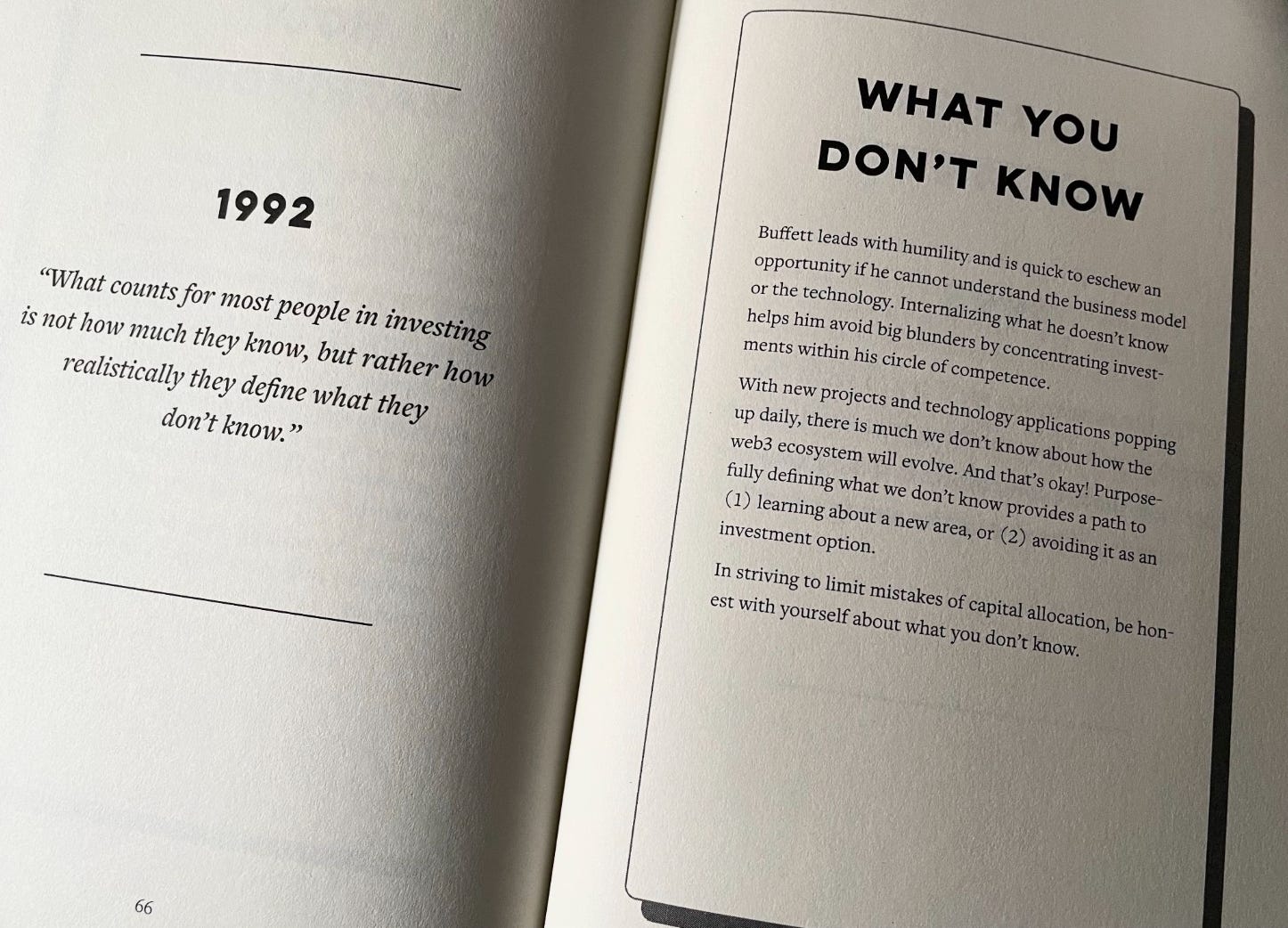
oh! one last thing…if you want to dive deeper into how Buffett’s investing principles applies to digital assets, check out my book.
We took 1,300+ pages of wisdom from the Oracle of Omaha and condensed it into a snackable, easy-to-read guide for digital asset investors. Pick up your copy today!
Matthew Snider is the founder of Block3 Strategy Group, author of “Warren Buffett in a Web3 World,” and publisher of the BitFinance newsletter. He holds a Series 65 and MBA, and has been an active participant in digital asset markets since 2015. This article is for educational purposes only and should not be considered financial advice. Always consult with a qualified professional before making investment decisions.