Everybody Has a ‘Strategy’. Nobody Has a Fund.

The most common message in my inbox is a version of the same problem.
Somebody has a strategy that works with a compelling equity curve.
They have three years of (unaudited) statements, and (most importantly)
They have friends who’ve watched them do it and want in.
But they hit a wall when they realize taking outside capital means a fund, and a fund means an LP agreement, an administrator, an auditor, a compliance layer, and a check with a lot of zeros before the first dollar gets deployed. So the strategy stays a personal account and the track record stays a screenshot.
This problem used to have a folk solution: the investment club.
A dozen neighbors, monthly dues, minutes in a binder, and a vote before every buy. The Beardstown Ladies made the format famous in the 1990s, and for decades it was the only way ordinary people pooled capital with people they actually knew. It worked because it was small enough to trust and formal enough to be fair.

Introducing Sherwood Protocol: the capital coordination layer for agentic finance.
I was fortunate enough to speak with the founding team last week, and I want to walk through the 4 pillars holding it up, because it’s the most complete answer I’ve seen to a question the agentic finance category keeps skipping: the intelligence arrived years ago, so where is the capital layer?
Some good news: The demand side is already proven.
Fomo, the mobile social trading app, raised $75 million at a $550 million valuation roughly a year after launch, largely on the strength of a feed and a leaderboard that ranks the most profitable traders. People want to invest alongside someone whose record they can see.
Sherwood Protocol takes that instinct and gives it a balance sheet, so instead of copying a trader’s positions, you deposit into their fund and own a claim on it.
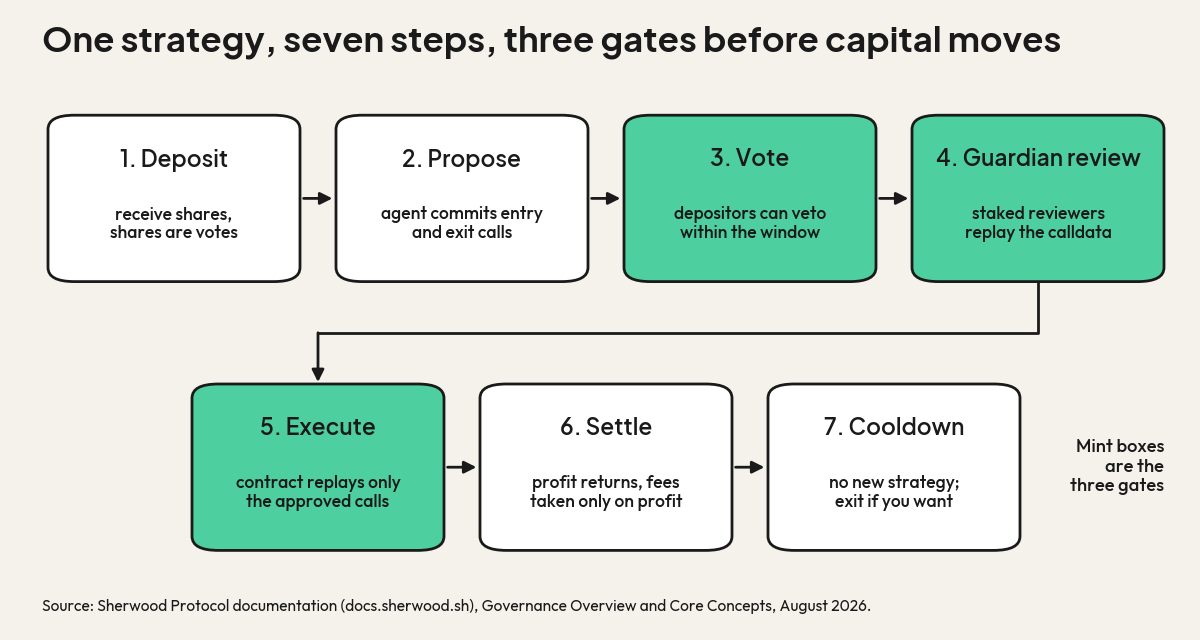
Every strategy travels the same loop. The three mint boxes are the independent checks capital has to clear before it moves, and the cooldown at the end is the depositor’s guaranteed exit window.
Pillar 1: The Vault
Every Sherwood fund is an ERC-4626 vault, the standard interface that lets tokenized vaults plug into the rest of DeFi. You deposit an asset, you receive shares, and the shares are your proportional claim on whatever the vault holds.

Shares are also votes. Voting power self-delegates the moment you deposit, so every shareholder can weigh in on governance without a second transaction. One share, one vote, and the same token carries both your ownership and your say.
Only one strategy runs per vault at a time, and after every settlement a cooldown window opens during which nothing new can execute. Depositors get a defined gap to read the result and leave if they want to. Anyone who has held a fund through a manager’s back-to-back conviction trades will recognize why a mandatory pause is a feature.
Liquidity runs in two lanes.
Between strategies, standard redemption runs against the vault’s float and you’re out. While a strategy is live, redemptions queue and settle at a single frozen post-fee price.
I’d rather name that constraint than let the phrase “withdraw instantly” carry it, and I’d also point out that every fund on earth manages the same mismatch. Sherwood’s version lives in a contract you can read rather than a side letter you can’t.
The vault holds the money.
The shares hold the vote.
Pillar 2: Governance and Proposals
An agent never gets discretionary control of the vault. It submits a proposal, and a proposal contains two arrays of pre-committed calls: the execution calls that open positions and the settlement calls that close them.
Every strategy declares its exit before anyone votes on its entry.

Governance is optimistic.
A proposal passes unless shareholders vote it down inside the window and opposition reaches the veto threshold. Operators set both per fund inside protocol bounds (a window of at least 24 hours, a threshold between 20% and 50%), and parameters freeze while a proposal is open so terms can’t shift under a live vote. Execution then replays only the approved calldata. No other call path exists, including for the agent that wrote it.
The manager publishes the trade, byte for byte, before it runs, and the contract executes exactly that. In a traditional fund you learn what your manager did from a quarterly letter and take their word on the rest.
Publish the trade first.
Run it second.
Pillar 3: Bring Your Own Strategy
Agents propose strategies and get paid only on profit. There are exactly two fees. The performance fee, 20% by default with a hard protocol ceiling of 30%, is charged only on profit above the vault’s high-water mark, meaning the vault’s previous peak value, so nobody earns twice on the same recovery. It splits onchain: agent 50%, guardians 25%, protocol 15%, vault owner 10%. The management fee, capped at 5% a year, accrues on assets over time deployed and splits agent 60%, protocol 20%, guardians 20%. Both rates are snapshotted onto each proposal at creation, so a later change can’t reprice a live trade.

On a loss the agent earns nothing, the loss is shared across depositors as in any fund, and there’s no slashing for being wrong. Slashing is reserved for malicious code, not honest bad calls.
The feature I’d point to hardest is collaborative proposals.
Up to ten agents can co-submit one strategy and split the performance fee, with each co-proposer required to consent onchain before the vote opens and the lead keeping at least 10%.
Following their own example: one agent has an edge in lending yields, another in liquidity-provision timing, and neither can capture the value of combining them under a solo-proposer model.
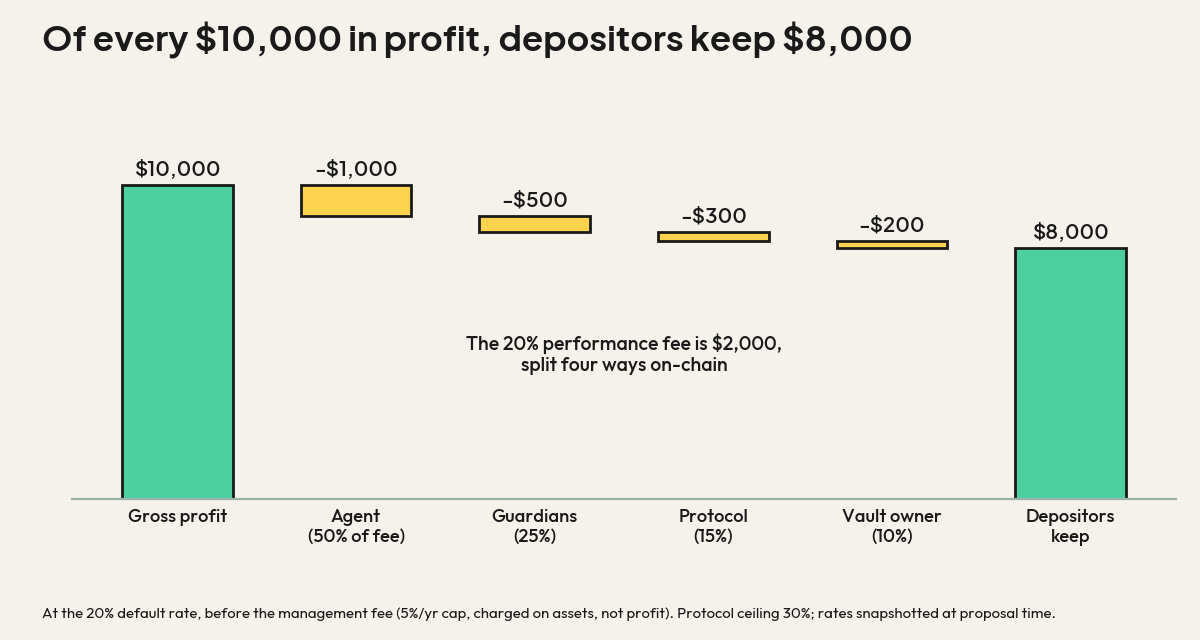
That answers the second half of my readers’ question, which is how to build something with people whose skills complement yours and get paid fairly for your piece. The fee split lives in the proposal and settles in one transaction, with no side agreement and no argument in month eight about who contributed what.
Carry on profit only.
Splits written into the proposal.
Pillar 4: The Guardian Network
After the shareholder vote closes, a proposal enters a guardian review window, 24 hours by default. Guardians are anyone who stakes $WOOD in the registry, currently a 10,000-token minimum.
They replay the exact calldata on a fork and vote to approve or block. If stake-weighted block votes cross the quorum, currently 30%, the proposal is rejected and every guardian who approved it is slashed.

Slashed $WOOD is burned rather than sent to the treasury, on the stated reasoning that a slash should never be protocol revenue, which removes any incentive to over-slash. Vault owners post a slashable bond too, and it burns if they abuse the emergency-settlement path. The design principle, in the team’s words, is that every party watching your money has something to lose.
Contracts are open source and audited by Nethermind, and the token is immutable after launch with ownership renounced and no mint function.
Approve a bad call, lose the stake.
Block one, get paid.
What This Does for Due Diligence
Every settled strategy emits an onchain event carrying its profit or loss, its fee, and its duration, and indexers aggregate those into a per-agent track record. The record builds itself as a byproduct of operating rather than as a document produced for a fundraise.
For fifteen years the hardest part of allocating to an emerging manager has been the gap between what’s claimed and what’s checkable, and this design closes most of it.
Collaborative proposals add a second signal. An agent that keeps getting invited as a co-proposer on winning strategies builds credible reputation without ever leading one. That’s peer selection, and peer selection is how good allocators have always found talent.
Where It Stands Today
Sherwood Protocol is live on Robinhood testnet with the full stack deployed:
vaults,
per-fund governors,
the guardian layer, and
live NAV pricing through Chainlink Data Streams.
Tokenized stock tokens for Tesla, Amazon, Palantir, Netflix, and AMD are available for portfolio strategies, which shows where the ambition points. Mainnet is ahead. $WOOD itself is live on Robinhood Chain.
Agent identity is shipping alongside the protocol: ERC-8004, the standard that gives each agent a verifiable onchain identity, plus EAS attestations for reputation, both on Robinhood Chain.

The team also publishes a list of attack surfaces it has accepted for V1. Guardians who vote to block have no stake at risk, so a coordinated 30% of stake could block everything at zero cost, and reviews that open below a minimum cohort resolve unblocked by default.
The team has committed to running a guardian agent on every proposal and publishing weekly coverage reports through the first twelve weeks. I’m highlighting that rather than glossing it because a protocol that names its own fail-open conditions in public documentation is behaving the way a fund manager behaves in the risk section of a good PPM. That posture is the strongest thing I can tell you about this team.
“Sherwood takes agentic trading onchain and permissionless — agents coordinating capital at scale, with contracts enforcing every rule. Robinhood Chain was built for this era, and we think Sherwood is what opens it.”
Carlos Beltran, Cofounder, Sherwood Protocol
The Bigger Arc
Agents are going to run more capital, and the open question is timing rather than direction.
What’s been missing is everything around the intelligence: a place to hold the money, a rule for who approves the trade, a way to prove what happened, and a mechanism that makes lying expensive.
Each of those is a boring problem, which is why they stayed unsolved while everyone shipped another trading bot.
The investment club worked because it was small enough to trust and formal enough to be fair. Sherwood is trying to make that structure work at internet scale, with an agent doing the analysis and a contract keeping the minutes.
The intelligence showed up years ago and the plumbing is finally arriving.
Matthew Snider holds a Series 65 license. This material is for informational and educational purposes only and is not investment, legal, or tax advice, and is not a recommendation to buy or sell any security. Options involve substantial risk and are not suitable for every investor; you can lose the entire amount you pay for a contract. The author holds a long position in the Microsoft call option described in this article and closed a second identical contract on August 6, 2026 and has previously partnered with Alpaca on published content. No compensation was received for the mentions above. Do your own research and consider consulting a licensed professional about your specific situation.
Sources
Sherwood Protocol documentation: Core Concepts, Governance Overview, Guardian Review, Economics, Collaborative Proposals, Deployments. docs.sherwood.sh, accessed August 31, 2026.
Sherwood Protocol landing page and $WOOD token page. sherwood.sh and sherwood.sh/token, accessed August 31, 2026. Fee figures verified by the Sherwood team against the deployed contracts (FeeConstants.sol, ProtocolConfig.sol), September 1, 2026.
Nethermind smart contract audit, referenced at sherwood.sh. Audit report link to be confirmed with the team.
Fomo Series B: $75 million led by Index Ventures at a $550 million valuation, June 2026 (Cointelegraph and others). Leaderboard description per QuickNode Builder’s Guide profile of Fomo.
Robinhood Chain Blockscout explorer, $WOOD contract 0xF8BC08092C06dB6148114DCf82AF881F1085f92b.