Gotta Hold ‘Em All

In 1999, I was twelve years old and my allowance was $5 a week.
A meaningful portion of that went straight to a cardboard display at the local hobby shop, where booster packs of the Pokemon Trading Card Game were going for $3.29.
I wasn’t thinking about CAGR.
I wasn’t thinking about supply mechanics or sealed product premiums.
I was dreaming about pulling a coveted Charizard and make all my friends jealous.
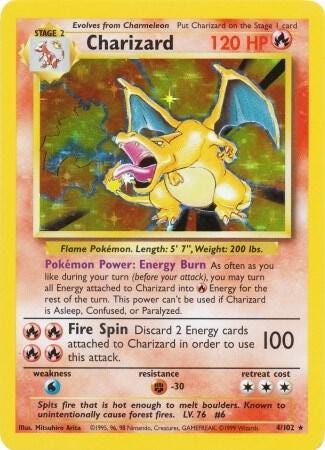
I never pulled one….womp
But Pokemon turns 30 TODAY!, and I spent some time recently running the numbers on what those packs would be worth today if I had just left them sealed on a shelf.
The answer is going to be uncomfortable for anyone who has spent the last three decades feeling good about owning the S&P 500.
The Numbers First. Then the Nuance.
A sealed 1st Edition Base Set booster box went for $100 at retail in early 1999.
That same box sold at Goldin Auction in February 2026 for $496,000; a compound annual growth rate of approximately 37%.
For reference: the S&P 500 has returned about 10.3% annually over the same period. The Magnificent Seven, which everyone now agrees was the trade of the generation, has compounded at roughly 16.6% since 2000.
Put $100 into the S&P in 1999. You have about $550 today. Put that same $100 into a sealed box and hold it. You have $496,000, which is certainly not a rounding error.
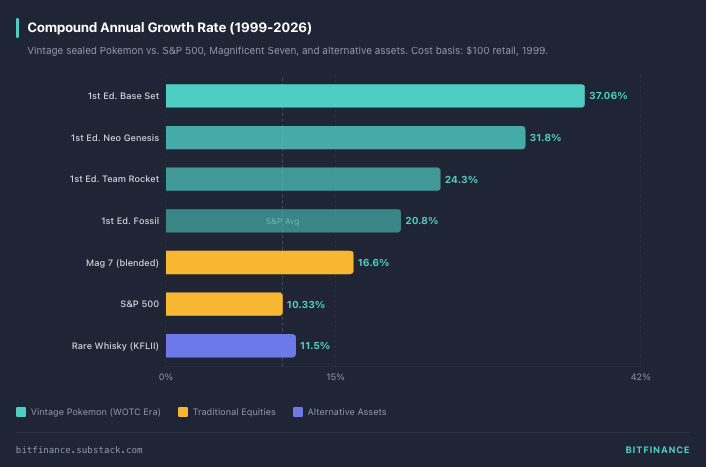
Said another way, a sealed 1st Edition Base Set booster box generated approximately 902x the return of an equivalent S&P 500 investment over the same 26-year period.
Even the weakest vintage set, 1st Edition Fossil, delivered an annualized return of over 20% -- nearly double the long-run equity average.
My Thesis: Be the Casino, Not the Gambler
Most people who talk about Pokemon cards as an investment focus on appreciation over time. That part is real, but it is not the most interesting part.
What actually drives the thesis is something happening on Twitch and YouTube every single night. Thousands of streamers are opening packs. Live. For millions of viewers. It’s entertainment, it’s gambling-adjacent, and it’s permanently removing sealed product from existence.
Every box cracked on camera is gone from the sealed population forever. There is no restocking. There is no reprint. Every opened pack is a lottery ticket cashed and retired.
That mechanic is absolutely fascinating to me and it has an analogy most readers here will recognize…
THE CORE THESIS
Holding sealed vintage product is structurally similar to selling covered calls. You are not speculating on whether someone will pull a Charizard. You are collecting a premium for owning the optionality , the unripped lottery ticket. The longer it stays sealed, the scarcer sealed product becomes, and the more valuable your unripped ticket becomes to the person who wants to find out what’s inside.
Buffett and Munger have always preferred being on the right side of the odds. The casino does not gamble. It sells the experience of gambling. It collects the premium either way.
The sealed box holder is in the same structural position. The streamer cracks the box, absorbs the variance, and might or might not pull what they were looking for. The holder does not crack the box. They own the option. They let the market come to them.
And the market, increasingly, is willing to pay six figures for the chance to find out what is inside.
The Supply Mechanism Nobody Talks About
Between 1999 and 2001, Wizards of the Coast printed and sold the original English sets. Nobody was hoarding them.
These were toys sold at Target and hobby shops. The idea that you might want to not open them would have sounded strange.
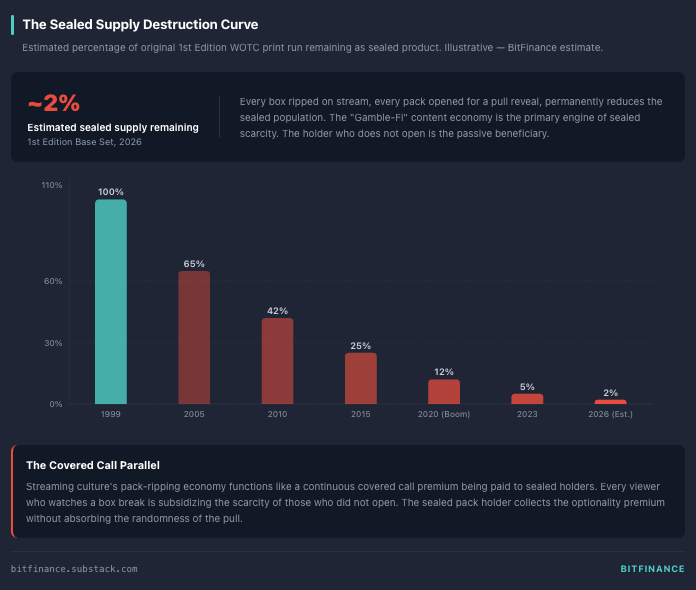
Best estimates put the remaining global population of sealed 1st Edition Base Set boxes somewhere between a few hundred and 5,000 units. The original print run was likely in the tens of thousands. The math on how many have been opened speaks for itself.
Every time a box gets opened, by a collector in 1999 or a streamer last Tuesday, the sealed population drops by one. Permanently. There is no new print run. There is no reissue. The supply curve has one direction…and that’s down.
Meanwhile, demand keeps growing.
TCG Pocket launched in late 2024 and brought millions of new players into the ecosystem. The Millennials who grew up with the original sets are in their peak earning years.
The 30th anniversary is driving the kind of mainstream media coverage that introduces vintage product to buyers who sat out the 2020 boom entirely.
SUPPLY DYNAMICS
The current ‘Gamble-Fi’ streaming culture does not threaten the sealed product thesis. It accelerates it. Every pack opened on stream is a sealed pack removed from the global supply. The holder of sealed vintage product is the passive beneficiary of every box break they choose not to watch.
The Comparison Nobody Expected
When I first put these numbers side by side, I sat with them for a while. I already knew Pokemon had appreciated significantly. That part is well documented. What I was not expecting was the size of the gap versus benchmarks that institutional investors treat as the default measure of wealth creation.
From a $100 retail cost basis in 1999, here is where each asset class sits today.
Even the weakest set in this analysis, the 1st Edition Fossil box at roughly 20.8% CAGR, has more than doubled the long-run equity average. The Base Set has beaten the Magnificent Seven by more than two-to-one on an annualized basis.
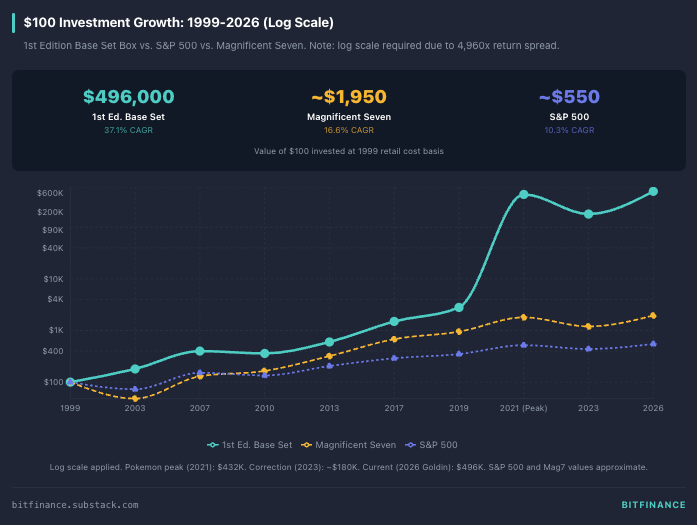
These numbers are real. They are also incomplete. And this is where most analyses of this asset class stop doing their job.
The Friction Is Real. (Do Not Skip This Section)
The headline returns are extraordinary. The friction costs are real and not small. Anyone telling you otherwise is probably trying to sell you a box.
The 28% collectibles tax rate is the most important number here.
Equities held long-term are taxed at 15-20%. Pokemon cards, like fine art, coins, and precious metals, fall under the collectibles classification in the Internal Revenue Code. That gap compounds against you across a multi-decade hold.
Layer on auction premiums, grading fees, storage, and insurance, and the realized return is meaningfully lower than the headline auction price implies. If you bought at retail in 1999, you are still sitting on a generational return after all of that. If you are trying to enter today at six-figure cost basis, the bar is substantially higher.
YOUR FRAMEWORK AS AN INVESTOR
The WOTC-era sealed product thesis was most accessible to original holders. If you had the foresight, or the luck, to hold sealed inventory from 1999, you are sitting on a generational return. For new capital entering today, the calculus requires discipline: target undervalued sets, manage friction carefully, and think in decade-long holding periods.
The 30th Anniversary and What Comes Next
Pokemon’s 30th anniversary is not a sentimental milestone. It’s a marketing inflection point. The franchise is generating mainstream media coverage this month at a scale that will introduce vintage product to a new wave of buyers who did not participate in the 2020-2021 boom.
TCG Pocket, the digital card game released in late 2024, has already driven a new wave of collecting enthusiasm that has carried into 2025. The franchise has demonstrated a remarkable ability to reinvent itself for successive generations, which is what sustains demand for the ‘origin assets’, the original sets, that new collectors cannot acquire through retail channels.
The remaining sealed population of vintage WOTC product will not grow but the demand base very likely will.
That supply-demand dynamic has driven 37% annualized returns for 26 years. There is no obvious catalyst for that structural imbalance to reverse.
There is also no guarantee it continues at that rate. Anyone telling you otherwise is selling something.
The Bottom Line
The data from 26 years of sealed Pokemon card pricing tells a story that most institutional investors would find hard to believe if you presented it without the context.
A 37% compound annual growth rate over more than two decades.
Returns that dwarf the Magnificent Seven.
A global auction ecosystem that is increasingly institutionalized and data-driven.
But the story is only remarkable if you held the product sealed.
Every opened pack is a lottery ticket cashed.
Every sealed pack is an option retained.
The real edge in this market was never about pulling the right card. It was about understanding that the people who opened their packs were subsidizing the appreciation of the people who did not.
I did not hold my packs in 1999. But I understand the thesis now. And for those who are sitting on sealed WOTC product today, the question is not whether the thesis has worked. It has. The question is how much longer you want to remain the house before someone at the table convinces you to play?
The answer: Probably longer than you think.
BONUS: WHAT I’M WATCHING…
3 Positions and the Lottery Tickets Inside
Congrats if you made it this far! For you I have something special on today’s anniversary.
These are the three sealed positions I am watching.
All three are out of print.
New supply is not coming.
The only variable is how many of the remaining sealed units survive the urge to be opened….👇🏻
Position 1: 1st Edition Team Rocket Sealed Booster Box / Packs
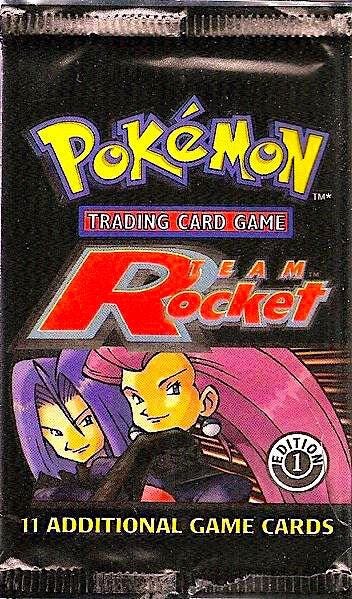
Why? The fourth WOTC set and the first to introduce Dark Pokemon, including a Dark Charizard that carries the same franchise premium as its Base Set counterpart.
Fixed print run, fully out of print. At a retail cost basis of roughly $100 in 2000, the current sealed box market value of $27,500 represents a 24.3% CAGR over 25 years.
The streaming and pack-rip economy is actively consuming whatever sealed inventory remains. Every Dark Charizard pulled on camera is one fewer that exists inside a sealed box.
The top PSA 10 pulls (Dark Charizard at $12K-$18K, Dark Blastoise at $2.5K-$3.5K, Dark Raichu Secret Rare at $2K-$3K) make for a compelling lottery ticket premium embedded in the sealed price.
Position 2: Evolving Skies Sealed Booster Box / Packs
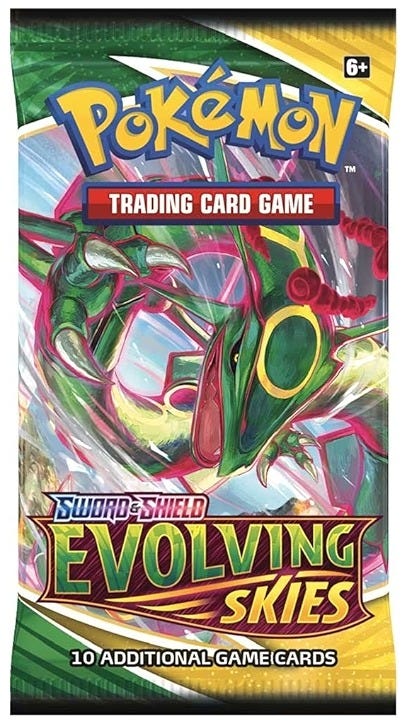
Why? The most collectible modern set. The Umbreon VMAX Alternate Art (the ‘Moonbreon’) has become one of the defining modern chase cards. However it’s worth noting that it’s PSA 10 population is relatively high at close to 20k.
Out of print since the Sword and Shield era. No reprint has been announced. The sealed population shrinks every time someone opens a box chasing the Moonbreon or the Rayquaza VMAX Alt Art.
The condition sensitivity works in the sealed holder’s favor. The harder a card is to grade PSA 10, the more premium the sealed box commands relative to the raw singles market.
Top PSA 10 outcomes: Moonbreon at $3K-$4K, Rayquaza VMAX Alt Art at $1.8K-$2K. These are the lottery tickets the market is opening boxes to find.
Position 3: Scarlet & Violet 151 Sealed Booster Bundles

Why? A deliberate nostalgia vehicle: every one of the original 151 Kanto Pokemon, reimagined with modern Special Illustration Rare artwork. The most accessible entry point for 30th anniversary buyers who never touched a WOTC box.
Out of print. The English ‘God Pack’ mechanic (introduced for the first time in this set) drives aggressive pack-opening behavior, which reduces sealed supply faster than most modern sets.
Top PSA 10 outcomes are anchored by the two most bankable pieces of Pokemon IP: the Charizard ex SIR (’Sunzard’) at $800-$1K and Mew ex SIR at $400-$600. These are the pulls people are opening boxes to find.
The 30th anniversary cultural moment is directly aligned with the 151 premise. Mainstream media coverage this month will introduce the set to a new wave of buyers who cannot buy it at retail.
— Matthew
X: @bit_finance_
oh! one last thing…if you want to dive deeper into how Buffett’s investing principles applies to digital assets, check out my book.
We took 1,300+ pages of wisdom from the Oracle of Omaha and condensed it into a snackable, easy-to-read guide for digital asset investors. Pick up your copy today!
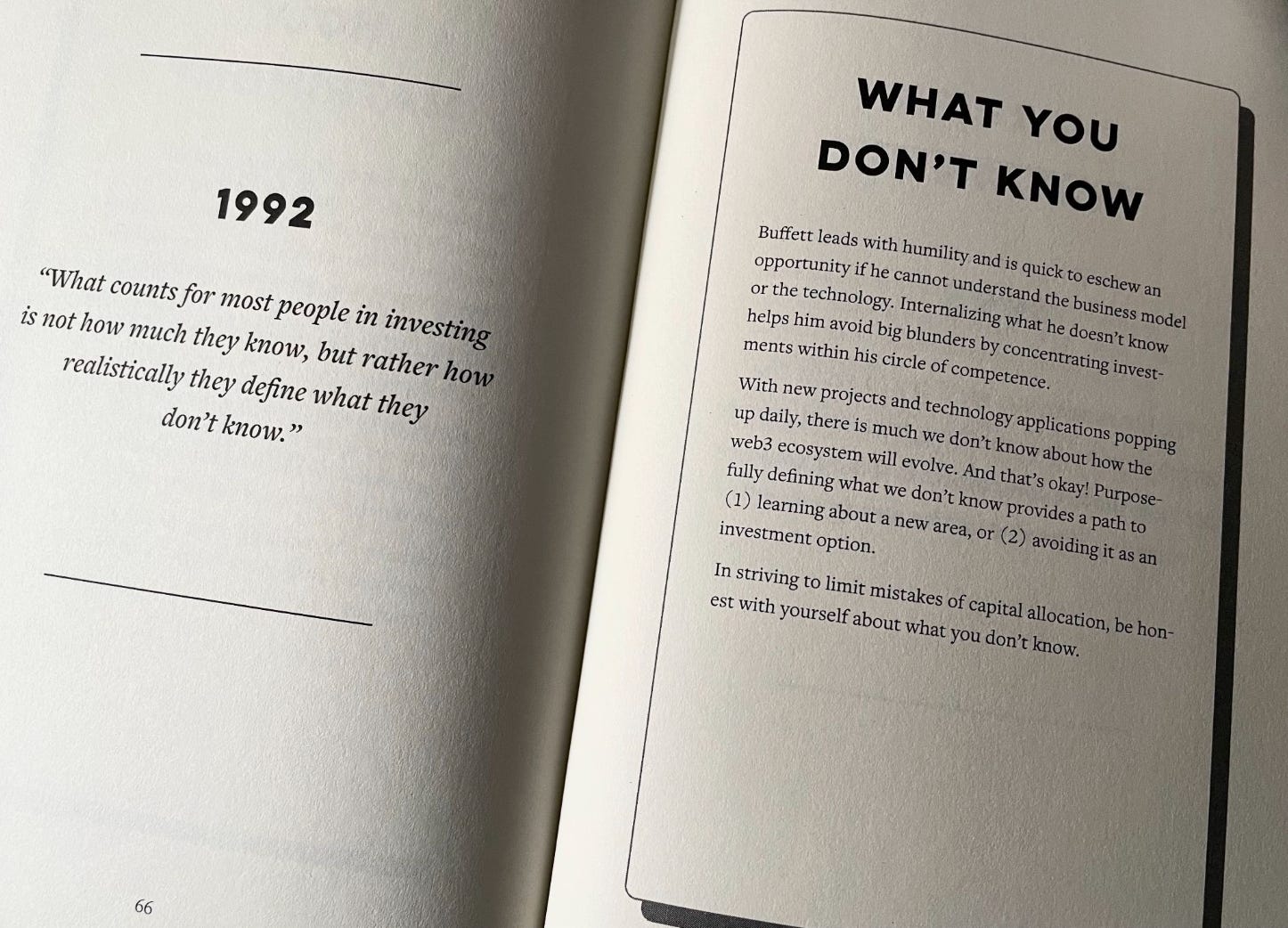
Matthew Snider is the founder of Block3 Strategy Group, author of “Warren Buffett in a Web3 World,” and publisher of the BitFinance newsletter. He holds a Series 65 and MBA, and has been an active participant in digital asset markets since 2015. This article is for educational purposes only and should not be considered financial advice. Always consult with a qualified professional before making investment decisions.