How I Plan to 100x a $1,000 Investment in 9 months.

I spent $1,000 this week. Not on Bitcoin, equities, oil futures, Pokemon cards, or any other speculative asset you can name.
I spent it on data.

If you’ve been following the Buffett Bot Diaries, you know the arc. I started with zero programming experience, sat down with an AI coding partner, and began building an autonomous trading system that applies Warren Buffett’s value investing principles to digital assets and equities.
There's a hardware upgrade coming (can't wait to tell you!) but before we get there, the project hit a stage where the engine was running, the code was solid, but the bottleneck shifted.
If we're going to build something our readers and future users can actually trust, the backtesting infrastructure needs to be airtight. That means the data feeding it can't be cobbled together from free APIs and best guesses.
So I went looking for the most complete, institutional-grade data package I could find to build our backtesting engine. One we could clean, scrub, slice in every direction, and stress-test until we're confident the results are durable.
What I found, and what it's going to let us do, is worth the whole article.
The Garbage In, Garbage Out Problem
Anyone who has spent time in quantitative finance has heard the phrase: “garbage in, garbage out”. It sounds obvious but it’s the single most common reason that backtested strategies fail to perform in live markets.
Here’s the problem in plain terms.
When you backtest a trading strategy, you’re asking a very specific question: if I had run this exact set of rules over the past several years of market history, what would have happened?
The answer you get is only as reliable as the data you’re feeding the machine. Incomplete data, inconsistent timestamps, gaps in pricing history, survivorship bias in the asset universe. Any of these can produce results that look compelling on screen and fall apart the moment real capital is on the line.
The deeper issue is something called overfitting. This is like the persistent villain of backtesting work. It’s essentially the idea that you’re telling yourself a story about why something happened based on a particular set of circumstances, when in reality the pattern was noise dressed up as signal.
You might look at a backtest and see a strategy that returned 40% annually over three years. Impressive! But…was it capturing a genuine market inefficiency, or did it just happen to align with a specific set of conditions that won’t repeat?
Overfitting is the silent killer of systematic strategies. And the primary weapon against it is data.
Not just more data.
Better data.
Cleaner data.
Data you can slice, dice, run backwards, forwards, and sideways until you’re confident that what you’re seeing is durable rather than decorative.
What a $1,000 Data Package Actually Looks Like
The investment went into institutional-grade financial data feeds. We’re talking about nearly 2 TB of minute bars going back 17 years. Full options chains. VIX term structure. Treasury futures. Crypto spot + CME futures. All pipeline-ready for systematic backtesting. We're not scraping free APIs and hoping for the best.
This is the kind of historical pricing, volume, and market structure data that professional quant shops use to build and validate their models. The difference between free data from a public API and paid institutional data is roughly the same as the difference between a napkin sketch and an architectural blueprint.
Both describe a building.
Only one of them should be used to pour the foundation.
In total, here’s what we got:
Index ETFs: SPY, QQQ, IWM, DIA
Index Futures: ES, NQ, MES, MNQ, RTY, YM (continuous + individual contracts)
Full VIX complex: VIX, VIX3M, VIX1D, VVIX, SKEW, VX futures, UVXY, VXX
Crypto futures: CME BTC, Micro BTC, Micro ETH, IBIT, BITO
Mag 7: AAPL, MSFT, N
VDA, AMZN, GOOGL, META, TSLA (bars + options)
Sector SPDRs: XLF, XLE, XLK
Fixed income: TLT, IEF, SHY, HYG, LQD + Treasury futures (ZN, ZF, ZT, US)
Commodities: GLD, gold futures, WTI crude futures
Extended: TQQQ, SQQQ, ARKK, EEM, FXI, emerging markets
Options chains (EOD with greeks) for everything that trades options
Minute-level resolution across the board
With this data, the Buffett Bot can now run backtests across multiple asset classes with the kind of granularity and reliability that I couldn’t access before.
We can test strategies across different market regimes, from the 2020 crash to the 2021 bull run to the grinding sideways action of recent months and also identify whether a signal is robust across conditions or whether it only works when the wind is blowing in one particular direction.
If you’ve been reading the backtesting books I mentioned in last week’s Diaries entry, this is what Marcos Lopez de Prado means when he talks about combinatorially purged cross-validation.
You can’t do that kind of work with free, inconsistent, retail-grade data. You need the real thing and this is my favorite kind of competitive advantage.
The 100x Thesis
Here’s the part where I make a bet in public.
I’m going to 100x this investment. Not by trading with it. By putting it to work.
The thesis is straightforward. A $1,000 data package, deployed across the full range of what we’re building here, should generate $100,000 in revenue over the next nine months. Not from a single trade. Not from one lucky call. From the compounding value of having a reliable, institutional-quality data foundation underneath everything this project produces.
Think about all the ways this data flows outward.
It powers the Buffett Bot’s backtesting engine, which produces the strategy validation that I write about in these Diaries. Those Diaries drive subscriptions. The strategies themselves, once validated, produce insights that feed into consulting work with RIAs and institutional allocators through Block3 Strategy Group. The data generates original research that becomes content, which becomes credibility, which becomes client relationships.
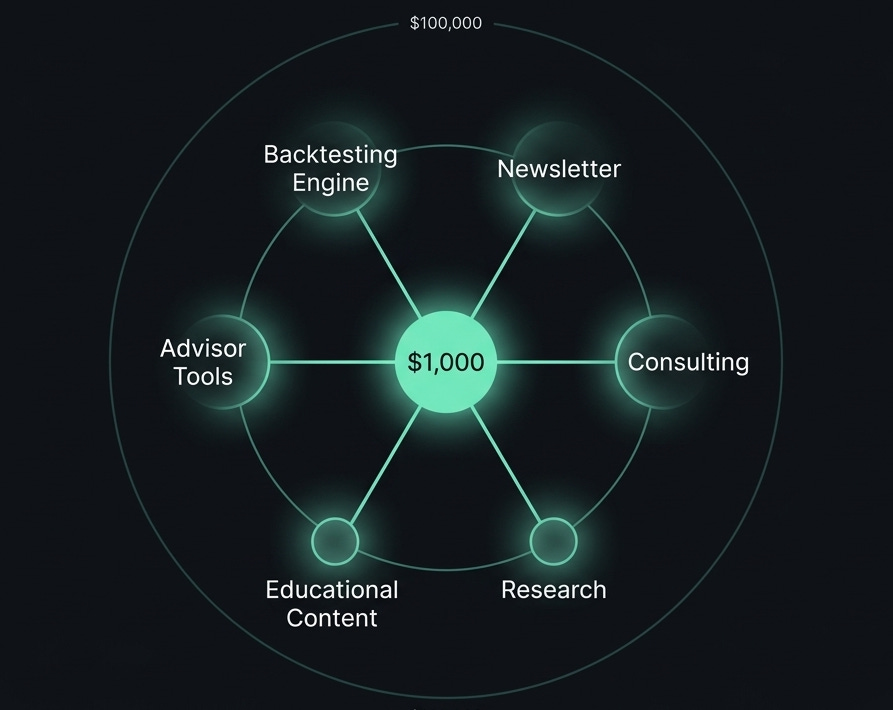
It’s not one revenue stream. It’s a data asset that feeds an entire ecosystem of output. The newsletter. The consulting practice. The educational content. The tools I’m building for advisors.
Every one of those channels benefits from having a credible, rigorous data foundation rather than a cobbled-together collection of free feeds and best guesses.
Why This Matters More Than Picking a Stock
There’s a version of this story where I took that $1,000 and bought Bitcoin. Or shorted oil. Or picked a handful of small-cap AI stocks and hoped for the best. That would have been a bet on the market. This is a bet on myself.
Buffett’s mantra is that the best investment you can make is in your own abilities.
He wasn’t talking about buying a motivational course. He was talking about acquiring the tools, knowledge, and infrastructure that allow you to operate at a higher level for the rest of your career.
A $1,000 stock position, even if it doubles, is still just $2,000.
A $1,000 investment in the data infrastructure that powers a consulting practice, a newsletter, a suite of analytical tools, and an AI-driven trading system has a return profile that compounds in ways that a single position never can.
I’m building an engine with data as the fuel and the returns won’t show up as a line item in a brokerage account. They’ll show up in the quality of the work, the depth of the analysis, and the trust that comes from being someone who does this at a level that most people in this space simply aren’t willing to invest in.
The Lesson for Builders
If you’re building anything in this space, whether it’s a trading system, a research practice, or a client-facing analytics platform, the temptation is to move fast and figure out the data layer later. I get it. The tools are exciting.
The AI makes it possible to build things in hours that would have taken months a few years ago. But the tools are only as good as what you feed them.
There’s no shortcut to data quality. There’s no prompt clever enough to turn bad data into good analysis. The machine learning books all say the same thing in different ways: the model is the easy part, the data is the hard part.
The willingness to invest in the hard part is what separates systems that look impressive in a demo from systems that actually survive contact with live markets.
So I wrote the check. Nine months from now, we’ll see whether the thesis holds. I’ll be transparent about it the whole way through, just like everything else in this build.
That’s the bet. Not on a ticker. On the infrastructure underneath all of it.
Want to Build Your AI Trading Bot?
Let Me Know!
The Buffett Bot Diaries has generated more inbound than anything I’ve published. Several of you have asked how to build something similar.
If there’s enough interest, I’m putting together a live session covering the full build: the scoring system, the architecture, and how I went from zero coding experience to a working autonomous trader.
This is AI education, not investment advice. The bot is the case study.
If you want in, raise your hand here. I’ll only run it if enough people ask. No drip campaigns. Just a heads-up when it’s ready.
Fill out the 30-second interest form here. 👈
Moving right along…
This Week in 2 Minutes
Beyond NVIDIA: 5 AI Investments Most Advisors Can’t Name (Yet) (Mar 9)
The AI investment conversation has matured well beyond the Magnificent Seven, and most advisors are still working off the same five-name list. We broke down five companies across five different layers of the AI value chain:
Tempus AI in healthcare,
Nebius Group in European cloud infrastructure,
Palantir at a 30% pullback,
The Franklin FTSE South Korea ETF for semiconductor exposure at 10x earnings
The Themes Humanoid Robotics ETF as the speculative frontier.
Each one came with a bull case, a bear case, and a Buffett Framework Question.

I Spent 3 Days on a Beach with 600 Advisors; Here’s Where the Money Is Moving (Mar 13)
The FutureProof Miami recap. Five trends from 20 intentional meetings with independent advisors, fund operators, and AI vendors. Here are the highlights:
AI is being embraced as a fiduciary upgrade rather than a replacement.
Stablecoin yield, not Bitcoin, is the conversation RIAs actually want to have.
Private credit is getting scrutinized more carefully.
Tokenization is leapfrogging Bitcoin adoption in terms of institutional curiosity.
Bitcoin-linked annuities are emerging as a product category that most annuity professionals don’t even know exists yet.
This Week’s Winners and Losers
Winners 🏆
Energy. Again. WTI crude hit $95.73 on Thursday as Iran’s new supreme leader declared the Strait of Hormuz should stay closed. Brent pushed back above $100. The IEA coordinated its largest-ever reserve release: 400 million barrels globally, including 172 million from the U.S. Strategic Petroleum Reserve. The market shrugged. Prices barely moved on the announcement, which tells you everything about how the market is pricing the duration of this conflict. Energy stocks continued to print. The iShares Global Energy ETF hit its highest level since May 2008.
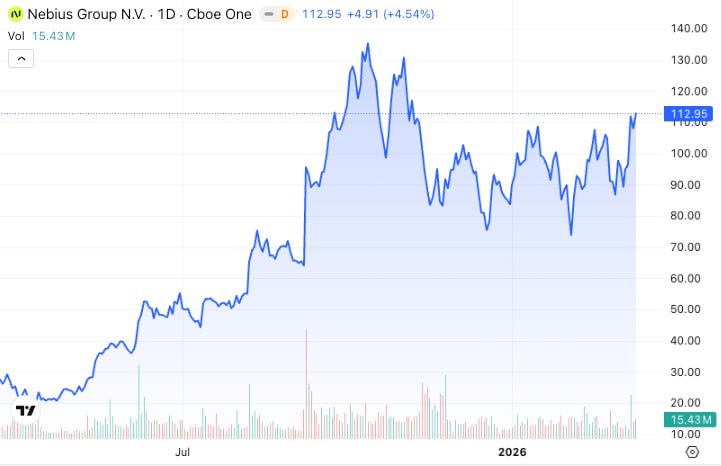
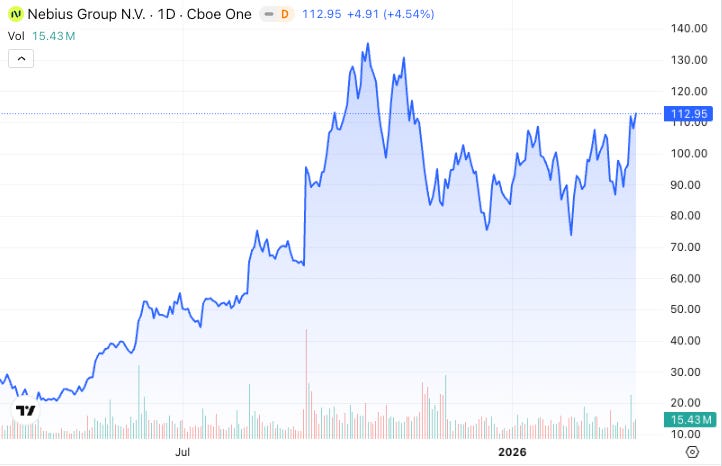
Nebius (NBIS). We wrote about Nebius on Monday as one of five AI investments most advisors can't name yet. Two days later, NVIDIA announced a $2 billion strategic investment in the company. The stock jumped 26%. The deal gives Nebius early access to NVIDIA's next-generation Rubin platform, validates the European AI cloud thesis we laid out in that piece, and cements Nebius alongside CoreWeave, Lumentum, Coherent, and Synopsys in NVIDIA's growing portfolio of $2 billion infrastructure bets. When Jensen Huang writes checks this size, he's telling you where the buildout is heading. We're not taking a victory lap. (But if you read Wednesday's article, you understood the thesis before the headline hit. That's the point of doing the work.) 😎
Bitcoin’s quiet resilience. BTC is holding above $71,000 while the S&P 500, Nasdaq, and Dow all posted 2026 closing lows. Arthur Hayes pointed out that Bitcoin has outperformed gold, the Nasdaq 100, and the S&P 500 since the Iran conflict began on February 28. The crypto fear and greed index is in extreme fear territory, funding rates are negative, and the price is... not going down. That disconnect between sentiment and price action is worth watching.
Gold. Above $5,000 per ounce and trading near all-time highs. The classic geopolitical hedge is doing exactly what it’s supposed to do. If you’ve held gold through the last 18 months, you’re looking at returns that would embarrass most equity portfolios.
Losers 📉
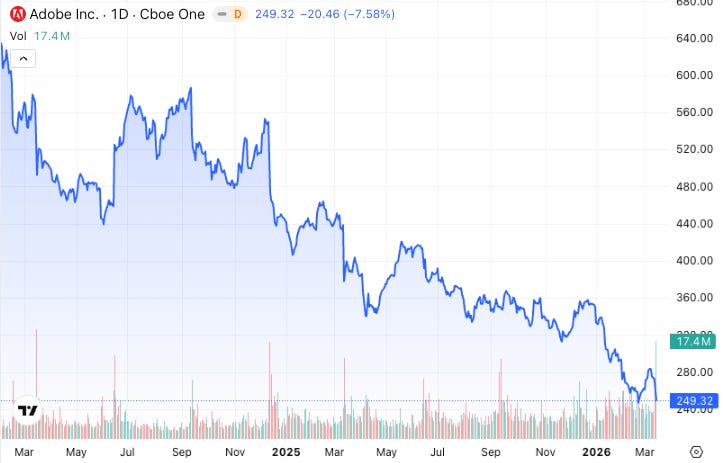
Adobe (ADBE). CEO Shantanu Narayen announced he’s stepping down after 18 years. The stock dropped 7.6% on Friday despite a revenue beat and raised guidance. Under Narayen, Adobe transformed from boxed software to a cloud subscription powerhouse. The timing of his departure, during the most disruptive period in software since the cloud transition itself, is what spooked the market. Adobe is now down 31% year to date. The AI disruption narrative for legacy software companies isn’t going away.
U.S. equities broadly. The S&P 500 fell 0.6%, the Dow lost 0.3%, and the Nasdaq shed 0.7% for the week. All three posted 2026 closing lows. The Dow dropped below 47,000 for the first time this year. This is the third consecutive week of losses, and the driver hasn’t changed: oil above $95, the Iran conflict with no end in sight, and a Fed that is boxed in by rising energy costs on one side and weakening growth on the other.
Investor sentiment. The AAII bearish sentiment reading hit 46.4%, its highest since November. Bullish sentiment fell to 31.9%. When nearly half of retail investors say they’re bearish, contrarians start paying attention. Whether that’s a signal or just noise depends entirely on what happens with oil prices over the next two weeks.
On Deck This Week
The Fed Meeting. Wednesday’s FOMC decision is the main event. Nobody expects a rate move. The real story is the dot plot and the updated economic projections. Oil is above $95. CPI came in at 2.4%. Payrolls went negative last month. The market is now pricing only a December cut, which tells you how quickly stagflation fears have repriced the entire rate trajectory. If Powell signals any willingness to cut despite energy inflation, risk assets rally. If he holds the line, expect more of the same grinding pressure.
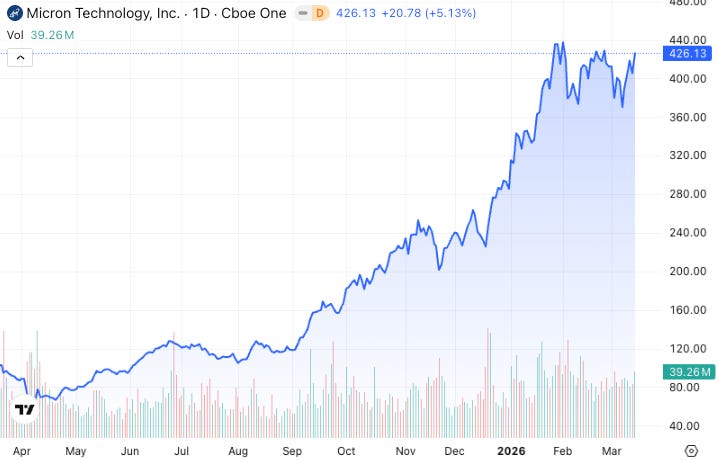
Micron Earnings (Thursday). The memory chip bellwether reports Thursday evening. If you read our FLKR thesis in Wednesday’s article, you know why Micron matters: HBM demand is the bottleneck in every major GPU system, and Micron is one of the key suppliers alongside SK Hynix and Samsung. A strong guide from Micron validates the AI CAPEX cycle. A miss raises questions about demand sustainability. Either outcome moves the semiconductor complex.
The Word Nobody Wants to Say. Stagflation. Oil above $95. Payrolls negative. Consumer sentiment falling. Rate cuts getting pushed out. The macro setup is increasingly uncomfortable, and the Fed’s Wednesday meeting will either calm the narrative or confirm it. Pay attention to the language. The data is doing the talking.
Matthew Snider is the founder of Block3 Strategy Group, author of “Warren Buffett in a Web3 World,” and publisher of the BitFinance newsletter. He holds a Series 65 and MBA, and has been an active participant in digital asset markets since 2015. This article is for educational purposes only and should not be considered financial advice. Always consult with a qualified professional before making investment decisions.