Kalshi's Trading Volume Is Real. That's the Problem.
I use Kalshi. Not heavily, and not for income, but I've kept an account since it launched because it offers markets you can't find anywhere else, and I like poking at new financial plumbing to see how it works.
It’s also been a wonderful sandbox for building with AI. Back in April, I was able to successfully use their API to pull pricing details that I was able to arbitrage during the March Madness basketball tournament this year. Fun times!
Walk past a restaurant with a line out the door at seven o’clock and you’ll assume the food is good. That’s the point of the line. It’s the cheapest advertisement a restaurant can buy, and it’s cheap because it can be bought: pay a dozen people to stand on the sidewalk and the neighborhood fills in behind.
Trading venues have a line out the door too. It’s called volume, and this week the line at Kalshi’s crypto counter got a second look from a quant, then the Journal, then the CFTC….that’s never a good sign.
What Happend?
It started September 19th with a quant posting as Beni, whose thread opened “Kalshi fakes their crypto volume and I can prove it.”
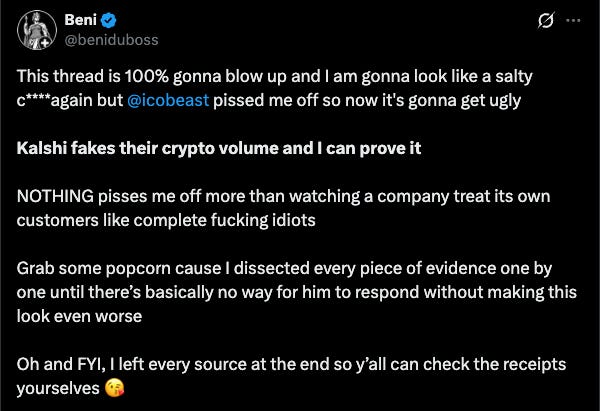
His exhibit was the ETH perpetual: about $539 million of volume in a day against roughly $3.1 million of open interest, the value of positions still open at day’s end. The ratio says $174 changed hands for every $1 anyone chose to keep. His follow-up found one trade size, right around $5,500, making up roughly half of ETH perp notional over four days.
On Tuesday the Wall Street Journal ran its own analysis of Kalshi’s public data and found the same fingerprint at scale citing roughly $5 billion of near-identical trades, and a CFTC review.
Accounts of the article add that the pattern runs to nearly a million trades since August and more than a third of recent activity in the market. A review is not a finding, and nothing public shows who was trading. Still, when a large share of a market arrives in one lot size, the simplest explanation is a program, and the question is who’s running it and why.
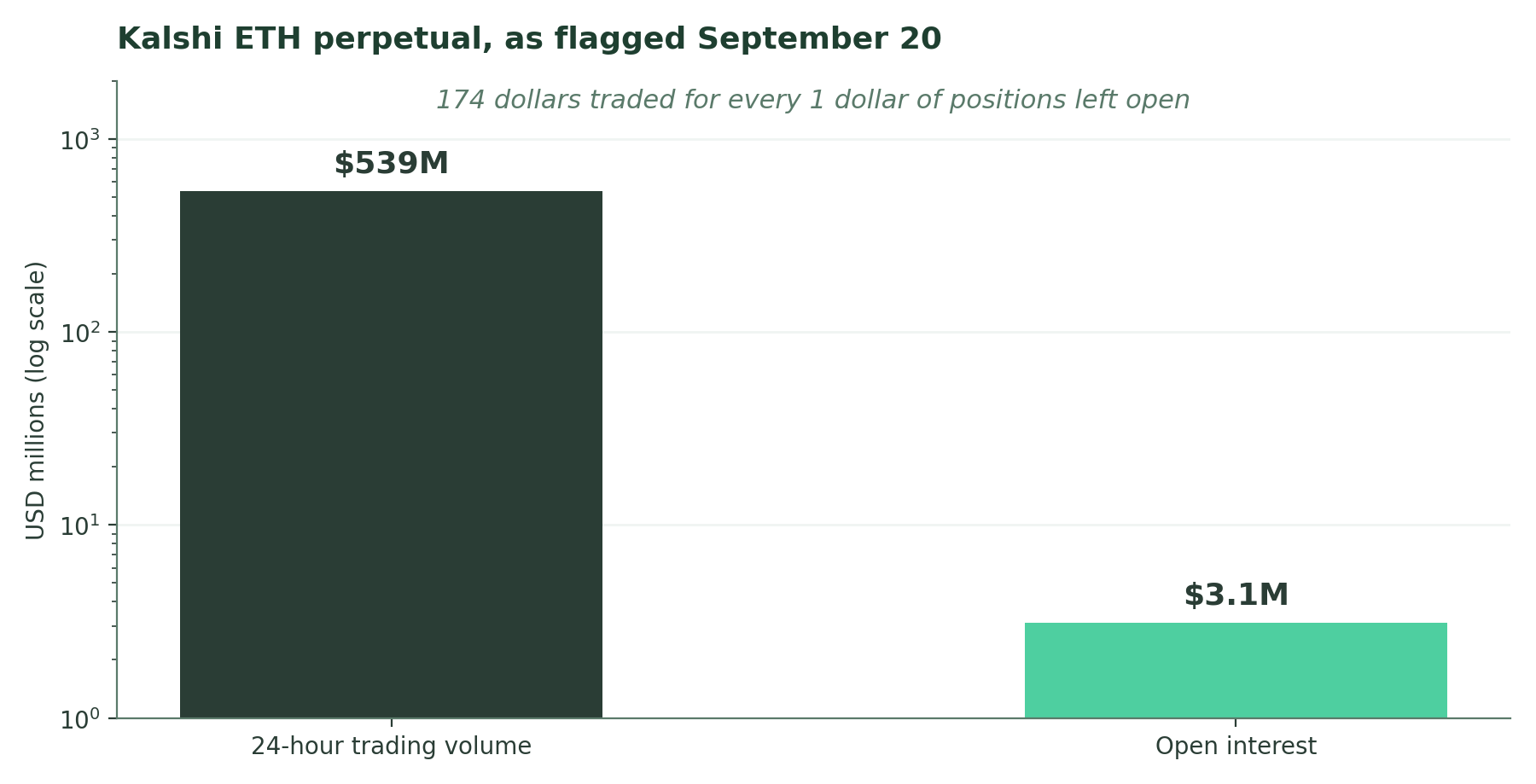
Figures as posted by Beni on X, September 20. Kalshi disputes the framing. Sources: CoinDesk, crypto.news.
Kalshi answered Tuesday with a full post, and it’s worth reading.
The short version: the trades were real, both sides wanted them, and the pattern is a liquidity program working as designed.
Wash trading is banned in the rulebook, self-trades are blocked by the matching engine, pre-arranged trades are surveilled, and the company says it’s seen no evidence of either.
On the narrow question of whether a rule was broken, Kalshi’s account is credible, and the CFTC will decide whether it’s complete. The wider question is what it admitted along the way.
Kalshi’s Answer is the Interesting Part
Here’s the mechanism, in Kalshi’s own framing. The exchange pays market makers a flat monthly fee to keep fixed-size orders, say $5,000 a side, resting inside a tight spread most of every hour. Separately, firms that clear their own trades are on a fee holiday: every perps fee comes back as a rebate at month end. Put the two together and you get a predictable scene.
The paid maker has to keep quoting after the price moves, and faster, fee-free takers pick him off every time. By Kalshi’s own reading of the critic’s data, the takers walked away with about $98,000.
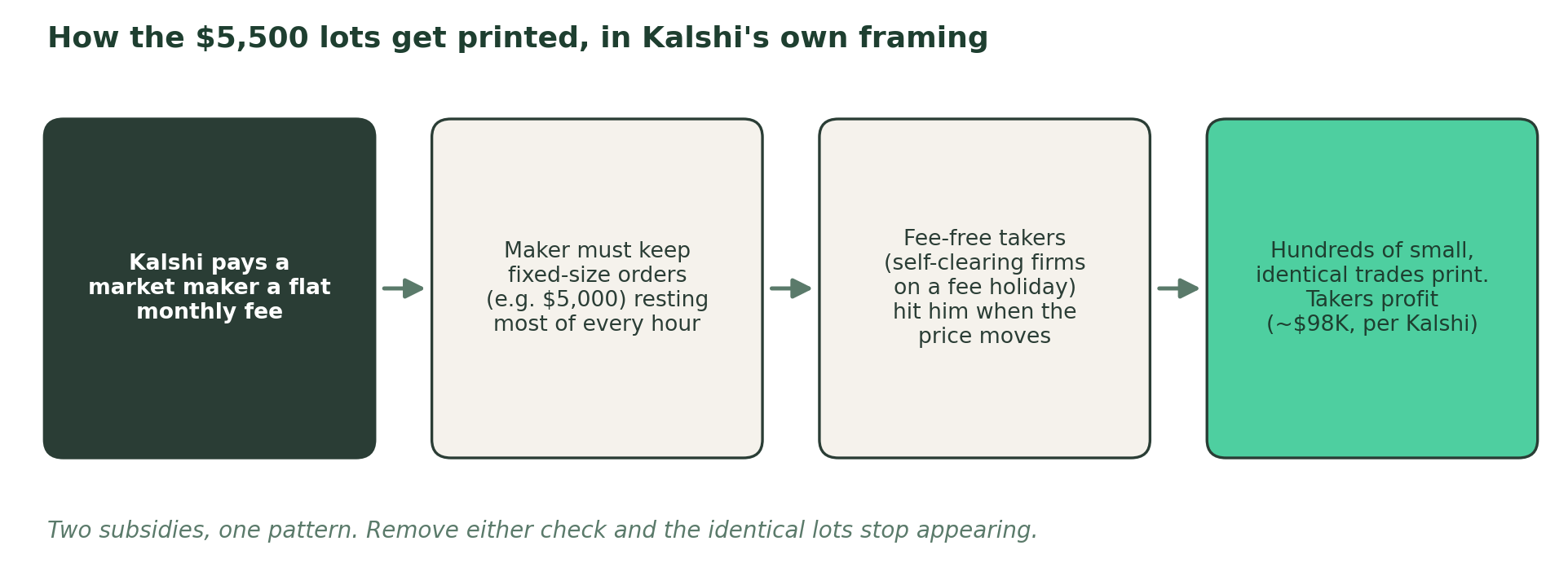
Reconstructed from the worked example in Kalshi’s September 22 post. The firm names in the post are fictional; the mechanics aren’t.
Kalshi presents this as proof of real economic activity, and it’s right. It’s also volume that exists because the exchange pays for it. The maker is on the book because Kalshi writes him a check. The takers are there because Kalshi waived their fees. Remove either subsidy and the $5,500 lots stop printing.
The post also answers the complaint that a three-cent contract counts as a dollar of volume, and fairly: a three-cent YES has a 97-cent NO on the other side. That isn’t the issue here.
The line isn’t fake.
The line is bought.
The Moat Measured in Volume
This matters beyond one contract because of what investors think they’re buying.
Prediction markets claim two moats.
The first is the regulatory license, and it’s real but no longer exclusive: Polymarket has its U.S. clearance, Robinhood routes sports markets through Kalshi, DraftKings plans to clear through Polymarket. A shared moat is a cost of entry.
The second moat is liquidity, the network effect where traders go wherever the other traders already are. Liquidity can’t be photographed. It’s proven by volume, which brings us to the price tag.
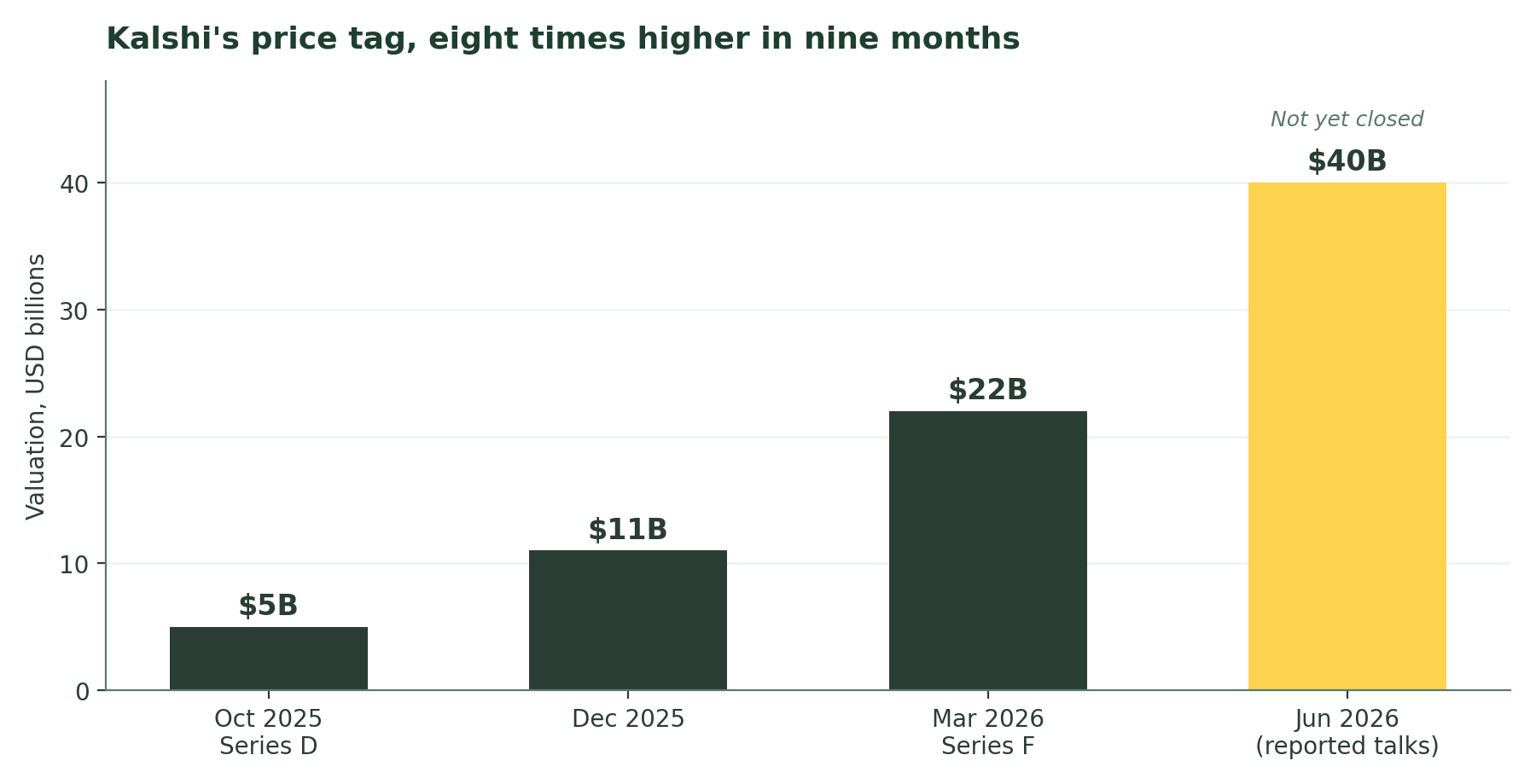
Reported valuations from the Series D through the June 2026 fundraising talks. The $40B round had not closed as of this writing. Sources: The Block, Fortune, Dealroom.
Kalshi raised at $5 billion last October, fielded offers near $11 billion within weeks, closed at $22 billion in the spring, and by June was reported in talks at $40 billion. Over the same stretch, annualized volume tripled to about $178 billion.
Sports drove close to 90% of 2025 revenue, and nobody’s disputing the sportsbook.
What’s disputed is the growth story on top, and that story is told in perps volume.
Kalshi’s post offers its own receipts: more than 350,000 lifetime perpetual traders, thousands of new ones a day since June, open interest doubling in 30 days, $40 million of its own capital in the guaranty fund.
Those are real numbers. So is the sentence a few lines above them, where the company says it’s paying for this liquidity because perps are new. A valuation that quadrupled on new-product traction is being underwritten partly on a subsidy with no announced end date.
DeFi Ran this Experiment First
None of this is new to anyone who’s spent time on-chain. Decentralized exchanges have fought phantom volume for years: traders churning their own orders to farm airdrop points, protocols reporting notional instead of matched volume, TVL that counts the same dollar three times through recursive lending.
A Columbia working paper last year put roughly a quarter of Polymarket’s three-year volume down to wash trading, with no evidence the platform took part. When manufacturing activity costs nothing and someone pays for it, the activity metric stops carrying information.
The useful counterexample is Hyperliquid, top of CoinGecko’s 2026 revenue ranking at about $429 million through mid-September. Revenue is harder to fake than volume, because faking it costs real money.
On-chain investors learned to look past TVL toward fees a couple of cycles ago. Prediction market investors are about to learn the same lesson at a higher price.
THE BUFFETT FRAMEWORK QUESTION
Buffett never valued a business on how much merchandise moved across the counter. He valued it on what the owner could take home after the counting was done. Applied here, that means one check. Kalshi’s annualized revenue is reported at roughly $1.5 to $2 billion on roughly $178 billion of annualized volume, which is a take rate somewhere near 1%. Watch that ratio. If volume doubles and revenue doesn’t, someone’s standing in line for free.
The line is long either way. The question worth answering is whether you’d rather own the line or the register.
Back to the Sidewalk
A fair reading owes Kalshi its due.
The response was fast, specific, and more transparent than most exchanges would offer. Paying for liquidity in a new product is standard at CME and Nasdaq.
The trades were real. Nothing public shows a rule being broken, and a regulator taking a look is what regulators are for. If the CFTC opens a formal investigation, or Beni’s lawyers clear a release that names accounts, that changes things.
Neither has happened.
The part that doesn’t go away is the measuring problem. Two exchanges filed to list perpetual futures on individual U.S. stocks last week, and one was Kalshi. A venue asking to host the next generation of derivatives has now explained, in its own words, that its most-cited growth metric is a line it pays to keep full. That’s the business model rather than an accusation, and it means anyone underwriting the $40 billion should ask what the sidewalk looks like the month the checks stop.
The restaurant with the paid line still has a kitchen, and the kitchen might be excellent. You can’t tell from the sidewalk. You have to look at the receipts.
Matthew Snider is the founder of BitFinance and principal at Block3 Strategy Group, where he advises emerging digital asset fund managers and RIAs on fund operations and compliance frameworks. He holds both Series 65 and Series 7 licenses, and is the author of Warren Buffett in a Web3 World.
This material is for informational and educational purposes only and does not constitute investment advice, a recommendation, or an offer to buy or sell any security. Nothing herein should be construed as a personalized recommendation. Digital assets and the securities of digital asset treasury companies involve substantial risk, including total loss of principal. Past performance is not indicative of future results. Consult your own financial, tax, and legal advisors before making investment decisions.
Sources
The Facts Behind Kalshi’s Perpetuals Volume (Kalshi Team, September 22, 2026)
$5 Billion Flurry of Nearly Identical Kalshi Trades Draws Scrutiny (The Wall Street Journal, September 22, 2026)
$5 Billion Flurry Of Nearly Identical Kalshi Trades Draws CFTC Scrutiny - WSJ (Reuters wire via TradingView, September 22, 2026)
CFTC scrutinizes Kalshi after $5B in near identical ether perp trades (Crypto Briefing, September 22, 2026; account of the Journal analysis)
Kalshi Rejects Wash Trading Claims as Report Flags Unusual Activity in Ethereum Perpetuals Market (Benzinga via Yahoo Finance, September 23, 2026)
Columbia Study: 25% of Polymarket Volume Is Wash Trading (Decrypt, November 2025; co-author quote on exchange involvement)
Kalshi faces ‘fake crypto volume’ allegations as critic flags identical $5,500 trades (CoinDesk, September 21, 2026)
Kalshi Faces Accusations of Inflated Crypto Volume Over Repeated $5,500 Perp Trades. Kalshi Says It’s Real Demand. (The Crypto Times, September 21, 2026)
Crypto Weekly Report (2026/9/21): Fed Rate Hike, CLARITY Act Fails, Arc Goes Live (BTCC, September 21, 2026; Kalshi and Coinbase stock-perp filings)
Kalshi eyes $40B valuation, nearly triple rival Polymarket, as prediction markets split in two (Dealroom, June 26, 2026; volume and revenue figures)
Kalshi locks in $22 billion valuation, gaining slight edge over its rival Polymarket (Fortune, March 20, 2026)
Kalshi fielding investment offers at up to $12 billion valuation shortly after major funding round (The Block, October 2025)