Saylor Stopped Buying Bitcoin

Michael Saylor built his legend on a single, repeatable act:
Raise capital, buy Bitcoin, repeat.
For 4 years it didn’t matter whether the capital came from convertible notes, common stock, or an alphabet of preferred shares. Every dollar had one destination: Bitcoin.
That stopped in late June. What used to be a weekly ritual has now gone 30 days without happening.
The stack sits frozen at 843,775 Bitcoin, about 4% of everything that will ever exist, purchased for $63.7 billion at an average of $75,476 each. With Bitcoin near $64,000, the pile is worth around $54.7 billion, roughly $9 billion less than the company paid.
The pause isn’t the headline, though, because the company that swore it would never sell spent the turn of the month doing exactly that, and it sold near the bottom.
The Machine Ran in Reverse
To understand the pause, you have to understand what broke in June.
STRC, Strategy’s flagship preferred stock, was engineered to hug a $100 par value. When it trades above par, the company sells new shares and buys Bitcoin with the proceeds. That’s the accumulation engine, and I walked through its design when Saylor pitched it at Bitcoin 2026.
On June 18, STRC closed at a record low of $89 and the engine shut off, since the company only issues above par. By late June the shares had sunk to $71.25, MSTR touched a two-year low near $82, and the premium over the Bitcoin inside had compressed to almost nothing.
The board answered on June 29 with the Digital Credit Capital Framework: a formal dollar reserve, up to $1 billion each in preferred and common buybacks, a dividend bump to 12%, and written authorization to sell up to $1.25 billion of Bitcoin.
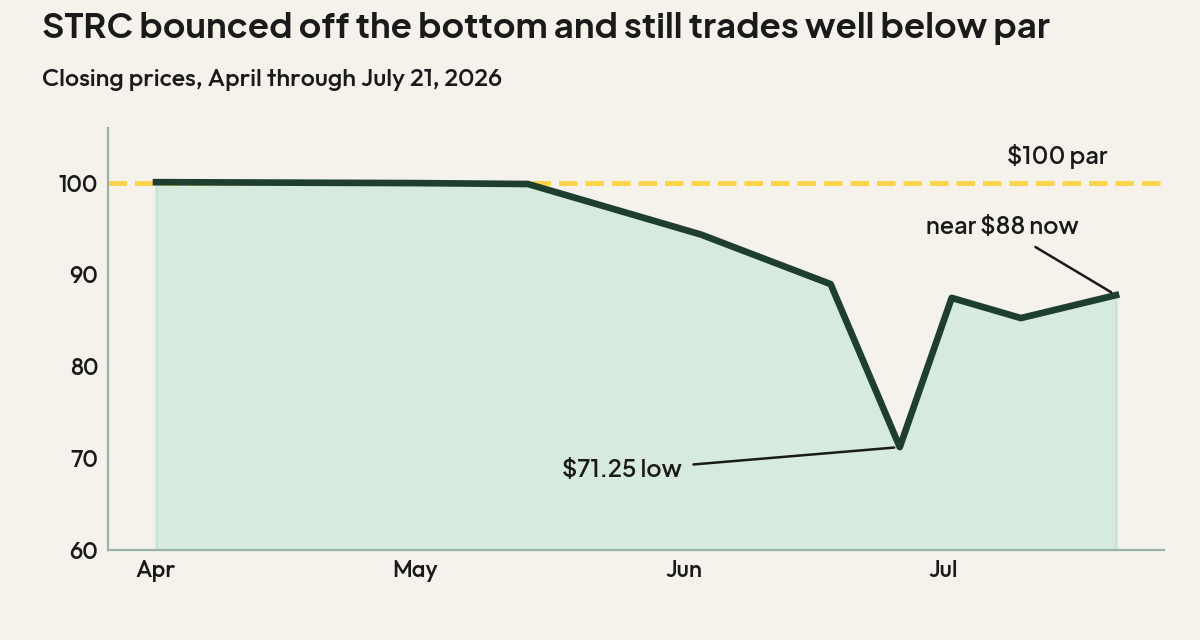
STRC closed near $88 on July 21, up from a $71.25 low and still $12 short of the price it was designed to hold. Source: Nasdaq, StockAnalysis.
The rescue plan worked, at a price we can now measure.
He Sold Near the Bottom
(a feeling many of us know well!📉🤦♂️)
The recovery headlines skip a step.
In the 5 trading days after the framework passed, Strategy sold 3,588 Bitcoin. The filings show 1,363 coins on June 29 and 30 at an average of $59,256, then another 2,225 in the first week of July at $60,773. Those coins cost the company $75,476 apiece on average.
I like to think I’m pretty decent at math. The last time I checked, when you sell something for $60,000 that you paid $75,000 for, that’s a locked in 20% loss. That’s the arithmetic behind about $216 million in proceeds.
For 4 years the pitch was that Strategy could never become a forced seller, because nothing on its balance sheet could squeeze it hard enough. The first real stress test said otherwise.
When the preferred market shut, the coins funded the defense.
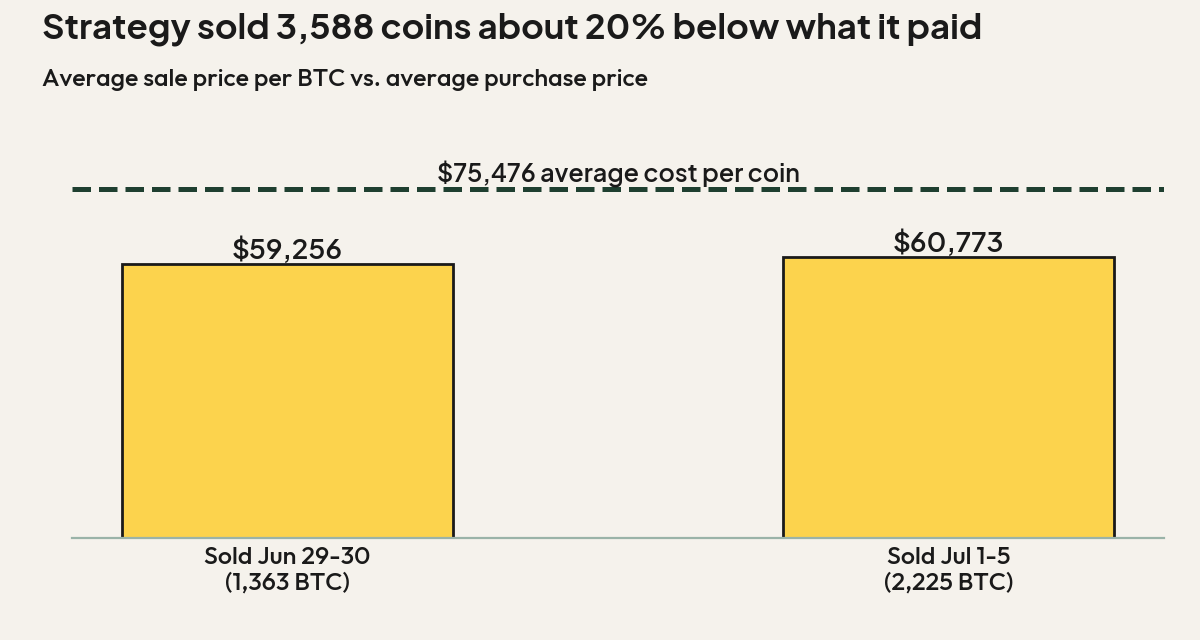
Average sale prices from Strategy’s 8-K filings against its average purchase price. Source: SEC filings.
Then Saylor Found a Cookie Jar to Reach Into
What happened next tells you more than the June panic did.
The Bitcoin sales stopped on July 5. Since then, Strategy has funded itself by selling its own common stock instead. Last week it sold 2.73 million MSTR shares for $263.5 million and routed the proceeds straight into its dollar reserve, which now sits at $3.225 billion. In early June that reserve held about $900 million.
It has more than tripled in seven weeks, and every dollar of it is earmarked for preferred dividends and debt interest rather than for Bitcoin.
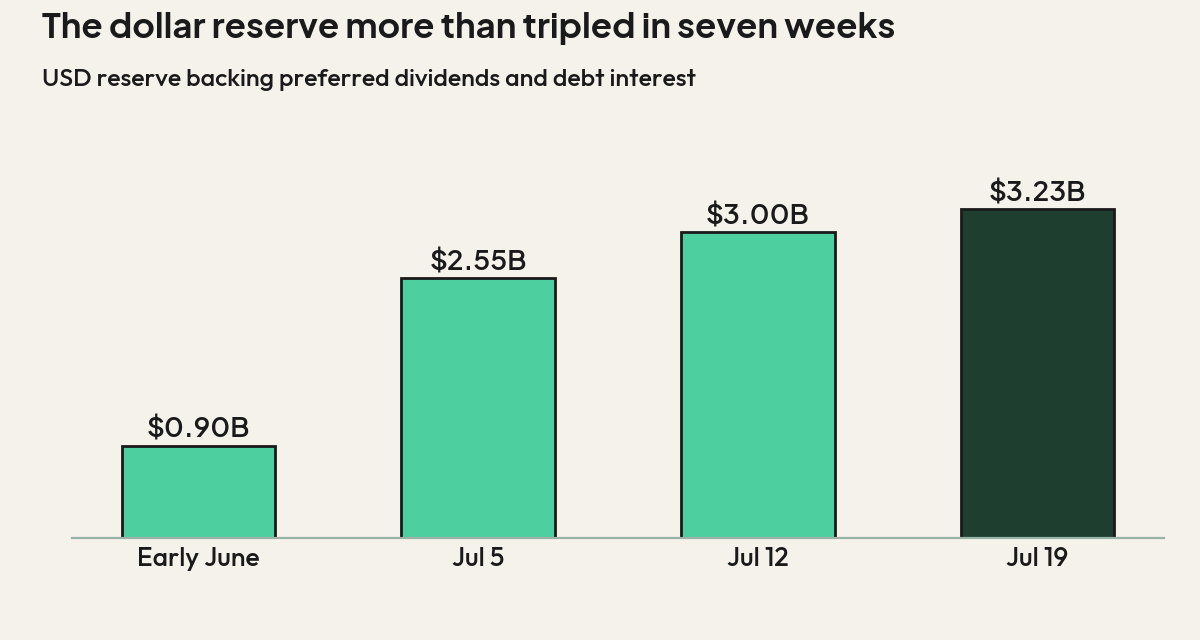
Reserve balances from Strategy’s weekly 8-K filings. Source: SEC filings.
Read the sequence in order and it shows you the pecking order in a crunch:
The coins went first, when the pressure peaked.
The common shareholders’ slice has gone out the door every week since, through dilution, once the panic eased.
The preferred holders, who are owed roughly $1.2 billion a year in dividends, a bill that has quadrupled since January, haven’t missed a payment.
Peter Schiff needled the company over it, arguing the stock sales punish common holders and hinting that Strategy may doubt the Bitcoin market could absorb a large sale without moving the price. On that second point, a company sitting on 4% of the supply has to think that way.
Buffett Framework Question
Would you buy a business whose only asset produces no cash while its liabilities demand cash every month?
Buffett built Berkshire on float, insurance premiums that arrive before claims go out, money that works for you while it waits. Strategy is the mirror image. Its preferred stack is reverse float: cash that must leave every month, funded by an asset that pays nothing while it sits.
When Bitcoin climbs faster than the dividends compound, the structure looks like genius. When it doesn’t, the company sells pieces of itself, coins first and shares after, to feed the machine.
What the Bounce Fixes, and What it Doesn’t
The market has rewarded the maneuvering. Saylor buzzed the tower, sold the coins, diluted the shareholders, and the crowd still cheered when he landed.

STRC closed near $88 on July 21, well off the low.
The 12% dividend is intact, the reserve now covers more than two years of preferred payments at the current run rate, and CEO Phong Le told Bloomberg the company remains a long-term buyer that wouldn’t sweat its debt unless Bitcoin fell toward $8,000.
Those are real stabilizers, no spin.
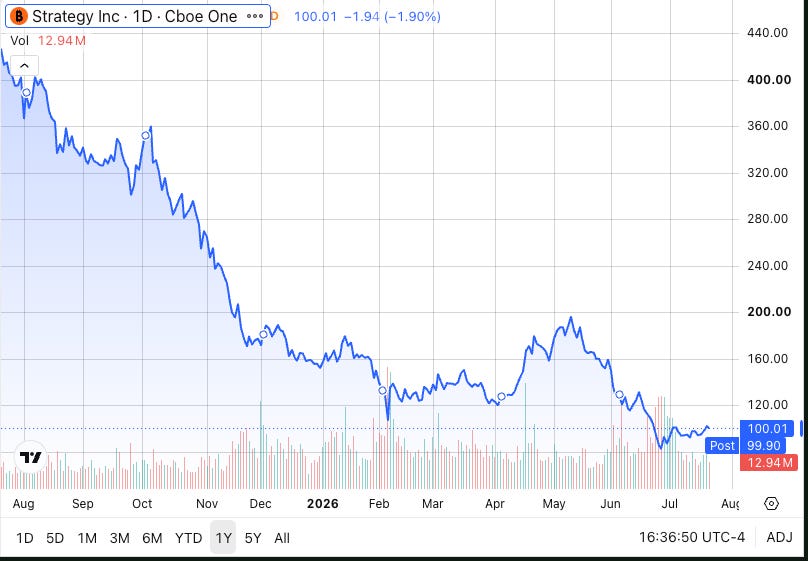
The bounce leaves plenty unfixed though because STRC still trades $12 below the number it was engineered to hold, which means the accumulation engine is still off. MSTR is down 38.6% this year and closed last week below $95, with the company’s market value slipping under the worth of its coins. The treasury carries a $9 billion paper loss.
A machine built to convert market enthusiasm into Bitcoin now converts shareholder dilution into dollar reserves, and it has run in that direction for a month straight.
There’s a fair case that this is what disciplined management looks like: sell whichever security fetches the best price, protect the obligations, wait out the storm.
Strategy calls it active capital management, and buying back $100 promises in the $70s was smart capital allocation. The other reading is that we watched, in real time, which promises bend under pressure. The never-sell pledge went first. Earnings land July 30, and the number I’ll check before any other is whether the coin count moved.
I said it before and I’ll keep on saying it:
Saylor is not Bitcoin, and Bitcoin does NOT need Saylor.
What changed this summer is that the largest corporate holder on the planet showed us, first by written policy and then by filing, that its coins are collateral now. Collateral gets sold when the lender needs the money.
The stack survived. The story about the stack didn’t.
Matthew Snider is the founder of Block3 Strategy Group, author of “Warren Buffett in a Web3 World,” and publisher of the BitFinance newsletter. He holds a Series 65 and MBA, and has been an active participant in digital asset markets since 2015. This article is for educational purposes only and should not be considered financial advice. Always consult with a qualified professional before making investment decisions.
Sources
2. Strategy Form 8-K outlining planned Bitcoin sales, June 29 through July 5, 2026. Crowdfund Insider.
4. Strategy pads cash reserve by $225M with MSTR sale. Decrypt, July 20, 2026.