A $45 Billion AI Fund Just Got Liquidated Like a Crypto Trader
The week his fund came apart, Leopold Aschenbrenner was getting married.
Guests were arriving in Carmel for a multiday celebration. He and his team spent those nights on the phone, negotiating past midnight with the banks that had financed the largest bet on artificial intelligence anyone had made.
By Thursday morning it was over.
Ken Griffin’s Citadel bought the vast majority of Situational Awareness’s public stock portfolio at a discount of more than 10% to where those shares were trading, and those shares were already far below where they’d traded three weeks earlier.
Hours later, many of them rallied 15% to 25%.
Here’s the story of how this all unraveled and how this might impact your portfolio.
What Leopold Built
Two years ago, Aschenbrenner published a 165-page essay arguing that almost everyone was underestimating how fast AI would arrive, then turned that essay into a fund. (must be nice…)
At its peak in early July his fund at Situational Awareness managed roughly $45 billion. Investors included the Collison brothers and senior people from Meta and Jane Street, many locked in for years at $25 million minimums.
Through June 30 the fund was up 439% net on the year.
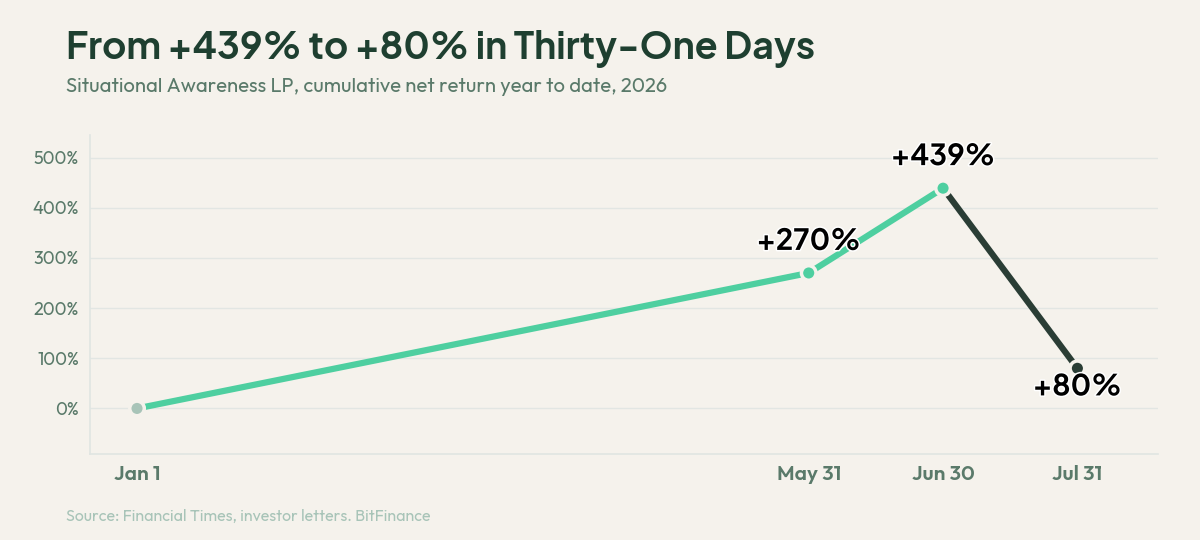
Cumulative net return year to date. Source: Financial Times, investor letters.
The thesis was simple: make bets on physical AI.
Remember that physical AI represents an industry niche that includes things AI models need rather than the models themselves.
Think memory chips, power generation, data centers, cloud capacity managed and operated by companies like SK Hynix, SanDisk, Bloom Energy, CoreWeave, Core Scientific and Nebius (one we’ve covered previously).
Against that sat a short book in software, on the logic that AI would compress the value of application companies while the infrastructure underneath grew scarcer.
On July 10, confidence was high enough that Situational Awareness served as an anchor investor in SK Hynix’s $27 billion US listing. Ten days before it lost everything on the public side, the fund was underwriting somebody else’s debut.
How the Math Works
For every dollar of investor capital, Situational Awareness borrowed three to four more, and bought options on top of that. (Options are a form of leverage that magnify gains as well as losses).
Goldman Sachs, JPMorgan, Citigroup and Bank of America financed the positions. Earlier in the year the fund had reportedly gone looking for still more borrowing capacity.
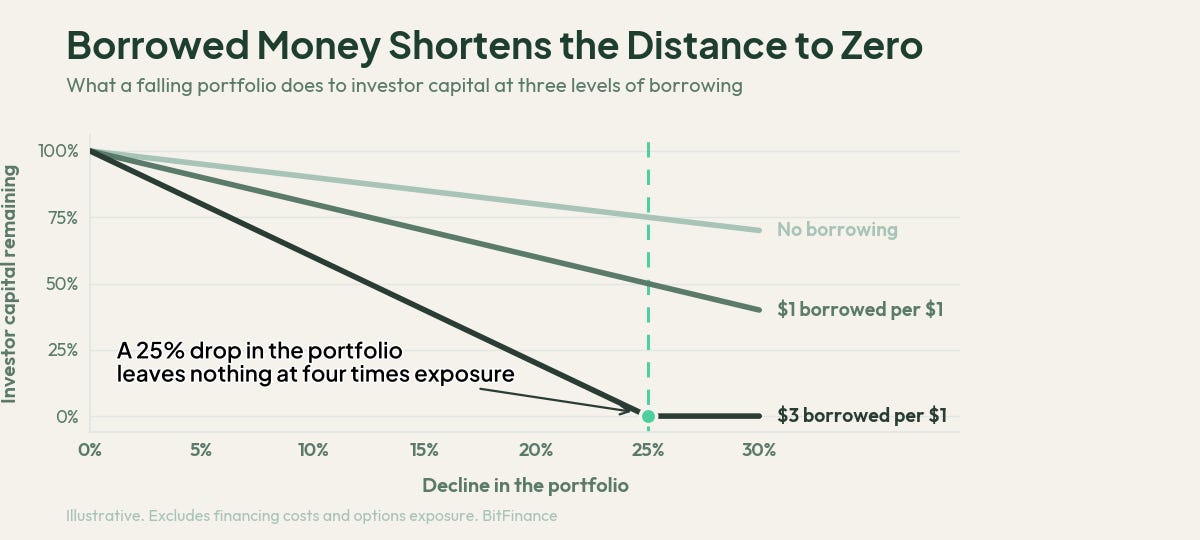
Illustrative. Excludes financing costs and options exposure.
Without borrowing, a portfolio that falls 25% leaves you with 75% of your money and a bad year. With 4x the exposure, the same decline leaves nothing.
The stocks don’t have to be wrong, they only have to fall further than your capital can absorb.
The long and short sides were never two bets. They were one bet on a single market regime, wearing two costumes.
How the Selling Became Mandatory
Sentiment turned in the middle of July.
Cheaper Chinese open-source models raised a question nobody had been asking: if the same capability needs less compute, how much of AI’s value settles in the infrastructure layer at all?
Investors started trimming. Over 3 trading days, hedge funds cut positions at a pace Goldman Sachs hadn’t recorded in three years.
The selloff hit everyone in that trade. It destroyed one fund.
Anyone who has watched a crypto perpetual futures market during a bad hour already knows the sequence. A large borrowed position becomes visible. Rival traders work out roughly where it has to be sold, then press prices toward that level. The selling that follows is a requirement rather than a decision, and it drives prices further in the same direction, which forces more selling. The position gets harvested rather than repriced.
The banks stopped reviewing the fund weekly and started reviewing it daily. Margin calls followed. Other hedge funds reportedly shared what they knew about the holdings and shorted the largest ones, positioning for a liquidation they were confident was coming.
Aschenbrenner later compared it to a bank run. The comparison is close, though his investors were locked up and mostly couldn’t leave. The run came from his lenders, and from traders who could smell what the lenders were about to do.
Academics call this predatory trading. Crypto traders call it Tuesday.
Situational Awareness spread its exposure across four prime brokers, so each bank saw only its own slice. The trade was opaque to the people financing it and transparent to the people hunting it, which is the worst arrangement available.
Leopold’s Really Bad Awful Hump Day
By Wednesday the fund had met every margin call and defaulted on nothing. It was still standing, and it needed to sell something large.
Late that night, Aschenbrenner reached a deal to sell the fund’s $3.5 billion Anthropic stake to a group led by Greenoaks and Sequoia. The private crown jewel, gone, in exchange for keeping the portfolio he’d spent two years building.
By Thursday morning he had reversed it.
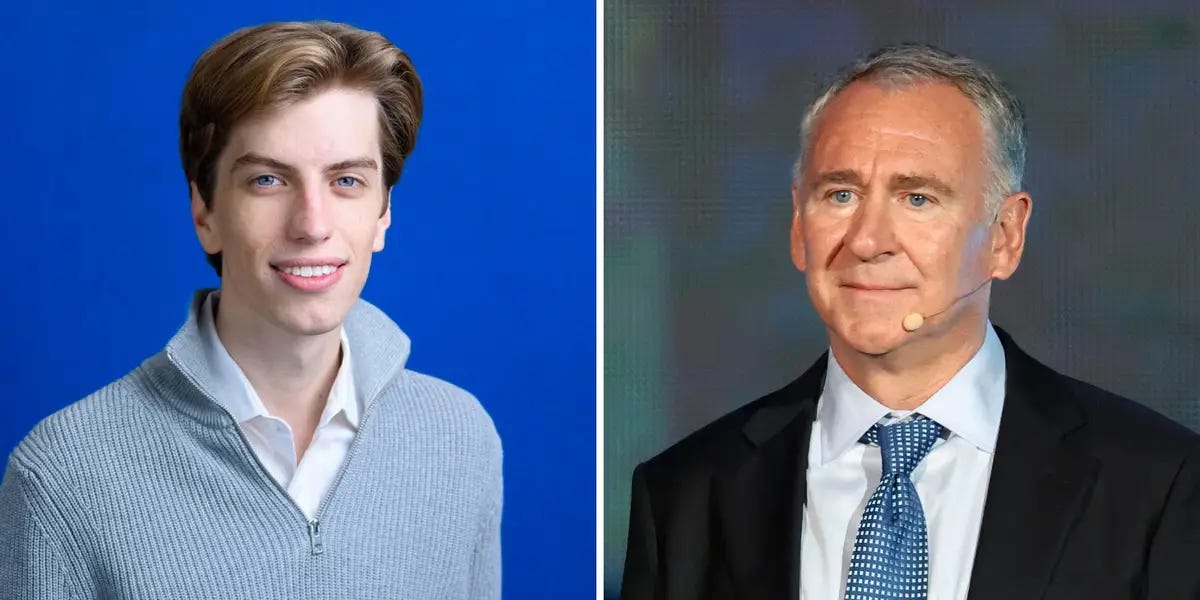
Citadel and Millennium negotiated past midnight. Just before the opening bell, Citadel took the public book at a discount of more than 10% to the last marks. The private positions stayed.
But it’s important to consider what survived.
The listed portfolio, the part he could exit any day he chose, is gone.
The private stakes, worth more than $10 billion and impossible to sell quickly, are still there. Nobody could re-appraise Anthropic overnight and demand cash against it, so illiquidity, which allocators normally treat as a cost you charge extra to accept, worked as protection.
The Note
There’s a part of this that made a lot of people angry, and I think it’s worth highlighting here.
The day before Aschenbrenner’s worst week reached its worst day an odd thing happened: Citadel Securities published a client note arguing the Fed should surprise markets with a quarter-point hike.
Frank Flight, the firm’s head of macro strategy, wrote that traders were underestimating how hawkish the central bank had turned. Bloomberg’s coverage on July 28 said the call was adding to market angst. Bond traders were already on edge going into a decision run by a new chair.
Citadel Securities is the market-making sister company to Citadel, the hedge fund that bought Aschenbrenner’s book two days later at a double-digit discount.
By Thursday, traders were saying the quiet part out loud. One widely shared post called it diabolical, arguing the firm had talked up a hike to accelerate the selloff and buy the same stocks cheaper.
While a good story, the record doesn’t support that angle. The Fed held, voting 9-3 to leave rates at 3.50% to 3.75%. Three members dissented in favor of hiking, so the call was closer to right than to reckless. Futures markets already put the odds near 38%. And Citadel Securities had been publishing a hawkish view for months, telling clients before the June meeting that it expected hikes in September and December. A house view held since spring is not a trap sprung in July.
What’s left is more uncomfortable than the accusation.
One firm’s research desk can shift rate expectations across the entire market while an affiliated firm’s balance sheet sits ready to buy assets that dislocation makes cheap. Nothing about that requires coordination. It requires no phone call, no shared spreadsheet, no crossing of any information barrier. The structure produces the outcome on its own, and it’s perfectly legal.
Citadel didn’t need to cause the fire to be the only one holding water.
Where This Leaves Things
Aschenbrenner may still be right about AI, and Citadel’s willingness to buy the book says those assets had real value at some price. The fund never formally defaulted, retains more than $10 billion in private positions, and plans to keep investing while dropping bank leverage and rebuilding its risk team. He told investors he takes full responsibility, which is more than most people manage.
All things told…those positions that cratered are now up pretty significantly after the acquisition by Citidel Securities. Coincidence? We’ll let you be the judge….🧐
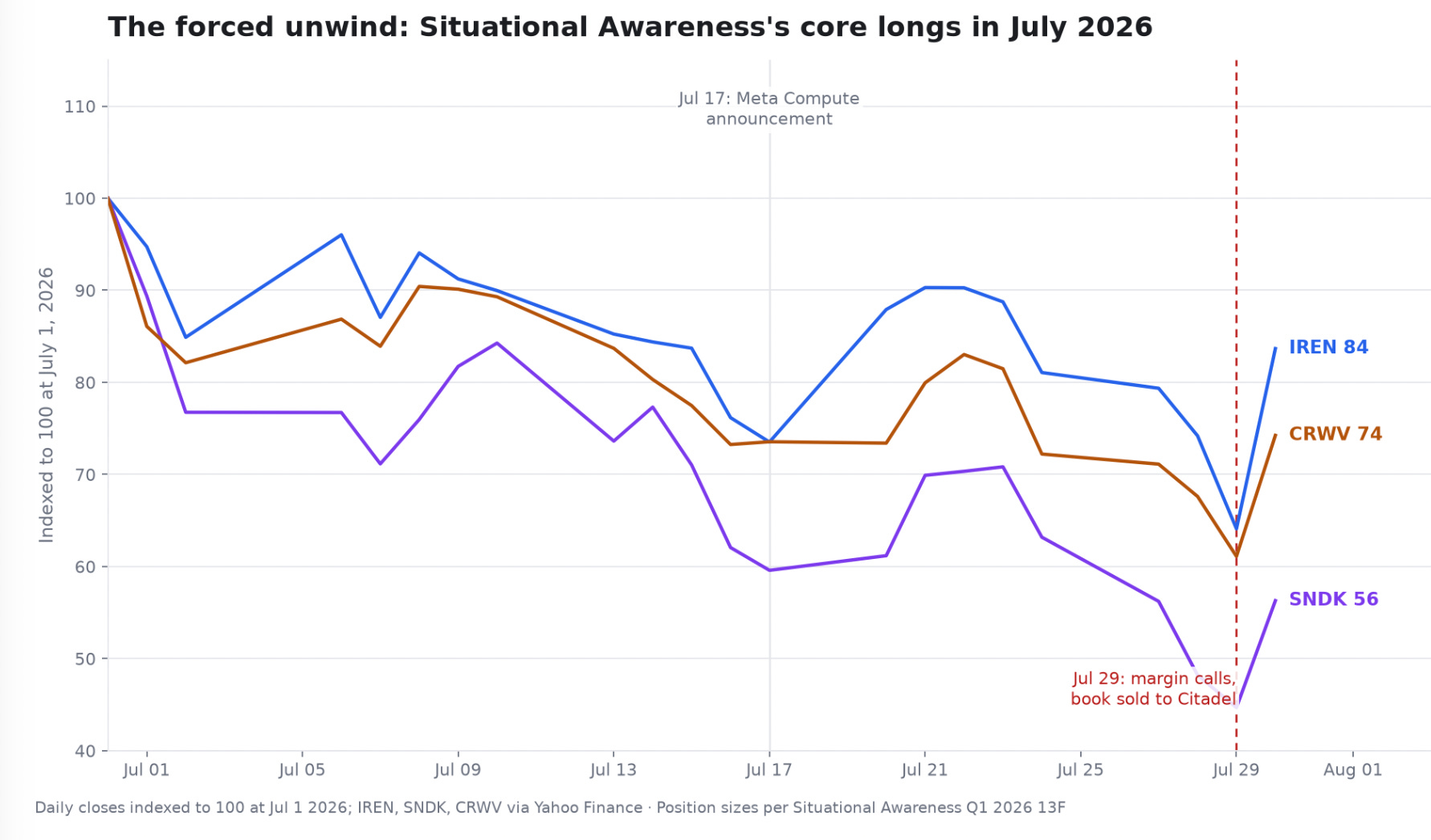
July settled a question about structure rather than about the thesis. Go back to the house. He was right about the neighborhood, he had the mortgage re-appraised every morning, and the appraiser stopped asking what he thought.
In a 2024 interview, Aschenbrenner described his own first principle: “Not blowing up is task No. 1 and 2.” Knowing the rule was never the hard part.
The Buffett Framework Question
Which of your positions can somebody else decide to sell for you? If the answer is any of them, you don’t own that position on your own terms, and what you paid for daily liquidity may be higher than it looks.
Matthew Snider is the founder of Block3 Strategy Group, author of “Warren Buffett in a Web3 World,” and publisher of the BitFinance newsletter. He holds a Series 65 and MBA, and has been an active participant in digital asset markets since 2015. This article is for educational purposes only and should not be considered financial advice. Always consult with a qualified professional before making investment decisions.