Stock Tokens Just Got a 5-Year Hall Pass. You’re Not Bullish Enough.
Whew…what a week it’s been for digital assets:
Tuesday: the Senate blocked the Clarity Act.
Wednesday: Circle switched on its own blockchain, with BlackRock, Visa and Mastercard among the validators.
Thursday: the SEC quit waiting for Congress and said real shares of U.S. companies can trade on blockchains.
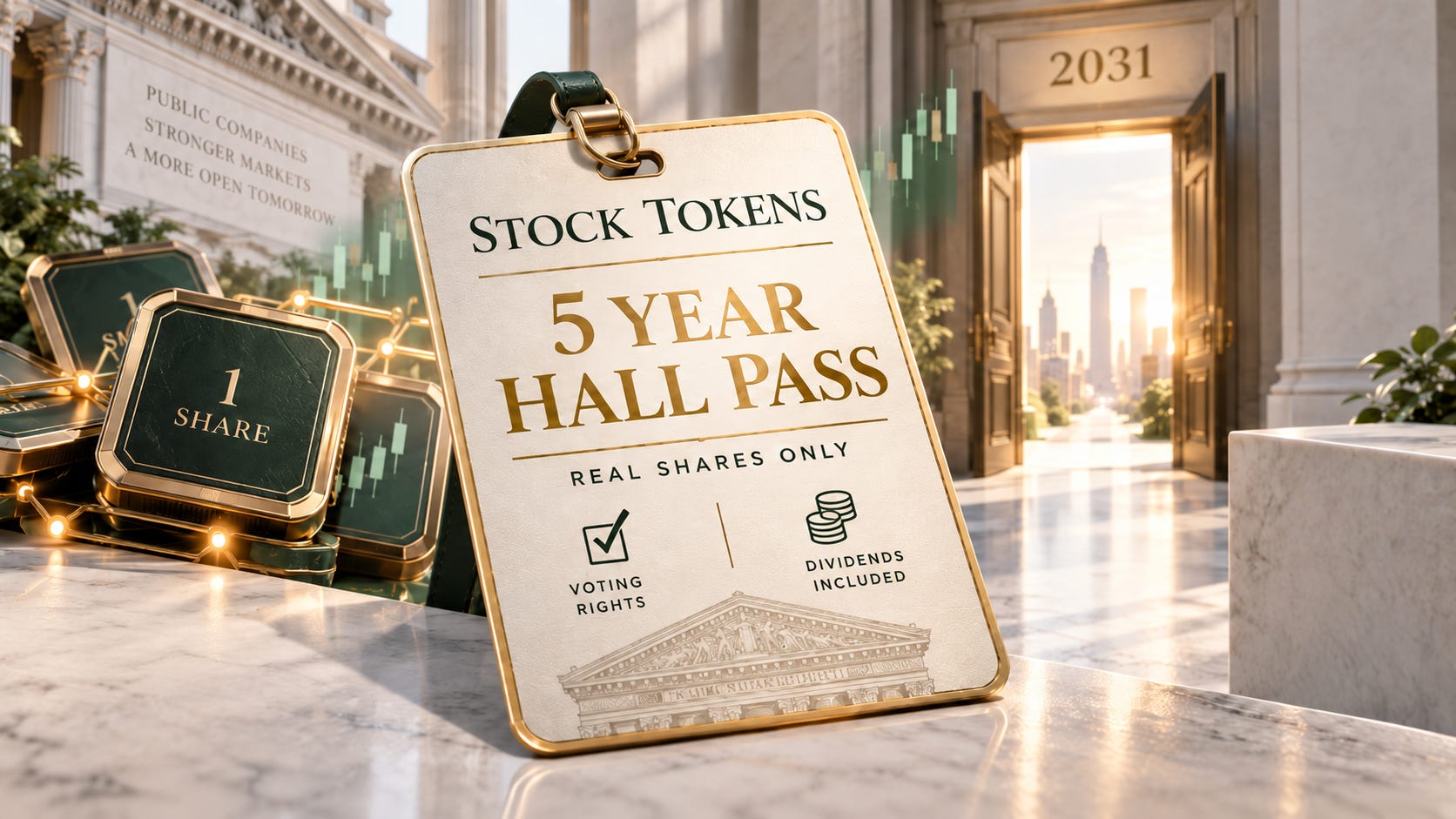
The SEC calls it the Innovation Exemption. I’d call it a hall pass.
You remember the deal. You’re allowed out of class, but only to one place, only for so long, and the teacher can take it back. Nobody confuses a hall pass with graduation, but it’s still the first time you’ve been allowed in the hallway.
Stock tokens got that deal this week: five years, a short list of places to go, and a regulator watching the clock.
First, What Exactly is a “Stock Token”
A stock token is a share of a public company that lives on a blockchain.
Done right, it’s the same share with the same vote and the same dividend, except it sits in your wallet, trades at 3 a.m. on a Sunday, and settles in seconds.
Done the other way, it’s a side bet. Most “tokenized stocks” sold offshore track a stock’s price without giving you the stock. Robinhood’s Stock Tokens work that way. They’re debt issued out of Jersey, they carry no shareholder rights, and Americans can’t buy them.
Thursday’s order picks a side. Only tokens carrying the same rights as the real share qualify, and synthetics are out.
It does two things, each for 5 years.
Trading venues can match buyers and sellers of these tokens without registering as a stock exchange, and the firms funding those venues’ trading pools don’t have to register as dealers.
The pools are automated market makers, the same formula-driven pots of two assets that power most crypto trading. Until Thursday, running one for Apple shares made you an unregistered exchange.
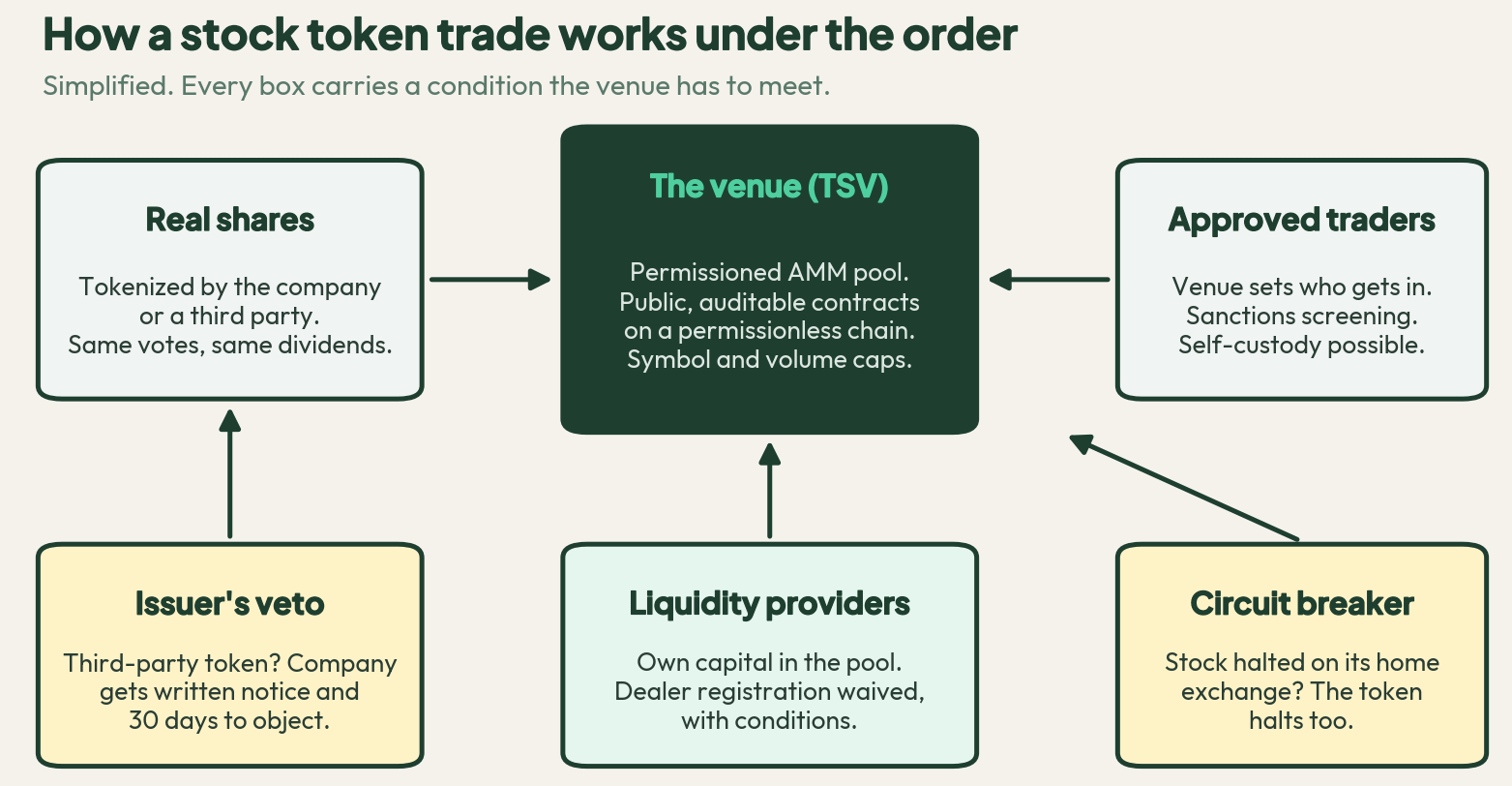
The venue in the middle gets the relief. Everything around it is the price of that relief. Source: SEC Release No. 34-106402.
What’s Written on the Hall Pass
Real ownership only. Votes and dividends included; the venue has to verify it.
The company can veto. 30 days to object before a 3rd party tokenizes its stock.
Size limits. Caps on how many tickers and volume each venue can handle.
Halts travel together. When the stock stops on its home exchange, the token stops too.
Open code, guest list at the door. The contracts are public on a public chain, but the venue decides who trades.
Getting the pass is the easy part.
A venue posts a public notice, tells the SEC, and waits 30 days. There’s no application and no approval queue, which puts the first possible opening around October 17.
I’ve structured more than $250 million of Reg D private placements, and the pattern from exempt offerings holds here. When compliance drops from a multi-year registration to a notice and a checklist, the first people through the door are small.
The Other Half: Safe Harbor for Crypto-Based Founders
This order has a sibling.
In August the SEC proposed Regulation Crypto Assets, which I covered in August. It lets a startup raise up to $5 million without registering, opens bigger lanes at $20 million and $75 million, and gives a team a way to certify its work is finished so the token stops being treated as a security.
One rule covers how a new token gets born. The other covers how an old-fashioned share gets to trade like one. The catch is timing, because the stock token order is live today while the founder rules are still a proposal sitting in a comment period.
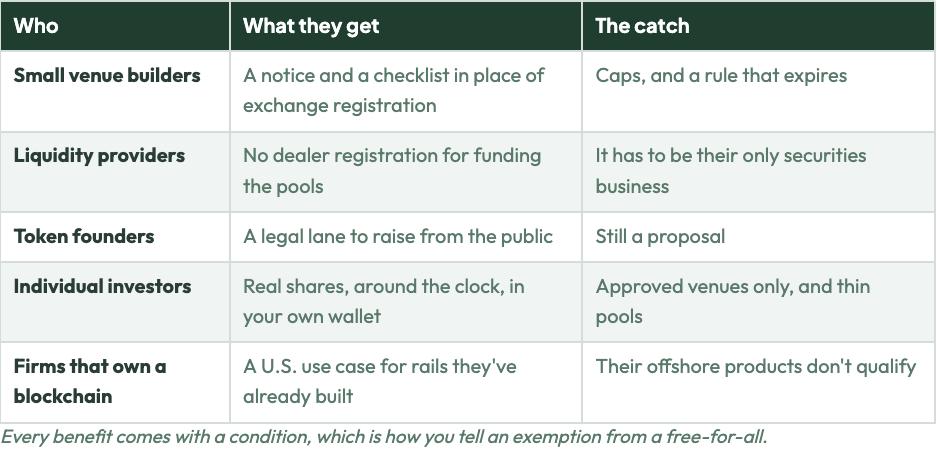
The last row is where the big names sit. Kraken’s Ink has been live since December 2024. Robinhood Chain opened July 1. Coinbase started listing stocks on Base in August. Circle’s Arc went live Wednesday, one day before the order.
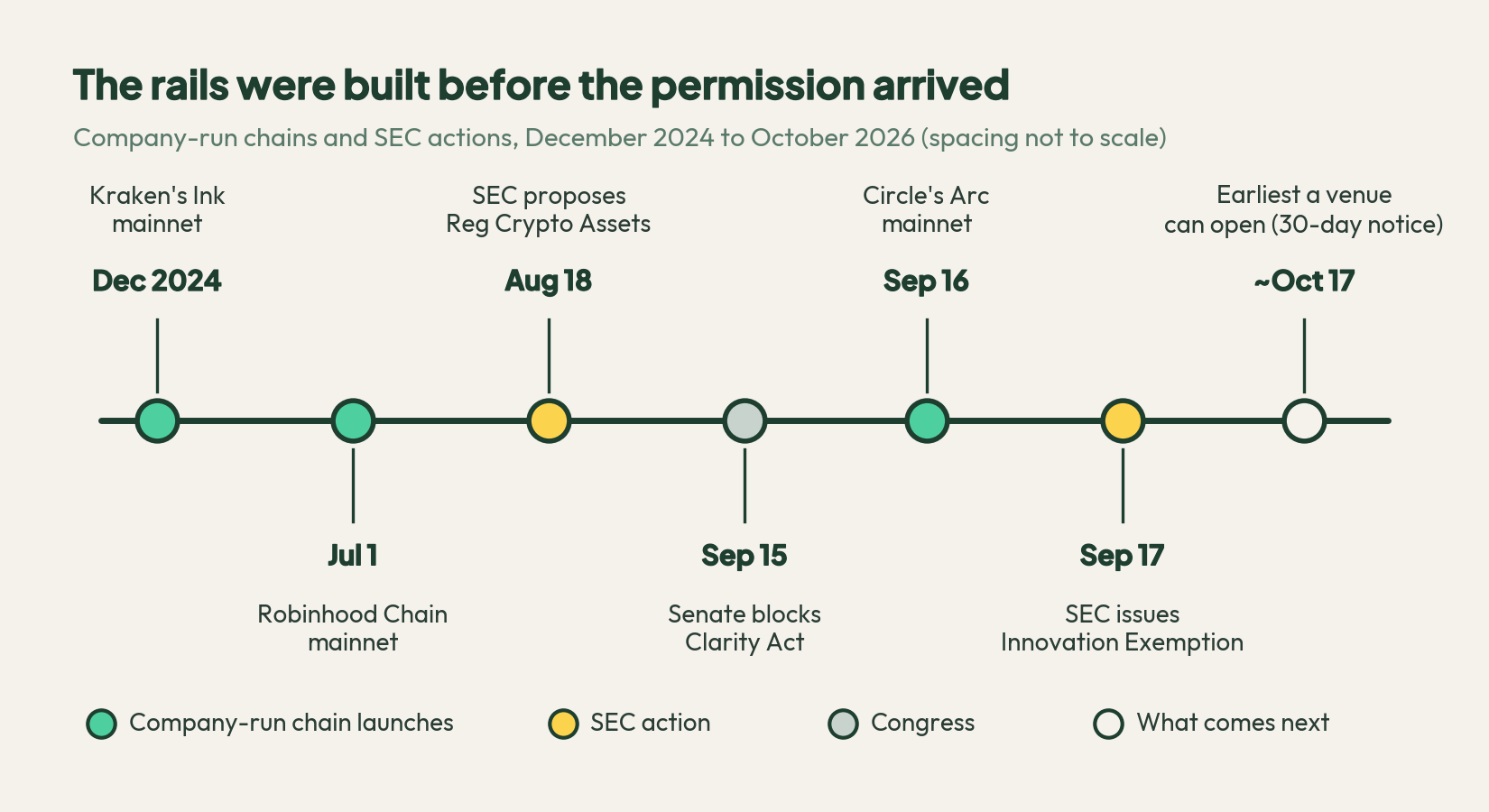
Green dots are companies building rails, gold dots are the SEC writing rules. Congress shows up once.
So far those chains haven’t carried much of what they were built for. Two weeks after launch, Robinhood Chain held about $312 million, and only about $12.8 million of it was tokenized real-world assets. Memecoins did the rest.
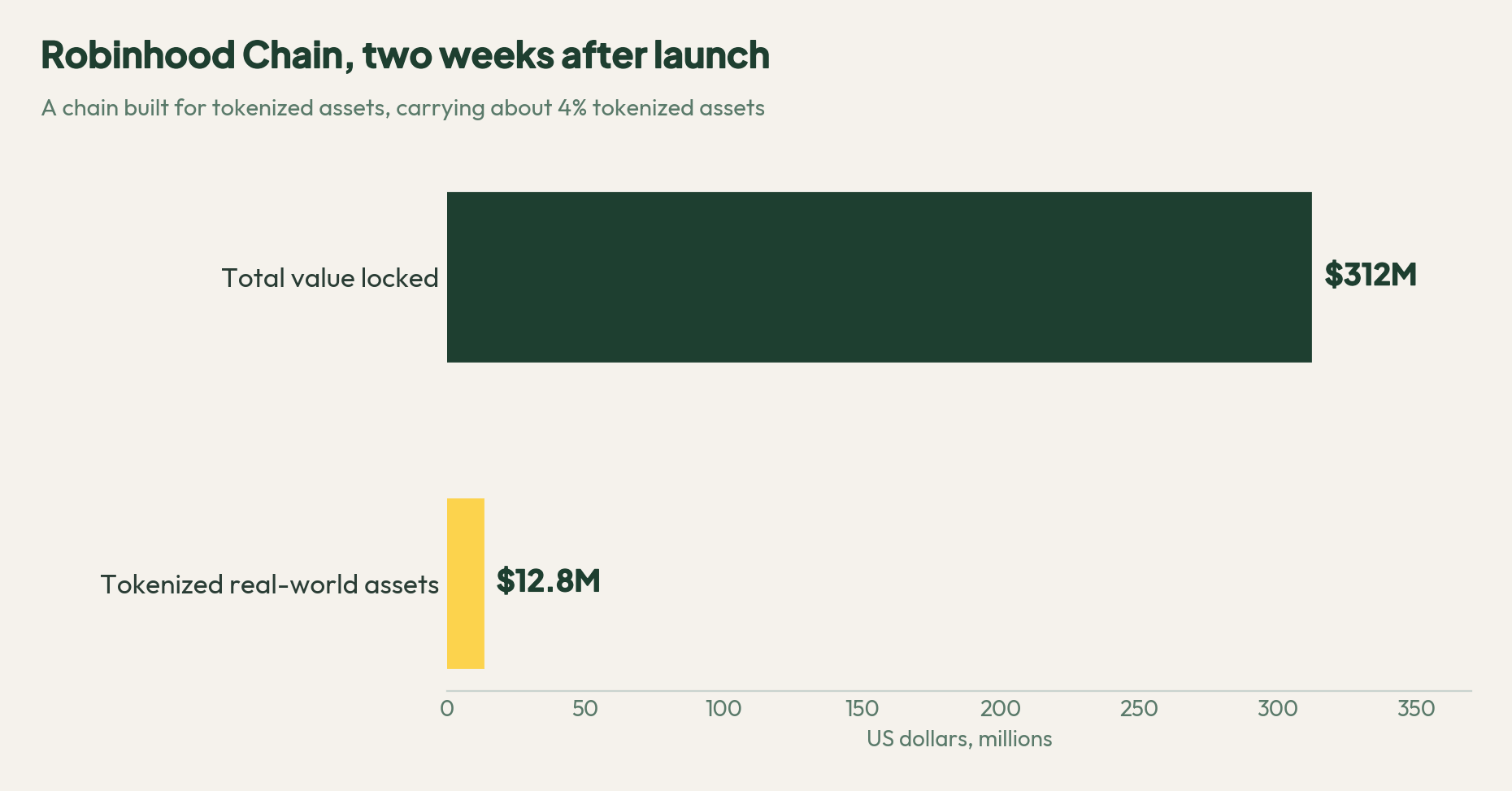
About 4 cents of every dollar was the asset the chain was designed for. Mid-July figures. Source: KuCoin Research
The explanation is plain. The stock tokens on those chains are offshore products Americans can’t buy, so the biggest pool of stock investors in the world has been standing outside.
The hallway was already built.
This week somebody started signing passes.
Who This Doesn’t Help…
Synthetic issuers, including Robinhood’s current structure. My hypothesis, labeled as one: the big platforms need a second product built on real shares, and a focused startup can file a notice faster than they can build it.
Anonymous DeFi. Every venue has a guest list.
Anyone reading temporary as permanent. Chairman Atkins said the exemption “must be followed by durable rulemaking.” It rests on this Commission’s authority, with midterms six weeks out and the bill that would’ve made it law stuck in the Senate.
Where This Leaves You - the Investor
There’s nothing to buy today.
When the first venue opens, ask three things. Is it the share or a side bet? Who’s on the guest list? How deep is the pool? A thin pool can quote a price well away from the NYSE’s, especially at 3 a.m. on a Sunday when nobody’s around to close the gap.
The skeptics have fair points.
Splitting one stock across a dozen small pools can make prices worse before it makes them better, and so far users on these chains have preferred memecoins to Microsoft.
On the other side, the rights are the same as the share’s, the code is public, and Americans finally get into a market that’s been open to everyone else for over a year.
A hall pass says nothing about where a student ends up, but it does tell you a teacher opened the door, wrote down where they can go, and is checking the clock. My guess is the small, fast builders use that time better than the incumbents who already own the hallway.
The pass expires in 2031.
The habits formed in the hallway won’t.
In Case You Missed It
STRC: The Most Hated Rally in Crypto (Sept. 16)
This summer you could've bought a $100 claim paying 12% a year for $71.25, and almost nobody did. On Wednesday I broke down how Strategy's STRC climbed back to $98.95, why the first 30 points came from the balance sheet instead of Bitcoin, and the two questions to ask the next time one of these Bitcoin-backed preferreds breaks.
BUILD LOG: My BTC bot is losing…but only slightly.
A quick update on the paper-trading Bitcoin accumulation bot I’ve been building in public. It isn’t going well. The account started at $2,500 and it’s down about $50, or roughly 2%. Those are small, pretend dollars, but they’re pointed the wrong way, and I said I’d show the losses along with the wins.
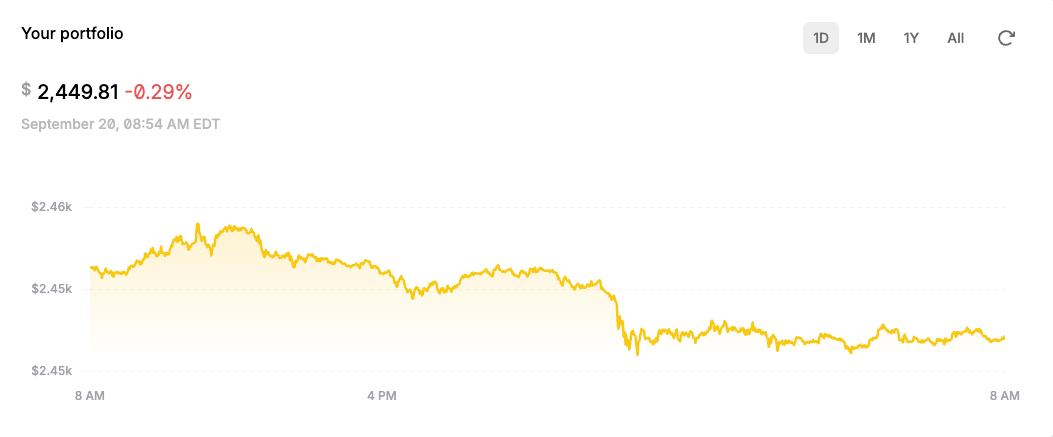
The numbers (matching each sell against the oldest open buy):
Realized loss: about $49.65 across 18 sells
Winners: Aug 31 8:06am (+$0.99) and Aug 31 12:06pm (+$0.69)
Worst stretch: the three September 3 buys at $80,885 to $81,596, sold September 7 to 8 around $78,300 to $78,850. That one cluster cost about $20.70, roughly 40% of the total damage.
Still open: about 0.00794 BTC from the September 18 buys, at an average cost near $77,620 (about $616)
Findings Summarized
The pattern is the real finding. The bot does the same thing every time: it buys in a cluster of three, four hours apart (full size, full size, half size), then sells in a cluster of three at lower prices a few days later. It’s buying after price has already moved up and selling after it’s already moved down.
Bitcoin spent this whole stretch bouncing between roughly $77,000 and $81,500 with no real trend, and that’s the worst possible market for a rule like that. It gets chopped up on every fake breakout.
So the bot isn’t broken in the sense of a bug. It’s doing what it was told, and what it was told doesn’t work in a sideways market. It also trades a lot for a bot called an “accumulation” agent: 39 orders in 24 days, ending with less Bitcoin than a simple weekly buy would’ve stacked.
We’ll be sure to keep you updated!!
Matthew Snider is the founder of BitFinance and principal at Block3 Strategy Group, where he advises emerging digital asset fund managers and RIAs on fund operations and compliance frameworks. He holds both Series 65 and Series 7 licenses, and is the author of Warren Buffett in a Web3 World.
This material is for informational and educational purposes only and does not constitute investment advice, a recommendation, or an offer to buy or sell any security. Nothing herein should be construed as a personalized recommendation. Digital assets and the securities of digital asset treasury companies involve substantial risk, including total loss of principal. Perpetual preferred securities carry no maturity date and no contractual obligation to return stated value. Past performance is not indicative of future results. Consult your own financial, tax, and legal advisors before making investment decisions.
SOURCES
SEC Issues “Innovation Exemption” to Facilitate the Trading of Tokenized NMS Stock and Request for Comment, Press Release 2026-90 (SEC, Sept 17, 2026)
Fact Sheet: Order Granting Temporary Conditional Exemptive Relief for Trading of Tokenized NMS Stock, Release No. 34-106402 (SEC, September 17, 2026)
SEC Unveils “Innovation Exemption” for Tokenized NMS Stocks: What You Need to Know (Hamilton & Associates, September 17, 2026)
SEC Proposes New Regulation Crypto Assets, Press Release 2026-76 (SEC, August 18, 2026)
Stock Tokens, Robinhood Chain Documentation (Robinhood, accessed September 18, 2026)
Robinhood Accelerates Global Expansion with Robinhood Chain Mainnet (Robinhood, July 1, 2026)
Ink fast-tracks Layer 2 mainnet launch (Kraken, December 18, 2024)
Circle Arc Mainnet Launch: Can It Become the Next Robinhood Chain? (KuCoin Research, September 17, 2026; source for the $312M and $12.8M Robinhood Chain figures)
Coinbase, Robinhood, and Circle face common distribution challenges in tokenized assets (KuCoin News, September 16, 2026; source for Coinbase listing stocks on Base in August)
Arc Mainnet Goes Live: Do Funds Flow First to Meme Coins? (TechFlow, September 17, 2026)