STRC: The Most Hated Rally in Crypto

On June 26, a $100 claim on the largest corporate Bitcoin holder on earth traded for $71.25.
It paid 12% a year on that $100, in cash, and it had never missed a payment.
On Monday this week, it closed at $98.95, its best close in 15 weeks. Add roughly 2.5 months of dividends and a buyer at the June low is sitting on something north of 40%, on the security that was sold to them as the boring one.
Bitcoin, over the same stretch (pun intended!), did about 32%.
You’d expect a 40% move on a “savings account” to get a victory lap. Instead it’s the rally nobody wants to claim, and I think the reasons for that say more about how Strategy operates now than the price does.
Full disclosure before we go further: I’ve written about Saylor and STRC three times since May, and none of it was flattering.
I wrote about the 32-coin sale a preview
I called the June 29 rescue package an edit to the never-sell promise, and
In July I pointed out that the company sold near the bottom.
I stand by all of it. This piece is about what happened next.
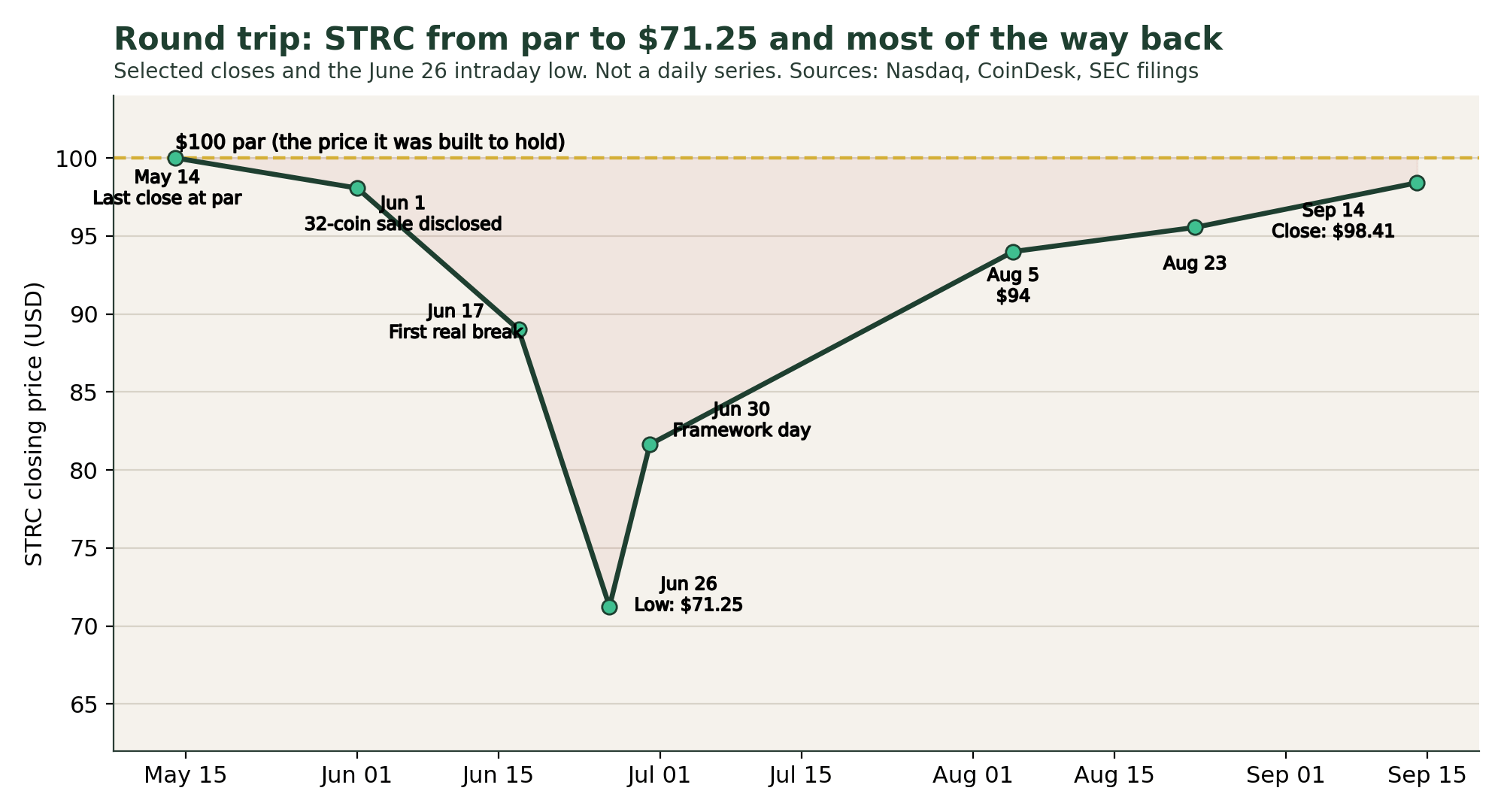
STRC’s round trip from par to $71.25 and most of the way back. Selected closes; not a daily series. Sources: Nasdaq, CoinDesk, SEC filings.
Think About How Gift Cards Work…
Picture a store that sells $100 gift cards and promises to pay the holder $12 a year, forever, just for holding one. The store takes the $100 and buys inventory with it. In this case the inventory is Bitcoin, and the store has been doing this for years.
One rule keeps the business running:
The gift cards have to trade at $100 in the secondary market, because the store only sells new ones when it can get face value. The day a card trades at $95, issuing new ones means giving away $100 promises for $95, and the store stops selling.
Now imagine a rough month. Rumors spread that the store is in trouble, a few nervous holders dump their cards at $90, then $80, and the brokers who’d lent money against those cards start calling in loans. Within two weeks the cards are changing hands at $71.
What does the owner do? She walks around town buying her own gift cards back. Every card she buys at $71 retires a $12-a-year obligation for 71 cents on the dollar.
She’s making money on the fear, and she’s also shrinking the pile of promises she has to keep.
That is, in a sentence, what Strategy has been doing since the end of June.
A quick vocabulary stop, since the product matters here.
STRC, nicknamed “Stretch,” is a perpetual preferred stock.
Preferred means it sits ahead of common shareholders in line for payment.
Perpetual means there’s no maturity date; nobody ever owes you your $100 back.
The dividend rate resets monthly.
The stated goal of those resets is to keep the thing trading near $100.
Everything about STRC is engineered around par, which is why a print at $71 was a five-alarm fire inside the company even if it looked like a bargain from outside.
Why Nobody Wanted STRC at $71
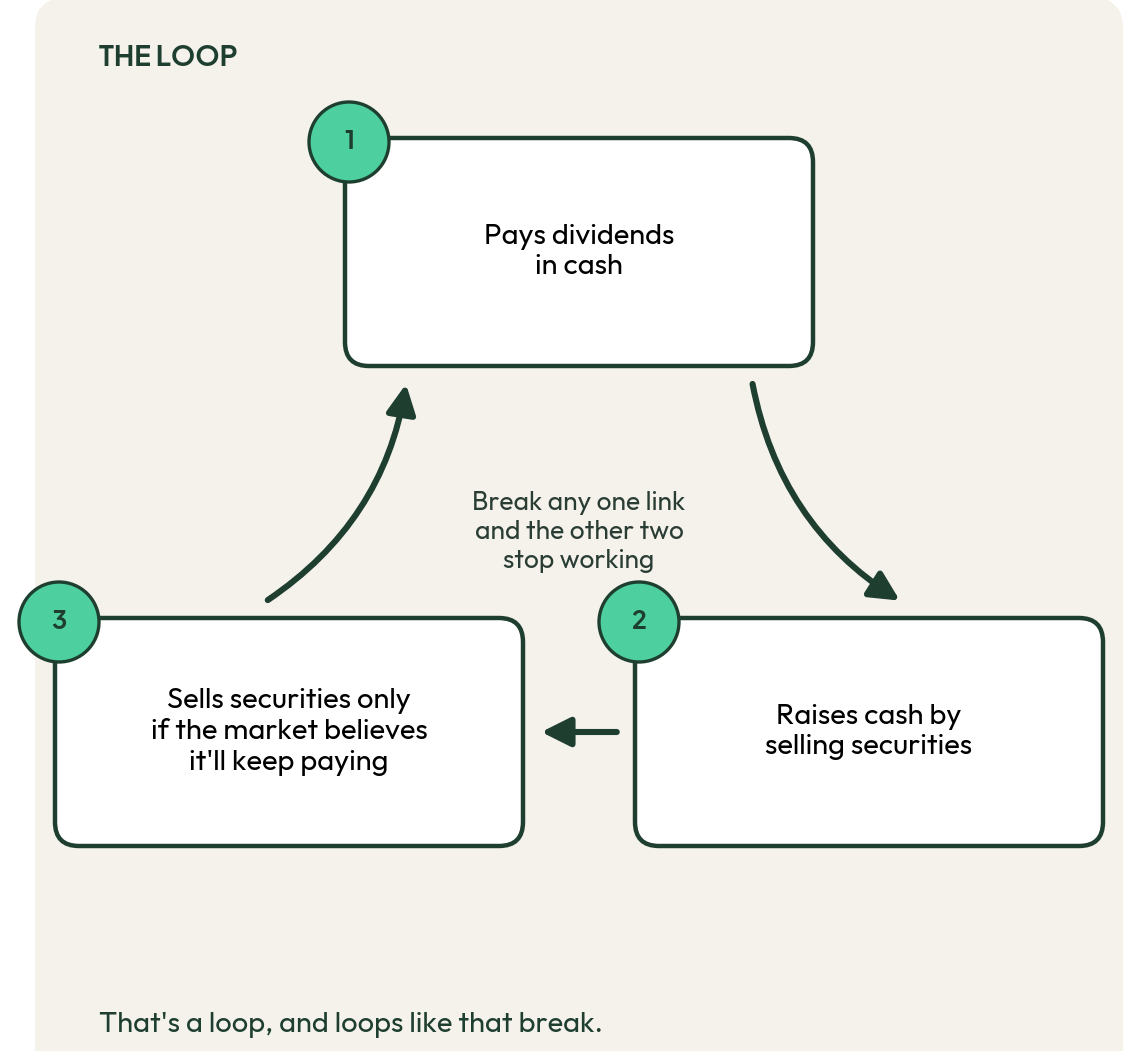
The bear case in June wasn’t a conspiracy theory. It was specific, and most of it was true because Strategy can only pay dividends with cash.
It raises cash by selling securities.
It can only sell securities if the market believes it’ll keep paying.
That’s a loop, and loops like that break. In late May the company sold 32 Bitcoin, a rounding error against 845,000, and the market read it the way a bank examiner reads a loan officer selling his house to make payroll.
Then Bitcoin broke $60,000, STRC slipped below par, margin calls turned a slide into a cascade, a law firm announced an investigation, and Fortune ran a piece quoting a risk analyst asking whether the product was destined to collapse.
The dollar reserve covered about six months of payments. The Bitcoin stack was roughly $9 billion underwater.
Every one of those facts was accurate. The doomers were right about the risk. Where they were wrong, or at least early, was in assuming the company had no answer.
The Playbook in 3 Moves
The board adopted what it calls the Digital Credit Capital Framework on June 29: a dollar reserve with a twelve-month minimum, a $1 billion buyback authorization for the preferreds with STRC first in line, a dividend bump to 12%, and written permission to sell Bitcoin.
Then it executed, and the order of operations is the story.
Move one: sell coins. In the five trading days after the framework passed, Strategy sold 3,588 Bitcoin for about $216 million at an average near $60,000, against a cost basis of roughly $75,400. A locked-in 20% loss, spent to fund dividends when nothing else on the balance sheet would sell. Another 3,300 or so coins went out the door in late July and early August, most of that going straight into STRC repurchases.
Move two: sell shares. Once the panic eased and MSTR recovered, the coin sales stopped and the at-the-market stock sales took over. Some weeks it was $263 million, one week it was $544 million, and the proceeds went to the reserve and to buybacks. The reserve went from $871 million in late May to $5.1 billion by August 23.
Move three: pay cash. This is the part that’s new this month. Strategy bought back $176.3 million of STRC in the first week of September and another $139.3 million last week, and both tranches came out of its dollar cash account. It sold no Bitcoin, it sold no MSTR shares, and the coin count has sat at 845,050 for two weeks running. The buyback authorization was doubled to $2 billion on September 8. Total STRC repurchased since July: roughly $950 million.
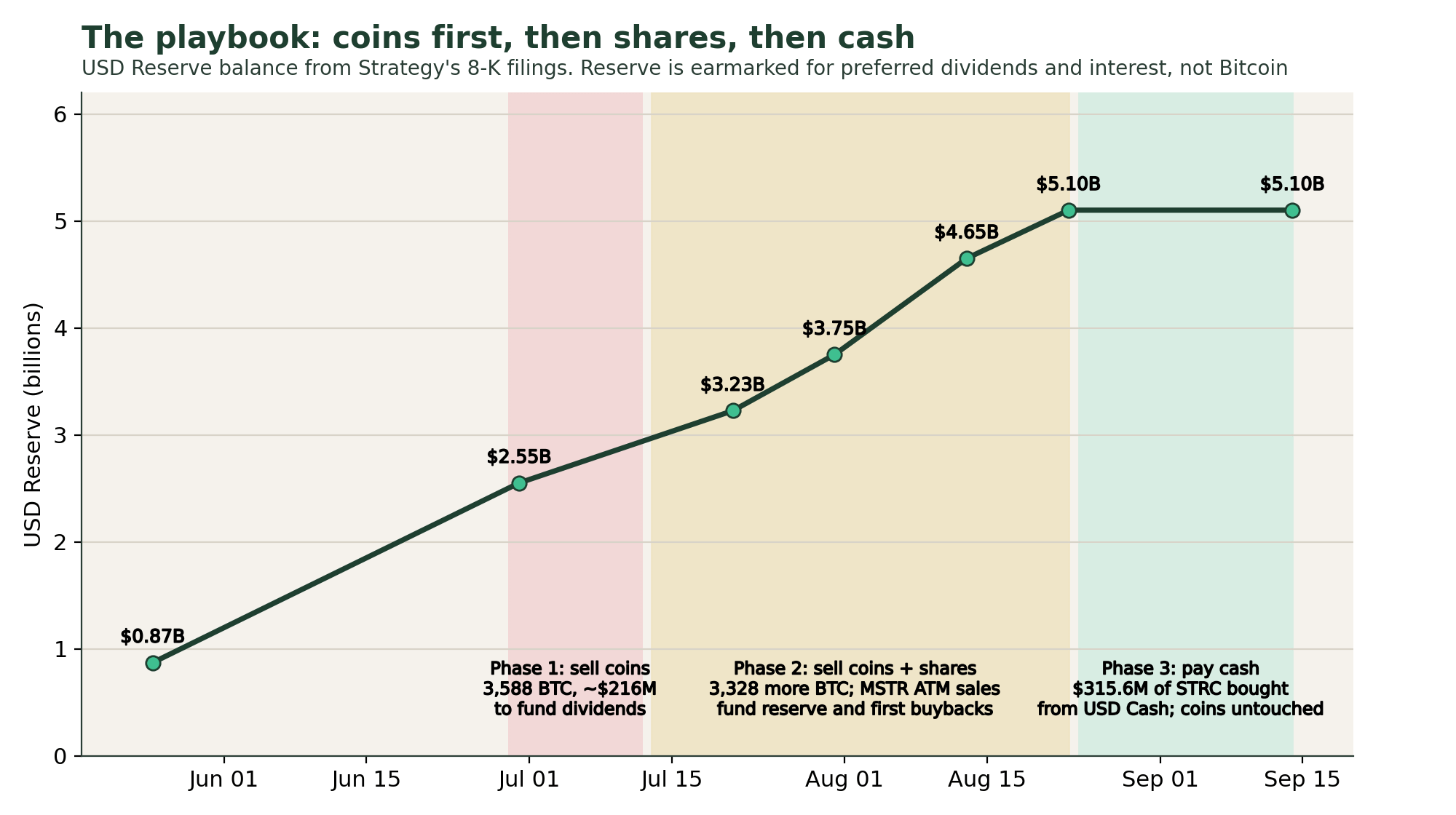
USD Reserve balance from Strategy’s weekly 8-K filings, with the three funding phases shaded. The reserve is earmarked for preferred dividends and interest, not Bitcoin.
Read the three moves as a pecking order and it’s not flattering: the coins went first, at the worst prices. Read them as a procedure and it’s something else. Sell whichever security fetches the best price at the time, protect the obligations, buy your own paper back below par, and stop touching Bitcoin the moment you can afford to. It’s written down now, it’s been run once under real stress, and the market watched it work.
The rally that didn’t need Bitcoin
The part most coverage skips is the timing of all this which is wild to me.
STRC bottomed on June 26.
Bitcoin bottomed four days later near $58,500.
Then the two went separate ways for six weeks. By August 5, STRC was at $94, up 32% from the low. Bitcoin was at about $63,600, up 9%, and stuck in a $62,000 to $66,500 band the entire time.
The preferred outran its own collateral by better than three to one, over a stretch when the collateral did almost nothing.
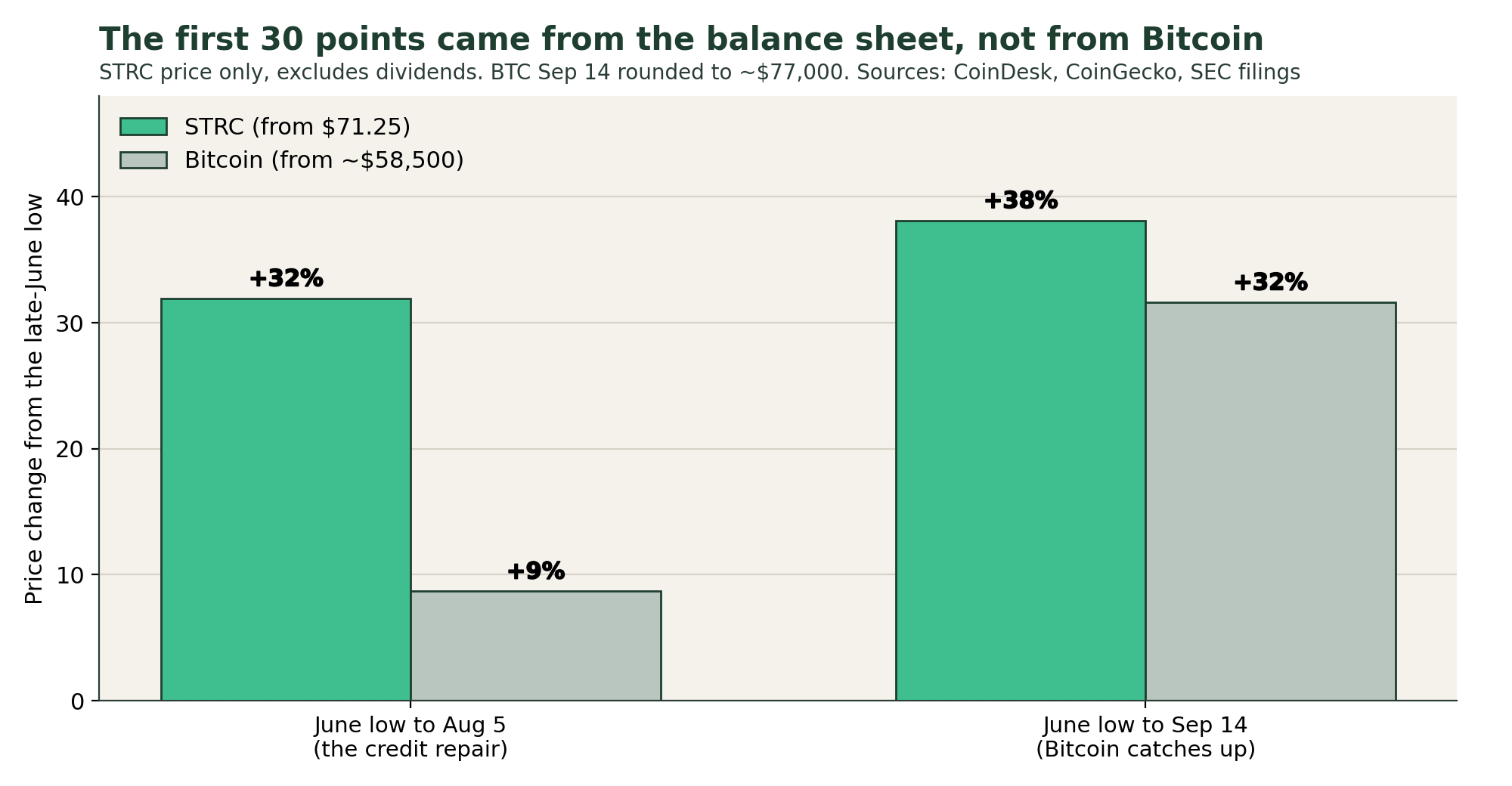
STRC versus Bitcoin from the late-June lows, price only. The first leg was a credit repair; the second leg was Bitcoin catching up.
Bitcoin’s run to $82,000 in early September was the last leg, and it moved STRC from the mid-90s to the high-90s.
The first thirty points came from the balance sheet. A buyer at $71 who thought they were making a leveraged Bitcoin bet got the right answer for the wrong reason. A buyer who understood they were betting on how the store owner would behave got the right answer for the right reason.
What’s Leveled Off, and What Hasn’t
The stabilizers are real.
Bitcoin is back near $77,000, which puts Strategy’s 845,050 coins at about $65.7 billion against a $63.7 billion cost, a paper gain of roughly $2 billion where there was a $9 billion paper loss in July.
The reserve and cash accounts together hold $6.4 billion, which covers years of the roughly $1.2 billion a year the company owes its preferred holders. MSTR is up about 34% over the past month. Saylor’s own credit model, which he publishes weekly, puts STRC’s implied credit spread at 57 basis points, a level the company treats as investment grade.
I’d take that figure as a company estimate rather than a market one, but it’s the number management is steering by.
A fair reading owes the skeptics their due, and they have a few good points.
Roughly $950 million later, STRC is still $1.59 short of the number it was built to hold. Nothing obligates the buybacks to continue. Strategy’s own filings say it may stop repurchasing at any time, and the reserve is a corporate policy rather than pledged collateral.
Common shareholders paid for the summer through dilution. Every dollar spent defending STRC is a dollar that didn’t buy Bitcoin, and after one 4,603-coin purchase in late August the company has gone two straight weeks without adding a single coin.
Back to the store
At $98, the trade that made this interesting is gone. Your upside from here is $1.59 to par plus a 12% coupon that management has said it intends to reduce once the price holds.
For someone who wants the income and understands there’s no maturity and no guarantee, that’s a defensible position. It isn’t the asymmetry that existed in June.
What carries forward is the procedure, because the store owner published it.
There’s a growing pile of Bitcoin treasury preferreds in the market now, all built the same way: a stated value, a coupon, a volatile pile of inventory behind it, and an issuer whose entire model depends on the paper trading at par.
When the next one breaks, two questions will matter more than where Bitcoin is going. Does the issuer have the cash, the authorization, and the incentive to defend its own paper? If so, does it buy the paper back before it sells the inventory, or after?
This summer, Strategy answered both. The answers were in the 8-Ks every Monday, and none of it required a view on Bitcoin.
The discount was about fear.
The recovery was about procedure.
P.S.
If this was useful, forward it to whoever’s been arguing about MSTR in your group chat all summer. If you bought STRC in the 70s or 80s, reply and tell me how you sized it, and whether you’re still holding at $98. I read every one. 🧐
In Case You Missed It

Last week I spent three days at Boston Blockchain Week, including a panel on tokenizing real-world assets alongside tZERO and AKRU. The SEC’s crypto task force counsel opened the week, vaults came up in every other conversation, and I made the case on stage that AI makes advisors better at their jobs rather than replacing them.
The short version of what I took home: tokenization has moved from pitch decks to plumbing, and a tokenized asset still deserves the same diligence as any other.
Matthew Snider is the founder of BitFinance and principal at Block3 Strategy Group, where he advises emerging digital asset fund managers and RIAs on fund operations and compliance frameworks. He holds a Series 65 license, passed the Series 7, and is the author of Warren Buffett in a Web3 World.
This material is for informational and educational purposes only and does not constitute investment advice, a recommendation, or an offer to buy or sell any security. Nothing herein should be construed as a personalized recommendation. Digital assets and the securities of digital asset treasury companies involve substantial risk, including total loss of principal. Perpetual preferred securities carry no maturity date and no contractual obligation to return stated value. Past performance is not indicative of future results. Consult your own financial, tax, and legal advisors before making investment decisions.
Disclosure: I do not hold a position in STRC, MSTR, but I sure do hodl BTC.
Sources
Strategy repurchases $139 million of STRC shares, leaves bitcoin holdings unchanged (The Block, September 14, 2026)
MSTR Stock Forecast as STRC Buybacks Fuel Concerns Over Strategy’s 20% Market Share (CoinGape, September 15, 2026)
Strategy makes a $139 million move, but leaves Bitcoin untouched (TheStreet, September 14, 2026)
Strategy Buys Back $139M of STRC as Bitcoin Holdings Stay Unchanged (CoinCodex, September 14, 2026)
Michael Saylor’s Strategy Pauses Bitcoin Buys Again, Buys Back $176M in STRC Shares (CoinGape, September 8, 2026)
Strategy Inc Form 8-K, August 24, 2026 (SEC EDGAR)
Strategy Inc Form 8-K, June 29, 2026: Digital Credit Capital Framework (SEC EDGAR)
Strategy Provides Capital Structure Update after Completing $1.5 Billion Debt Repurchase (SEC EDGAR, May 26, 2026)
Strategy’s STRC rebounds 30% as company builds cash reserve, bitcoin price stabilizes (CoinDesk, August 5, 2026)
How STRC lost its par: The timeline behind Strategy’s preferred stock meltdown (CoinDesk, June 20, 2026)
The sell-off in Strategy’s preferred stock has investors questioning everything (Fortune, June 29, 2026)
Bitcoin price, September 15, 2026 (CoinDesk)