An 89-Year-Old Asset Manager Just Launched the First Actively Managed Crypto ETF
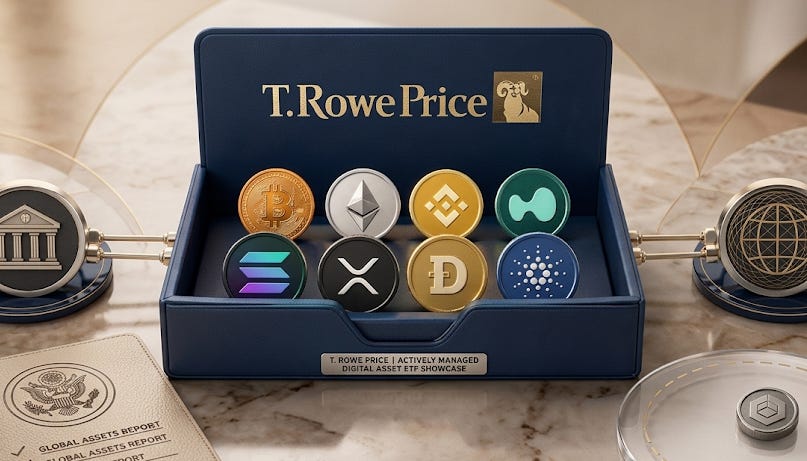
T. Rowe Price (yes that one!), an 89-year-old asset manager with $1.89 trillion under management launched a crypto fund last Thursday.
The T. Rowe Price Active Crypto ETF began trading on NYSE Arca on July 16 under the ticker TKNZ. On paper it looks like the multi-token basket products we’ve seen before. Under the hood it’s something the US market has never had: a spot crypto portfolio where human managers pick the weights.
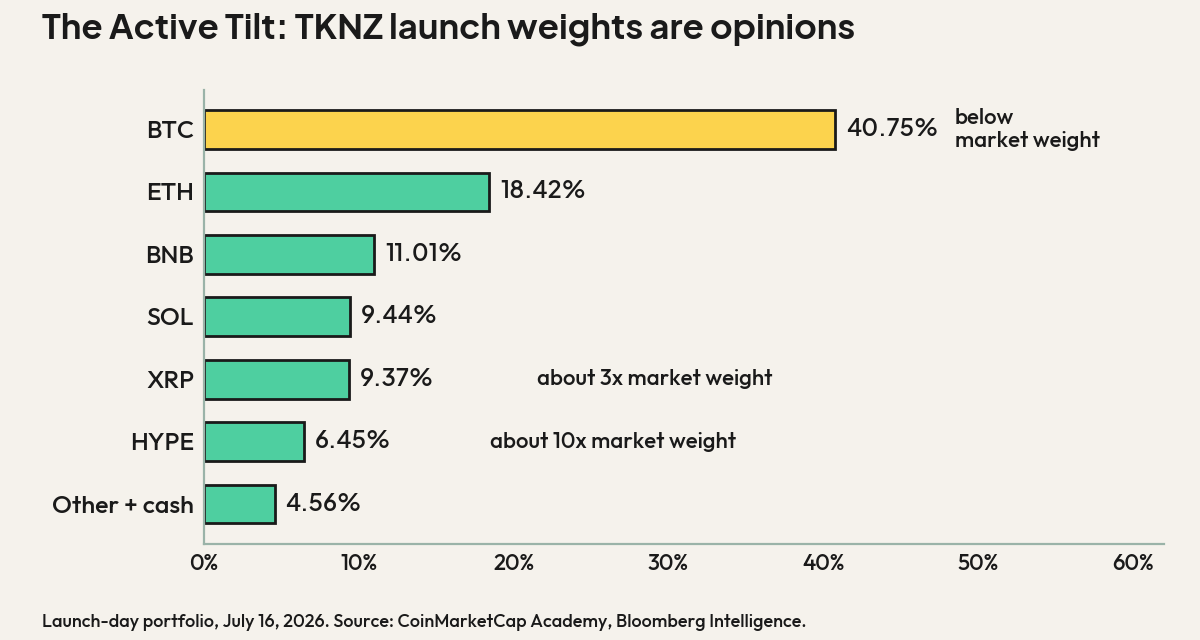
Their first picks were opinions, not mirror images. Bitcoin, which represents well over half the crypto market by capitalization, got 40.75% of the fund. XRP got roughly three times its market share. Hyperliquid got close to ten times its share.
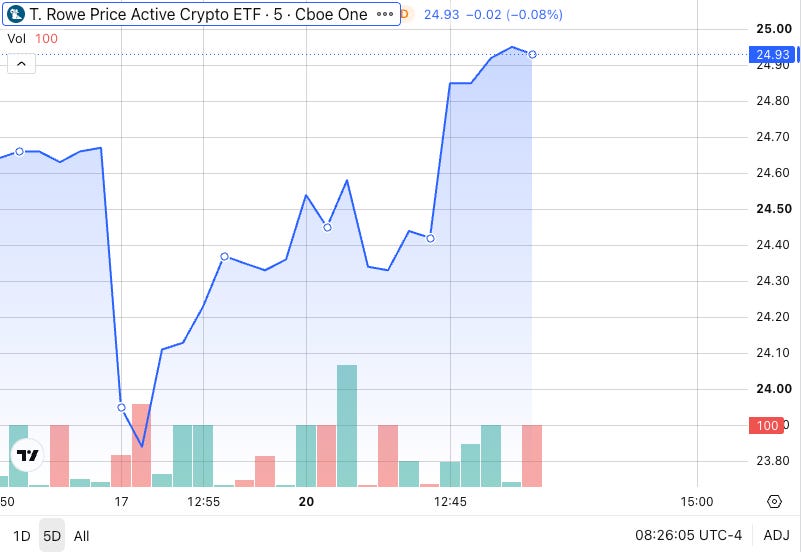
Here’s where the chart sits after only a handful of active trading days…
Bloomberg’s Eric Balchunas summed up the launch portfolio as underweight Bitcoin and overweight most of the rest, especially HYPE.
He meant it as an observation. I’d call it the whole point.
For the first time, a crypto ETF’s holdings are an argument.
What TKNZ Actually Is
Let’s get the mechanics straight, because the structure matters more than the marketing.
The basics. TKNZ holds spot crypto directly, launched with roughly $15 million in assets, and is designed to hold between 5 and 15 tokens from an approved universe. Here is the mix at launch:
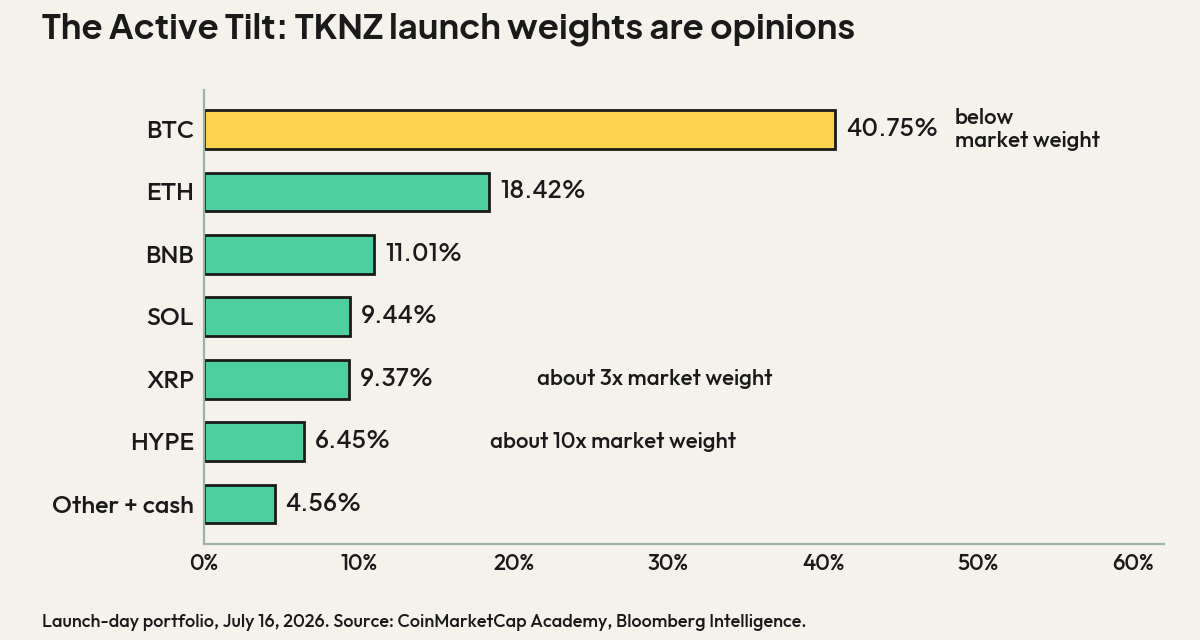
Stellar, Dogecoin, USDC, and cash rounding out the rest.
The approved universe extends further, including names like Cardano, Chainlink, and Sui.
The management. The fund is run by Blue Macellari, T. Rowe Price’s head of Digital Assets since 2022, with more than 20 years in alternative asset management. She’s joined by four co-portfolio managers all of whom have a long-standing experience with the firm. All in house, running on trading infrastructure the firm built itself alongside institutional service providers. The stated goal is to outperform the FTSE Crypto US Listed Index, not to replicate it.
The fine print. Here’s where you should slow down. TKNZ is technically an exchange-traded product, not a 1940 Act ETF. It’s organized as a Delaware statutory trust, it isn’t registered as an investment company, and it isn’t a commodity pool. That means it doesn’t carry the same regulatory requirements and investor protections as the mutual funds and ETFs most people know. None of this makes it a bad product, but you’re relying on the prospectus and the sponsor, not the ‘40 Act framework. Read before you buy.
One more detail worth filing away: the prospectus permits investing across proof-of-stake networks, but the fund won’t stake holdings for yield at launch. That lever exists for later.
Where It Fits in the ETF Map
The crypto wrapper business has moved through three generations in about two and a half years.
Generation one: single-token spot ETFs. The Bitcoin funds of early 2024, then Ethereum. One asset, one ticker, passive by definition.
Generation two: passive baskets. Grayscale’s GDLC converted in September 2025 with five holdings. Bitwise’s BITW followed in December with ten. Hashdex’s NCIQ and Franklin’s EZPZ compete mostly on fees, at 0.25% and 0.19%. These funds diversify you, but the weights come from a formula. Nobody’s making a call.
The hybrid vibe. CyberHornet’s 75/25 S&P 500 and Bitcoin blend deserves a mention because readers ask about it. It’s a fixed-ratio product, a portfolio recipe in a wrapper. Still nobody making a call.
Generation three: TKNZ. For the first time, the answer to “why these weights?” is “because we think so.” Five managers can rotate into what’s working, trim what isn’t, and hold cash when nothing looks attractive. That flexibility is the entire product.
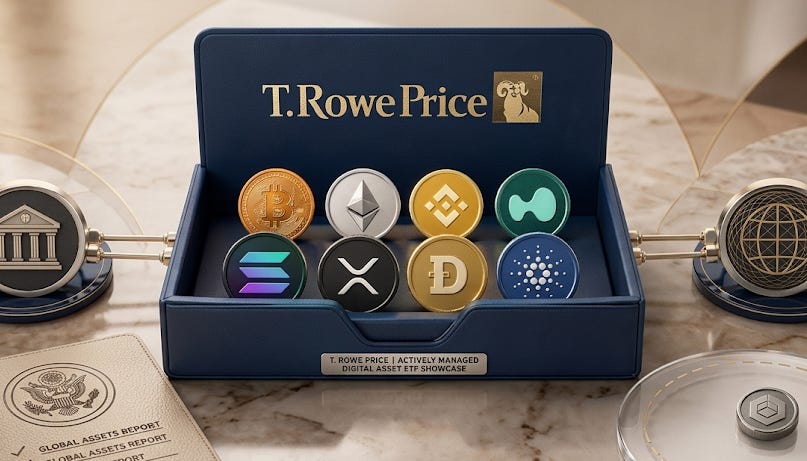
A Word for the XRP Holders
I know a lot of my subscribers are card-carrying members of the XRP Army, so this data point deserves its own paragraph.
Five professional portfolio managers at one of the most conservative asset managers in America reviewed the full eligible universe and gave XRP 9.37% of the fund; that’s roughly 3X its share of the overall crypto market, ahead of Hyperliquid and just behind Solana.
A passive index could never have produced that weight. Whatever you think of the token, an allocation like that is a research team putting fee-earning capital behind a view, in public, with daily disclosure.
That’s what active management produces that an index can’t: positions you can interrogate.
The Fee Math
TKNZ charges 0.75% today, net of a waiver that runs through May 31, 2027. On June 1, 2027, it reverts to a gross fee of 0.90%.
Stack that against the passive shelf:
Franklin’s EZPZ at 0.19%,
Hashdex’s NCIQ at 0.25%,
Grayscale’s GDLC at 0.59%,
Bitwise’s BITW at 0.75%.
TKNZ launches at the top of the range and is scheduled to climb past it.
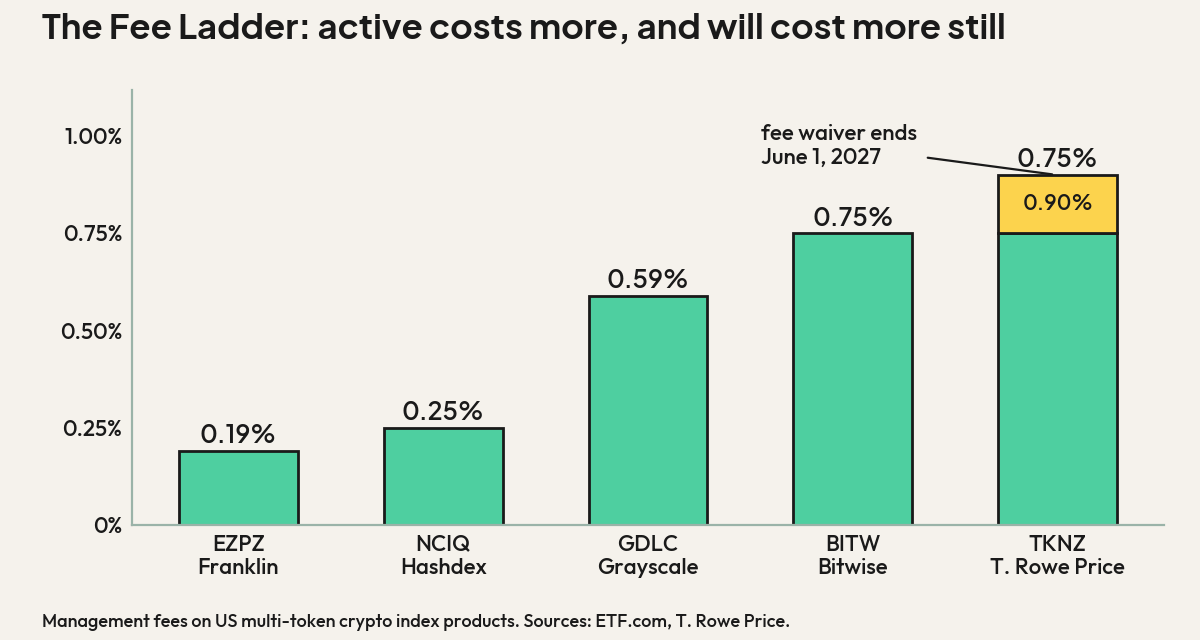
Management fees across US multi-token crypto products. The gold segment marks TKNZ’s scheduled reversion to 0.90%.
The Buffett Framework Question
Would you pay a manager 0.90% a year to pick among a dozen liquid tokens you could buy yourself, and what would they need to prove before you said yes?
Buffett’s long-standing case against active management rests on one piece of arithmetic: fees are certain, outperformance isn’t.
The same math applies here, with one wrinkle in the fund’s favor. Crypto is a market with no earnings calls, thin fundamental coverage, and violent dispersion between winners and losers. If active management can add value anywhere, an inefficient market is where you’d expect it.
The 0.90% question is whether this team can clear that bar after costs, every year, against a passive basket charging a fraction of the price.
They’ve made their opinions public. Now we get to grade them.
The Market It Launched Into
Timing tells you something about conviction.
T. Rowe Price filed for this product in October 2025, while the crypto market was selling off around it, and launched into a tape where Bitcoin has fallen roughly 45% over the past year.
Meanwhile HYPE is up around 38% over the same stretch and recently printed an all-time high near $74.50. The launch portfolio’s tilts map closely to that dispersion, with the overweights sitting in what’s been working.
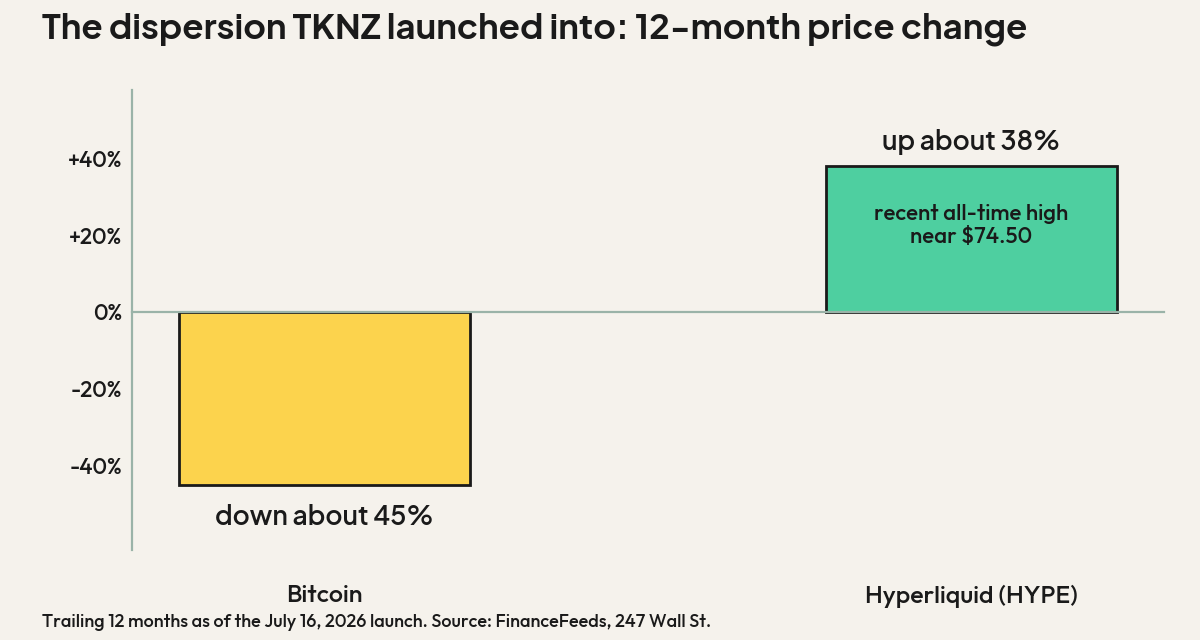
The 12-month spread between the fund’s biggest holding and its most aggressive overweight.
The fund itself is only a few trading sessions old as I write this, which is far too young to grade. Early price action has been soft, in line with the broader market, and drawing conclusions from three days of closes would be exactly the kind of analysis I’d warn you away from anywhere else.
We’ll check back once there’s a real track record to compare against BITW and GDLC.
The View From Someone Who’s Built These
I’ve spent years helping build structures that let people put crypto to work: funds, separately managed accounts, lending arrangements.
Every one of them came with paperwork, minimums, lockups, and a relationship with a manager you had to trust before you saw a single statement.
TKNZ collapses all of that into a ticket on NYSE that provides:
Daily liquidity
Daily published holdings
A management team you can name and evaluate
A fee you can see coming from a year away
Whatever you think of the allocations, the packaging is exactly what traditional finance has been promising crypto investors for a decade, and it took a firm founded in 1937 to deliver the first active version of it.

Here’s the part that cuts both ways.
If T. Rowe Price is first, others are lined up behind it. Filings are already stacking up across the industry, and every major asset manager watching this launch just learned the structure works. That’s excellent for adoption. It’s also the beginning of commoditization in this corner of the business, because a crowded shelf of active crypto funds means fee pressure, marketing wars, and a much harder path to standing out on alpha, especially in a market that’s spent the past year going down.
The fair counterpoint deserves the last word. Active management in crypto is unproven, and the same dispersion that creates the opportunity can punish a wrong-footed portfolio faster than any equity fund.
A tilt toward recent winners can look like insight in one quarter and momentum-chasing in the next. The daily-published weights mean every one of these calls gets graded in public, and the passive baskets charging 0.19% are a formidable benchmark to beat after a 0.90% hurdle.
The most useful thing about TKNZ may turn out to be the transparency itself, since we’re all about to watch, in real time, whether stock-picking discipline translates to tokens.
Until next time fam - trade safe!
Matthew Snider is the founder of Block3 Strategy Group, author of “Warren Buffett in a Web3 World,” and publisher of the BitFinance newsletter. He holds a Series 65 and MBA, and has been an active participant in digital asset markets since 2015. This article is for educational purposes only and should not be considered financial advice. Always consult with a qualified professional before making investment decisions.
Sources
1. T. Rowe Price, press release, July 16, 2026
2. The Block, launch coverage and Balchunas commentary
3. CoinMarketCap Academy, launch holdings breakdown
4. ETF.com, crypto index ETF fee comparison