Six Groups Get Paid When a Crypto Company Fails. You’re (Likely) Not One of Them.
Your portfolio is down. You’re looking at a screen full of red, and somewhere in it sits the thing that fell the furthest, which is also the thing that looks cheapest.
The instinct in a drawdown is to add to whatever is hurt worst. It’s the closest thing retail investing has to a reflex, and most of the time it has been rewarded.
The trouble is that a chart showing a 60% decline looks the same whether the cause was a market cycle or a company turning off the lights. One of those comes back. The other never does, and no amount of patience changes it.
Four crypto companies announced failures or wind-downs in the past seven days. Their tokens fell alongside everything else on your screen. Telling those two situations apart is the difference between a temporary loss and a permanent one.
Start with the arcade
I LOVED playing in arcades as a kid. Put me on Time Crisis or Cruisin’ USA and I’ll be good for hours.
Arcades are great because they have simple economics. You buy a handful of tokens at an arcade. They work in that arcade’s machines and nowhere else.
Then the arcade closes.😭
You still own the tokens. They’re metal discs now. When the place is liquidated, the landlord gets paid, the vending supplier gets paid, the bank that financed the machines gets paid, and whatever is left goes to the owner. You’re on none of those lists, because you never bought a piece of the arcade. You bought the right to use it.
That describes most crypto tokens. A right to use something can be genuinely valuable while the thing exists. The question is what you’re holding when it stops.
A Judge Already Priced one
In November 2023, the Celsius bankruptcy reached a question no court had answered: what is a token worth as a claim?
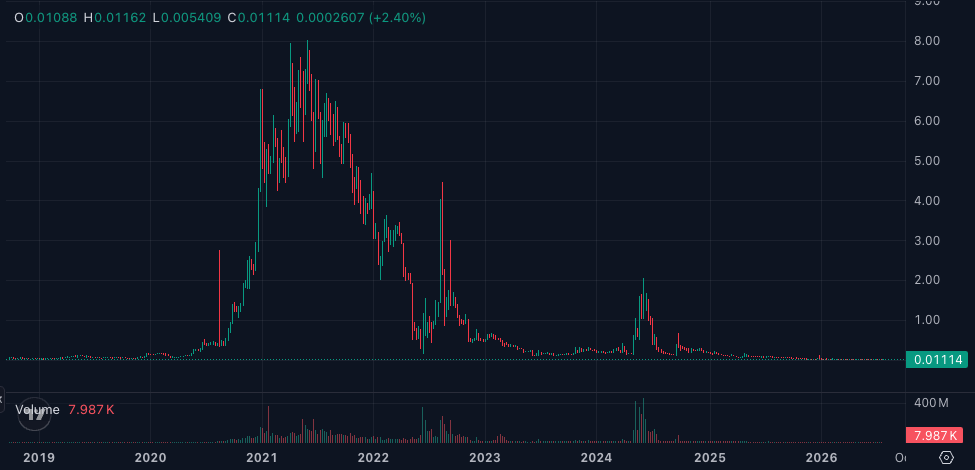
Holders of CEL, the token Celsius issued to customers who used its platform, argued they were entitled to more than the plan offered. The judge disagreed and valued CEL at 25 cents, reasoning from the utility the token provided on the platform rather than from the price it traded at.
A court looked at a token, asked what sat underneath the price, and put a number on it. As you can see, 25 cents was not nearly the $8 is was once worth, but it allowed holders to recoup at least SOME of what they had put in.
This was an exception, not the norm.
Where the Money Goes
When a company files for bankruptcy, there is a legal order for who gets paid, and it doesn’t bend to sympathy or to how early you bought.
Secured lenders come first, because they hold collateral.
Then the cost of running the bankruptcy itself, meaning the lawyers and advisors.
Then priority claims like unpaid wages and taxes.
Then general unsecured creditors. (think suppliers and bondholders)
Then preferred shareholders.
Then common shareholders, who are last and usually receive nothing.
Six positions. Token holders are typically in none of them.
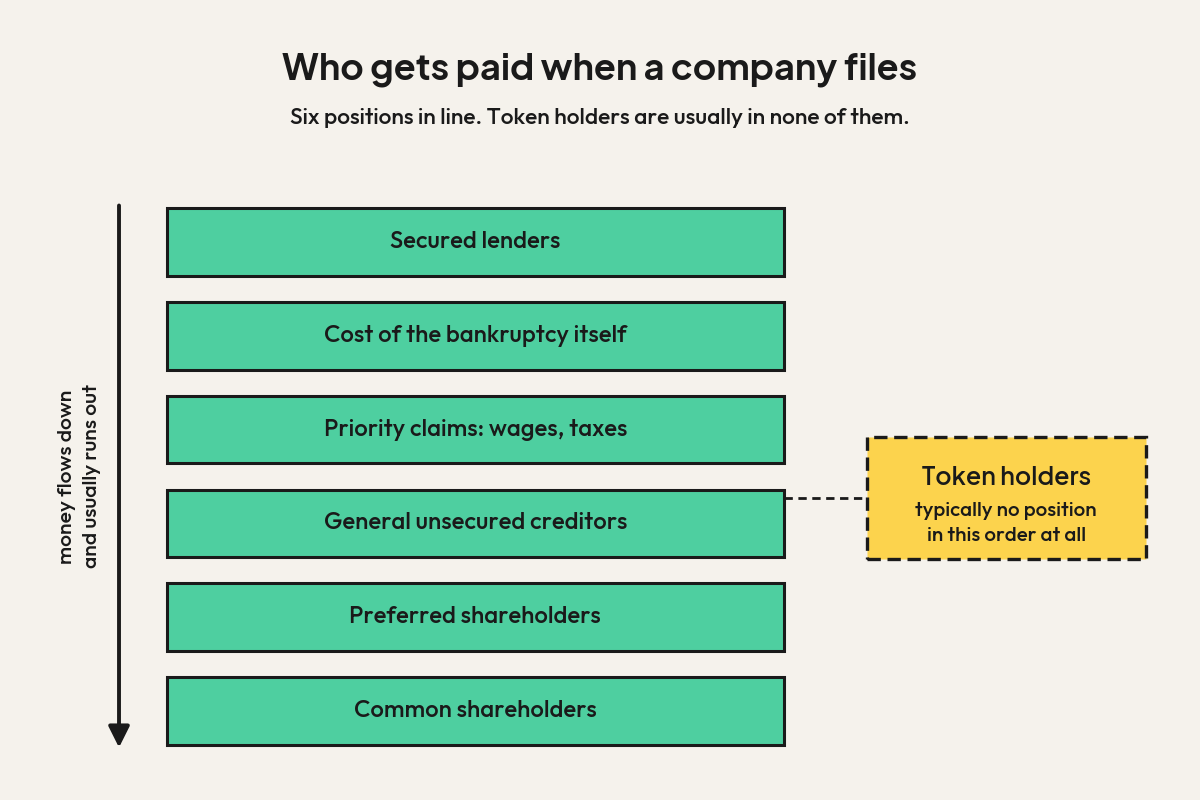
The order of payment in a Chapter 11 case, and where token holders sit relative to it.
Same Collapse, 2 Outcomes
FTX makes the point more clearly than any explanation.
By 2026 the FTX estate has distributed more than $7 billion, and smaller claims were repaid in full with interest. Customers were creditors, so they had a position in that order.
FTT was the exchange’s own token, the asset most people treated as a stake in FTX itself. FTT holders received nothing from the same estate.
One company, one bankruptcy, two entirely different results, decided by which document you were holding.
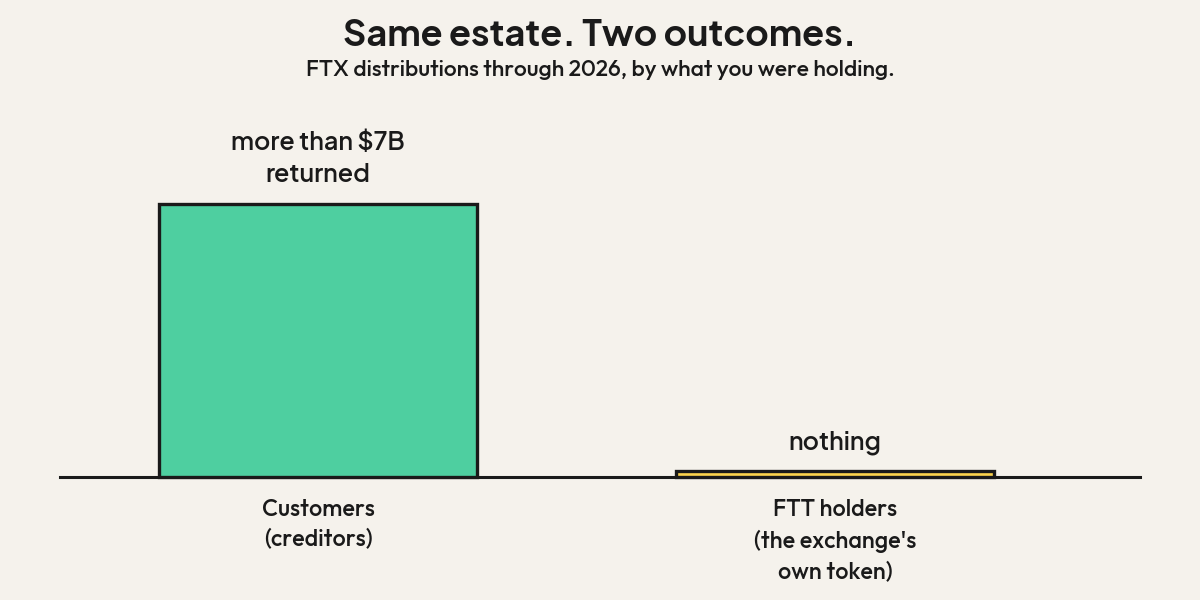
FTX estate distributions through 2026, by what the holder was holding.
The trap for anyone who reads the fine print
There is a wrinkle here that surprises readers who go looking for a way out.
Suppose a token holder argues successfully that the token was an unregistered security, which would seem to strengthen their position. Section 510(b) of the Bankruptcy Code subordinates claims arising from the purchase of a security down to the level of equity.
Winning that argument moves you behind every ordinary creditor rather than ahead of one.
The law has a specific answer here, and it runs opposite to intuition.
3 Questions You Can Answer Today
None of this tells you what to do with what you own, so work through these against anything in your portfolio.
Is there a company that can fail? Bitcoin has no issuer, no headquarters, and nothing capable of filing Chapter 11. An exchange token has all three. This is the largest single dividing line in crypto, and most people have never drawn it across their own holdings.
Does the token carry any claim on what that company earns? Read the terms. Most token documentation states plainly that the token conveys no equity, no dividend, no claim on assets, and no vote on the company. If you’ve never read yours, that’s an afternoon well spent.
Can the thing it does for you be switched off? Fee discounts, staking rewards, and access tiers exist because a company chose to offer them and can choose to stop. BMEX fell more than 90% and BMX fell roughly 58% because the utility behind them was being switched off, on a published schedule, in public.
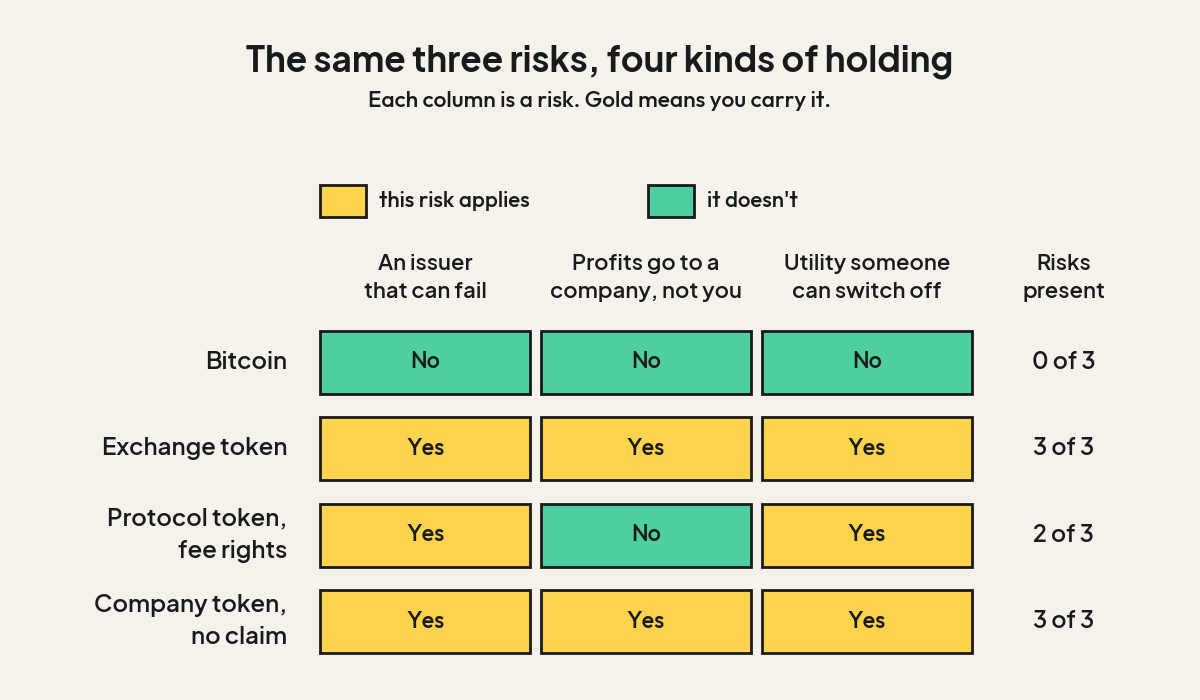
The same three questions restated as risks, applied to four kinds of holding.
The Exception, and Why it is One
Which brings me to the one unusual thing in last week’s news.
Storj filed Chapter 11 on July 26 and proposed sharing ownership of the reorganized company among management, investors, and token holders. That is rare enough to deserve careful reading.
It is an intention rather than a payout. The mechanism, the eligibility, and the terms would be developed during the case. Any plan has to clear the court. Creditors get paid before owners. What Storj offered is a seat at the table, which is more than token holders usually receive and considerably less than a recovery.
The reason it made news is the reason for this entire piece. It stood out because the default is nothing.
THE BUFFETT FRAMEWORK QUESTION
What do I own a claim on?
Buffett has said that risk comes from not knowing what you’re doing, and he meant something more specific than confidence. He meant the document, the claim, the position in line. A price tells you what somebody will pay you today. It says nothing about what you hold.
All four tokens traded actively right up until the announcements. The market had no view on any of this, because a price cannot hold a view on a legal document.
So before you average down into whatever fell hardest, work out which kind of red you are looking at. A drawdown in something with no issuer is a market doing what markets do. A drawdown in a claim that was never a claim is the arcade closing, and the tokens in your pocket are already what they are going to be.
Remember fam - these markets and companies are risky. They can shut down without notice and in most cases you have no claim to any part of the company which is different than with stocks.
Trade safe out there. 🙌🏻
Matthew Snider is the founder of Block3 Strategy Group, author of “Warren Buffett in a Web3 World,” and publisher of the BitFinance newsletter. He holds a Series 65 and MBA, and has been an active participant in digital asset markets since 2015. This article is for educational purposes only and should not be considered financial advice. Always consult with a qualified professional before making investment decisions.
Sources
1. Ropes & Gray, on the Celsius court’s valuation of CEL tokens, November 2023
2. Status of FTX distributions and FTT after bankruptcy
3. BitMEX, Exchange Closure Notice, July 23, 2026
4. BitMart, Notice Regarding Orderly Cessation of Operations, July 26, 2026